






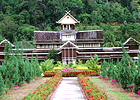
 Nestled between the “gateway state” of Selangor and the Historic City of Malacca, Negri Sembilan has a lot to offer visitors where places of interest and cultural diversity are concerned.
It is not particularly large, covering a total area of 6,643sq km, but it is blessed with picturesque valleys amidst undulating hills and mountains, and is a popular destination for gourmet tours with an abundance of dishes for visitors to choose from. Numerous restaurants in Seremban, the state capital, offer a mixture of Malay, Chinese and Indian food. From fully air-conditioned outlets to open-air food courts, the eateries of Seremban have earned it a reputation as a dining haven in the south.
Seremban, with a population of almost 600,000 people, has two five-star hotels and captivating historical sites such as the Seng Kong or Centipede Temple in Jalan Temiang, the hilltop temple of Seven Virgin Goddess and Kanni Kovil in Bukit Kepayang.
Visitors to the town may also indulge in a shopping spree where the latest fashions and designer items can be found in three shopping centres.
As the Titiwangsa mountain range tapers down to the southern tip of the peninsula, it gives rise to several waterfalls in the state, the likes of Jeram Toi, Litar Kijang in Jelebu and Ulu Bendol in Kuala Pilah.
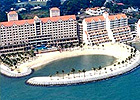
Waterfalls aside, Negri Sembilan’s most famous attraction must be the beaches of Port Dickson. With several kilometres of white sandy beach, Port Dickson offers sunbathing, swimming and watersports in numerous hotels and resorts; with the most popular spot being at Teluk Kemang.
Negri Sembilan is also an industrial state as the manufacturing sector is a major contributor towards the state’s economy, mainly in electrical goods, electronics, textiles, furniture, chemicals, machinery, metalwork and rubber products.
Agricultural activities such as rearing livestock, fruit orchards and vegetable farming are also apparent while rubber and oil palm plantations cover more than 300,000 hectares.
Among the main industrial areas are Senawang, Sungai Gadut, Tuanku Jaafar Industrial Park, Nilai and Tanah Merah in Port Dickson.
Negri Sembilan was established around the 15th century by the Minangkabau tribes of West Sumatra who migrated to the region during the height of the Malay Sultanate in Malacca.
The Minangkabau brought with them a rich cultural heritage, which is still preserved and practiced today as the fascinating Adat Pepatih – a matrilineal system of inheritance and administration that is unique to the state.
In its early history, Negri Sembilan as a unified state did not exist; it was, rather, a loose confederation of nine fiefdoms, which developed in the secluded valley of the region (hence its name, which literally means “nine states”).
It was only in 1773 when Raja Melewar became the Yam Tuan (head of state) that the fiefdoms of Sungai Ujong, Rembau, Johol, Jelebu, Naning, Segamat, Ulu Pahang, Jelai and Kelang were brought together under his rule.
The history of modern Negri Sembilan began with British intervention in the districts of Sungai Ujong, Rembau and Jelebu.
In Sungai Ujong, the British intervened to stop the conflict between Dato Kelana and Dato Bandar which was affecting the tin trade along the Linggi River. The British supported Dato Kelana and appointed W.A. Pickering as the British Resident in 1874.
By 1889, a treaty was made between the Yam Tuan Seri Menanti and the four Datuk Undangs wherein the Yam Tuan was installed as the ruler of the state of Negeri Sembilan. In the same year, the first British Resident of Negeri Sembilan, Martin Lister, was appointed.