 Where the Wild Things Are
By Petra O’Neill
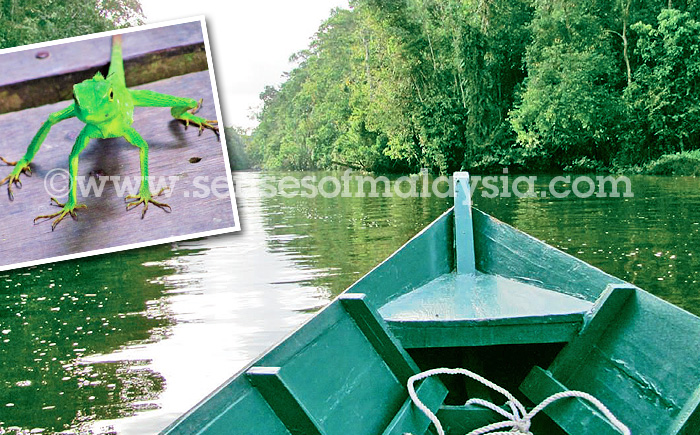
BORNEO IS A TREASURE TROVE OF WILDLIFE AND NATURAL BEAUTY, AND PETRA O’NEILL MADE
THE TRIP OF A LIFETIME INTO BOTH THE TREETOP HEIGHTS AND THE DARKEST DEPTHS OF THE RAINFOREST FOR A HOLIDAY THAT SHE WILL NEVER FORGET.
"So which country produces the best hikers?" I
asked. "Slovenia!" replied Ryan, our guide, as
he nonchalantly spun his index finger around
his belly button to dislodge a tiger leech
embedded there. We were in the Danum Valley
Conservation Area in Borneo, dressed from top
to toe in leech-proof hiking gear (although it
seems one snuck through), in one of the world's most remote rainforests and
best places for viewing wildlife.
As the third largest island in the world, Borneo is shared by three countries:
Indonesia, Brunei, and the Malaysian states of Sabah and Sarawak. While
much of it has been tamed by logging and palm oil plantations, it remains
one of the world's most dramatic and exciting destinations. It is an island of
dense prime growth rainforest, indigenous tribes, and abundant birdlife and
mammals including pygmy elephants, clouded leopards, gibbons, orangutans,
and proboscis monkeys..
ON THE TRAIL OF ORANG-UTANS
 I had persuaded my 17-year-old daughter
Nicky to come with me on a journey to
search for orang-utans that began in
Kota Kinabalu. At the Shangri-La Rasa
Ria Resort we discovered three well
cared-for baby orang-utans who would
swing down from the jungle canopy of
the resort's expansive nature reserve for
their daily feeding. In collaboration with
the State Wildlife Department, the resort
facilitates rehabilitation programs for
endangered species.
I had persuaded my 17-year-old daughter
Nicky to come with me on a journey to
search for orang-utans that began in
Kota Kinabalu. At the Shangri-La Rasa
Ria Resort we discovered three well
cared-for baby orang-utans who would
swing down from the jungle canopy of
the resort's expansive nature reserve for
their daily feeding. In collaboration with
the State Wildlife Department, the resort
facilitates rehabilitation programs for
endangered species.
Our next move was a six-hour bus ride
that took us past majestic Mount Kinabalu
before depositing us in Sandakan, a
bustling, vibrant city where we stocked up
on leech socks. During World War II over
2,600 Australian and British POWs were
interned here by the Japanese. Forced
to walk through dense jungle, only six
Australians survived, and a memorial
honours those who died.
Next morning, we visited the Sepilok
Orang-utan Rehabilitation Centre, a
4,500-hectare reserve for rescued orangutans.
The orang-utan gets its name from
the Malay words for "man" (orang) and
"jungle" (utan). Found only on Borneo
and the Indonesian island of Sumatra,
orphaned orang-utans rescued from
illegal hunting or found at logging sites
are taught survival skills and eventually
returned to a protected rainforest habitat.
After our encounter, we met our guide,
Mirawan, and travelled by speedboat
from Sandakan to Sukau upstream
along the mangrove-lined Kinabatangan
River – at 560km, it is Sabah's longest –
and past lowland rainforest.We paused
only to view sunning crocodiles, and
proboscis and macaque monkeys; the
area is renowned as having the largest
concentration of wildlife in Malaysia.
LODGE LIVING
The amiable manager and head chef at
Sukau Rainforest Lodge was Brett, an
Aussie who arrived on holiday three
years ago and never left. With no time to
unpack, we enjoyed hot banana fritters
before a late afternoon cruise in a small
wooden boat to view more wildlife. We saw
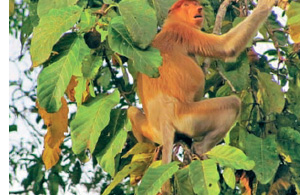
many proboscis monkeys, distinguished
by their long droopy noses and white
tails, scampering along branches in the
treetops, a female orang-utan with her
baby, plenty of mischievous macaques,
and then the most amazing sight: at least
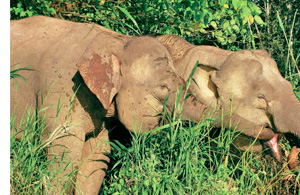
30 pygmy elephants, grazing along the
river edge only a metre or so away.The
pygmy elephant is, as the name suggest,
quite small, with large ears and straight
tusks and is genetically distinct from other
Asian elephants. Hornbills and egrets flew
across the sky in front of us as the light
faded under the thick forest cover.
After a splendid dinner overlooking the
river, we retired, with Brett suggesting that
a visit by the elephants during the night
was possible. "They like to look through
the windows," he said merrily, "I think
they are just curious!"
ANOTHER DAY IN WILDLIFE PARADISE
 Alas, no nighttime visitors disturbed our
sleep, and the next morning we entered
the Gomantong Caves – the largest in
Sabah – to hear the instruction, "Don't
look up while you are talking."The ground
was covered with a thick carpet of guano –
the spongy, smelly, moist droppings left by
the estimated 100,000 bats that call
these caves home. Flying rapidly in and
out of the cave's entrance were the tiny
swiftlets whose nests bring high prices for
bird's nest soup.
Alas, no nighttime visitors disturbed our
sleep, and the next morning we entered
the Gomantong Caves – the largest in
Sabah – to hear the instruction, "Don't
look up while you are talking."The ground
was covered with a thick carpet of guano –
the spongy, smelly, moist droppings left by
the estimated 100,000 bats that call
these caves home. Flying rapidly in and
out of the cave's entrance were the tiny
swiftlets whose nests bring high prices for
bird's nest soup.
"Do you want to walk across the ground,"
asked Mirawan, "or up on the boardwalk?"
I pointed my flashlight; the ground
surface appeared to be a mass of moving
cockroaches. "Look at this," said Mirawan,
and he spat. Thousands of creepy crawlies
converged on the spot. I felt goose bumps
and was relieved to leave.
After driving past various palm oil
plantations, we arrived next at Lahad
Datu, where our driver deposited us at
the Borneo Rainforest Lodge office for
our three-hour four-wheel drive journey
through the rainforest.
INTO THE FOREST
Spanning 438 square km of primary
lowland dipterocarp rainforest, Danum
Valley Conservation Area is recognised
as one of the world's most complex
ecosystems, and is a sanctuary for rare
and endangered flora and fauna. Far
removed from human habitation, it is
renowned for its rich variety of plants and
wildlife, with over 275 species of birds
and 110 mammals, including the rare
Sumatran rhinoceros, pygmy elephants,
clouded leopards, and orang-utans.
Ryan met us on arrival and invited us to
join him on a walk through the rainforest.
The next two days were damp and cool,
and Ryan guided us on walks to waterfalls
for refreshing swims, to viewing platforms
in the tree top canopy, and along high
escarpments for amazing views of the
river and rainforest below.
Ryan studied Mechanical Engineering at
university, but upon graduation found
that he missed the rainforest, as his father
had often taken him there when he was
a young boy. Under Ryan's guidance, we
saw many species of orchids, pitcher
plants, ferns, begonias, and plants used
by indigenous tribesmen for medicinal
purposes. We saw flying lemurs, gibbons,
proboscis monkeys, and orang-utans
including Abu, a large male who lives near
the lodge high up in the tree canopy.
Ryan talked optimistically of the survival
of Borneo's endangered species. The
Sabah Wildlife Department works in
collaboration with industry groups to
find opportunities to create more wildlife
corridors, improve the enforcement
against poaching, and improve the efforts
to conserve the forests.
Seeing orang-utans, proboscis monkeys,
and pygmy elephants up close in their
native habitat was one of the most
amazing travel experiences I've ever had.
We ended our Borneo stay on Mataking
Island, located close to one of the ten top
dive sites in the world, and after a day of
snorkelling with turtles and multicoloured
fish, we returned to find a monitor lizard
lying in our jacuzzi.
It was a wildlife experience I will
never forget.
GETTING THERE
Malaysia Airlines and Air Asia both fly
from Kuala Lumpur to Kota Kinabalu,
Sandakan or Tawau.
Travel between Kota Kinabalu and
Sandakan, Lahad Datu, and Tawau by
flight or express bus. Dyana has regular
services to Lahad Datu.
WHERE TO STAY
The Shangri La Rasa Ria Resort
provides a cocooned stay in paradise
with impressive service and attention to
detail. The resort has a comprehensive
program of activities with an
environmental focus that includes
meeting orang-utans undergoing
rehabilitation.
Tel: +608.8792 888.
Email: rrr@shangri-la.com.
Web: www.shangri-la.com
The Swiss Inn Waterfront Hotel in
Sandakan is centrally located with
comfortable rooms.
Web: www.swissgarden.com
The 20-room Sukau Rainforest Lodge is
managed by Borneo Eco Tours and built
in a traditional architectural style with
a spacious open lobby and restaurant
overlooking the river. Borneo Eco Tours
offer ecologically sustainable tours.
Tel: +608.8438 300.
Email: info@borneoecotours.com.
Website: www.borneoecotours.com
Borneo Rainforest Lodge provides a
unique rainforest experience. The allinclusive
tariff includes guided walks,
bird watching, and night safaris in an
open jeep.
Tel: +608. 8267 637.
Email: info@borneonaturetours.com.
Web: www.borneonaturetours.com.
The Reef Dive Resort, Mataking, has 20
rooms and a range of different rates for
the different suites.
Tel: +608.9786 044.
Email: sales@mataking.com.
Web: www.mataking.com.
INFORMATION
Sabah Tourism: www.sabahtourism.com
Tourism Malaysia: www.tourism.gov.my


