 |
Malaysia is one of the leading dive destinations in Asia, boasting a coastline of thousands of kilometres and over 200 islands with world-renowned locations such as Layang-Layang, Sipadan, Mabul and Redang. Its reefs have some of the richest marine environments in the Indo-Pacific Basin and, coupled with the pristine beaches of the islands and coastal areas, are an excellent price/value/service proposition, attested to by thousands of divers, naturalists and photographers from around the world. The most dynamic and sought after islands on the east coast of the Peninsula are Pulau Redang, Pulau Perhentian and Pulau Tioman, whereas Pulau Tenggol, Pulau Lang Tengah and Sibu have as yet vast untapped potential. Pulau Aur, Dayang and Gemas are weekendonly operations catering primarily for organised dive groups. |
Layang-Layang, Sipadan, Mabul, Lankayan in Sabah and Miri in Sarawak are the most developed destinations and, due to the type and level of diving and international clientele, among the most professionally managed.
The Peninsula of Malaysia has two distinct dive seasons: The period from March to October, and the off season November to February, when only the less attractive west coast or the rather more expensive locations in Sabah are dive-able. Many times I have been asked which are Malaysia’s best dive spots. Obviously, there is no clear-cut answer as each and everyone has differing perceptions and expectations. In answer though, my personal favourite has always been Layang-Layang.
For those with an affinity towards pelages and deeper dives in crystal clear water, world-renowned Layang-Layang and Sipadan are probably the choice locations. For the ‘muck-divers’ with an infinite amount of patience, the shallows of the reefs in Mabul, Kapalai and Lankayan are favoured. However, there are many locations on the east and west coast of the Peninsula and its numerous islands such as Pulau Redang, Tenggol, Tioman etc. that are also quite rich in bio diversity, perhaps not as dense or overwhelmingly exotic as Layang-Layang, but still some of Asia’s best nevertheless. What follows is a brief introduction to my personal list of ‘favourites’.
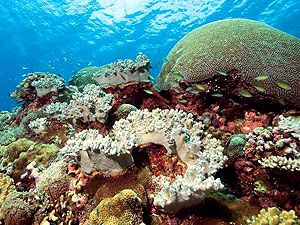 |
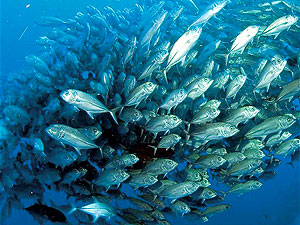
LAYANG- LAYANG The remoteness and isolation of this island is its very attraction. Because it’s difficult to access (the operator charters aircraft for the round-trip Kota Kinabalu-Layang-Layang), you won’t find boatloads of divers heading there at any one time. There is only one operator offering comfortable accommodation and impeccable service. The safety of divers is given top priority along with care for the environment, as Layang-Layang remains one of the truly pristine marine ecosystems in Malaysia. There are two distinct aspects to diving in Layang–Layang and its rich bio diversity of marine life. Firstly there’s the vertical walls, festooned by gravity defying gorgonian fans, descending to a dizzying depth of about 2,000 metres, populated by a variety of pelages such as hammerhead and white-tip sharks, manta and eagle rays, schooling jacks and barracudas, not to mention the frequent sightings of dolphins and sperm whales. Then there are the shallower reef plateaus and ledges of the reef to a depth of around 15m, home to a multitude of reef fish, corals and the tiniest of macro life forms. The distance from the continental shelf almost guarantees excellent horizontal visibility at every dive. |
Due to the onset of the monsoon season in the later part of the year, diving at Layang-Layang is confined to the period from March to August.
LANKAYAN
About 80 kilometres off the coastal town of Sandakan, once the centre of the eastern Sabah timber industry, lies the enchanting island of Lankayan, renowned for its excellent marine macro life in a ‘back to nature’ setting complete with beautiful chalets, white sandy beaches, swinging palm trees and gorgeous underwater life. A 90 minute speed boat ride from the jetty on the Sandakan waterfront will get you into the heart of the Sugud Islands Conservation Area (SIMCA), the first private sector managed marine protected zone in the Sulu Sea.
The reefs in the vicinity of Lankayan are patch reefs and submerged rocky outcrops. A multitude of habitants create a visual feast of colours, shapes and movements, a playground for green turtles, yellow tailed barracudas, stingrays, jaw fish and all kinds of reef fishes. Colourful nudibranche and a multitude of diverse macro life are ever present. Being part of the continental shelf, depth hardly exceeds 25m, which makes for easy and relaxed diving. The tidal currents are generally mild and visibility is in the range of at least 10-15m with seasonal variations. Diving is possible throughout the year, although November and December can get wet and windy with corresponding deterioration of conditions.
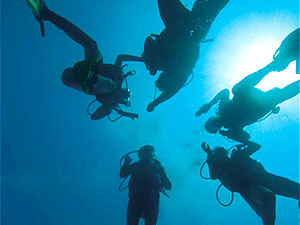 |
MIRI Normally, the last thing on any scuba diver’s mind would be to dive this oilrig infested coastline, when you have the entire East coast of the Peninsula or the more exotic locations in Sabah to choose from. Although not a new activity for resident dive enthusiasts, diving Miri’s reefs has largely been ignored by West Malaysians and foreign dive tourists. However, Miri’s coast line fronting the South China Sea and part of the continental shelf has a healthy patch reef system, largely undiscovered and undisturbed by commercial development and use. According to some marine scientists that have documented this area, the Miri reefs are among the healthiest in the whole of Malaysia, housing over 400 species of corals. Popular dive sites include ‘Sea Fan Garden’, Anemone Garden, ‘Batu Belais Reef’, and ‘Atago Maru’, a Japanese World War II shipwreck. All of the more than a dozen charted dive sites are located 10- 30km southwest of Miri town and can be reached within 15-45mins. The sea is usually calm and experiences hardly any current, making for very relaxed and easy dives. |
REDANG
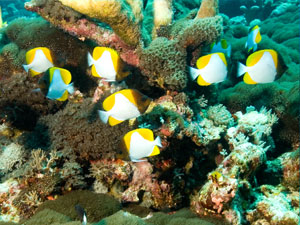
The reefs of the Redang Island archipelago are part of the Indo-west pacific region, an area whose faunal diversity exceeds that of other tropical regions. The reef-building coral species number more than 500. The marine ecosystem is also home to over 100 species of reef and pelagic fish and the green and hawksbill turtles.
The Redang waters offer a wide and diverse type of well-scouted dive sites, offering divers and snorkelers the opportunity of choosing what to explore, be it the abundant coral reefs, pelages or macro live forms. Visibility underwater is generally good, ranging from 10 to 20m most times.
 |
TIOMAN Diving activities are usually confined to the west coast of Tioman with the best sites located around the northwesterly- situated islands of Tulai, Chebeh, Sepoi, Soyak, Labas and Renggis, about 10-13km from the Salang or Tekek jetty and reachable by boat within 20-30min. The east coast of Tioman does not have any significant coral growth with the exception of some encrusting and soft corals due to its exposure to the severe weather and waves during the monsoon. Sea conditions during the period of March to October are usually calm and suitable for diving and snorkelling, with some sites such as Tiger Rock, Chebeh and Magicienne Rock experiencing strong surface currents during spring and neapm tide tidal movements, dissipating as you descend deeper. Most dive sites have dive site marker buoys to prevent anchor damage which also serve as descend lines and safety stop aids. Visibility can range from 8-20m and is usually best during March- May and September-October. |
Dive centres and resorts are concentrated on Salang and Tekek beach, offering anything from plain leisure to advanced diving and respective training and certification. Typically boat dives to the nearby islands are arranged by the dive centres, the house reefs serving as training sites and night dive locations. Accommodation is plentiful and only metres away from the beach, offering anything from very basic to luxurious.
PULAU JARAK
For those die-hard weekend divers, denied their usual east coast haunts from November till March, 60km west off Lumut, hides an alternative destination, Pulau Jarak. Admittedly, it is not Redang or Tioman or even Perhentian, but it makes for an excellent weekend dive trip, and most certainly good for a few surprises.
As the island is a mere rock, uninhabited and overgrown with lush bushes and trees, crowned by a light house aiding ships navigating the Straits of Melaka, the only option for the die-hard diver is a live-aboard trip. The standard and service quality of the dive boats varies considerably; from cattle class converted fishing boats to 3-star cruise boats.
The best option for a trip to Jarak is to book with one of the Malaysian pool of Live-aboard boats, in this case the ‘Kaleebso’, a 20m vessel that comfortably accommodates up to 20 divers in airconditioned two- and three-bed cabins.
So dive, explore, learn, cherish and respect the magnificent marine treasures of Malaysia. I am convinced that you will come back for more!
Knowing no Boundaries
 |
He has made over 11,000 dives in different parts of the world, published three books, wind surfed competitively, he parachutes, races yachts, cars, and bikes, owns the popular Piccolo boutique hotel in the heart of KL and there’s more! Originally from Munich, Germany, Dr Kurt has been living in Malaysia for the past 26 years with his wife and business partner Suzianna Wong and their two sons Nikolai and Mikhail. |
His love of the water began aged just three months. “Water has always been my element… I am a water baby… to teach me how to swim my mother threw me in the water at just three months old and instinctively I was able to swim,” he reminisces. When it came time for him to join the National Service in Germany his love for water made joining Germany’s equivalent of the Navy Seals a natural choice. “I was too tall to become a pilot so I chose to dive instead. It was the toughest and best diving education I could get.” This started his love of diving and soon enough he could not get enough of it. “Once you start to dive there is no turning back.”
Dr Kurt fell in love with the mystical and beautiful underwater world and wanted to share his experiences with everyone. “Every time I came back from a dive it was hard to describe what I saw and I wanted to capture it all as an image which is how my underwater photography started and then writing and before you know it I was asked to publish my work,” he expands.
In 2002 a publisher approached him and asked him to write a book on the wonderful dive sites to be found here in Malaysia. He spent two years working on it and his first book, “Diving in Malaysia”, was born. He then went on to and at the time of this interview he was in the process of writing his third, a follow up to his first book.
At 54 years old Dr Kurt is as fit, if and not more vibrant, than any 20-year-old out there. “If my health stays the same as it is today I have around another 20 years of diving left and I still have another 10 books in me,” he says. “Being young at heart keeps you sharp… keeps you bright eyed and bushy tailed… sure my bones might ache a bit more and my muscles are stiffer but I just shake it off. It’s all in the mind, maintain a youthful attitude and you stay young,” he tells me.
Apart from being an adventure seeker, Dr Kurt is a man who is passionate about the environment. “When you dive you see untouched beauty and you start to realise how fragile and threatened it is. Over the years I have seen increasing damage and so I started to look into conservation issues. Someone needs to educate people about how unique and rich in biodiversity our oceans are.”
“Conservation can be hip and happening and it can also have a solid economic benefit. Just look at the value of a shark for example: if you hunt it down for just its fins you can get a maximum of US$100 but if you put some sort of tourism in place so that people can see the shark in its own natural habitat that could bring in around US$10,000. The economic value of a live shark is so much more than having it in a soup,” he explains.
Dr Kurt’s youthful enthusiasm and passion for diving, adventure and most importantly the environment serves as an inspiration for us all. In his own words, you have to have passion in life, if not you’re just ticking along.
By Alexandra Prabaharan
Both of Dr Kurt’s books are published by Marshall Cavendish and they available in most good book stores
Diving in Malaysia - RM79.20
Layang-Layang - RM148
  |
 |