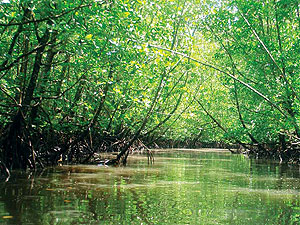
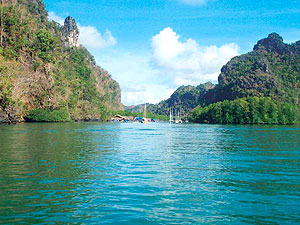
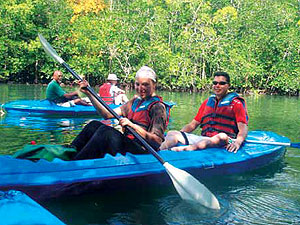
To many a kayak journey through the mangroves conjures up images of mud and mosquitoes. This may be the case elsewhere but not in Langkawi’s one hundred square kilometer Kilim karst Geopark.
These unusual mangroves formed around the slopes of hills which, after the flooding at the end of the Ice Age became islands in the south Andaman Sea. Over time, together with the help of crabs and other wild life, the mangroves created their own soil so that now they occupy a shelf of land fringing the limestone hills/islands.
This five hour trip with lunch and a visit to a limestone cave is good value and very interesting as Dev our guide was keen to share his passion and knowledge about Langkawi, a unique habitat over 500 million years old with several species not seen on the peninsula.
The deep water channels between the hills are popular with yachts passing through the Andaman Sea and a few thatched roofed floating restaurants have popped up near the good anchorages. Some of the yachts have not moved for years as their skippers find life here so idyllic. We started and finished at one of these restaurants.
There were 11 in my group, mostly Europeans, some were returning to visit the mangroves of Langkawi for the third time.
At times I got the feeling that I was in northern Australia as the terrain is similar. We kayaked through gorges under a perfect blue sky and the light definitely contributed to the feeling. The channels were wide initially and then to give our necks a rest from looking up at the cliffs, Dev brought us off the usual tourist routes. We were now in the cool green tranquil world of the mangroves themselves, deep where the motorboats
could not go.
With no motors to scare the wildlife, I saw a Crab- Eating Macaque actually eat a crab, something which I have never witnessed before. Dev says the welcome lack of mosquitoes is because the ecology is in equilibrium and the natural predators keep mosquito numbers down unlike in suburban KL.
We visited the insect predators in a small bat cave coming in by the back entrance. The cave ceiling had sea shells embedded in it indicating that this was an ancient raised seabed. Outside the cave, Dev showed us why mangroves are “the trees that walk”. If the land is unsuitable for mangrove seedlings to prosper, the parent tree will grow a semi circular adventitious root which very slowly strides out like a lower case “m” onto the ground some distance from the tree whereupon a new but identical clone begins to grow.
We continued our leisurely paddle along the river channels hearing only the sound of our paddle and the cries of the birdlife. While in the mangroves Dev spotted a mangrove pit viper having a Sunday snoozing. There were many eagles, the signature birds of Langkawi - white bellied Sea Eagles, Crested Serpent Eagles, Brahminy Kites and lesser birds such as the brown winged kingfishers. Besides birdlife, there were water monitor lizards basking on the banks or swimming in the river. Lucky paddlers may see some of the resident Langkawi dolphins come alongside their craft when they get closer to the sea. Also around somewhere were dugongs browsing on the sea grass beds off shore.
Nearing the end of our journey we came to the “hole in the wall”. This feature is a narrow opening in the karst cliffs that lets the river through to meet the Andaman Sea.
Returning to the floating restaurant with healthy appetites, we tucked into a tasty prawn tom yam and a quite generous nasi goreng kampong Langkawi style. After lunch we had a tour of the fish farm and its impressive inhabitants – a big grouper and several large sting rays that had the disconcerting trick of putting their heads outside the net and looking you straight in the eyes. I have seen many while diving but none have given me a full-on stare - a close encounter with an alien if ever there was one. They also had the trick of floating on their backs while being fed by hand and seeing their little lipstick pink lips nibbling the guides fingers was surreal. Other creatures were tuna, trevally, bat fish, sergeants, lobsters and large mantis prawns.
Replete with lunch, a launch brought us back to the Kilim jetty from where we returned to our respective hotels. In seven days on Langkawi and its islands the mangrove trip was the most consistently interesting thing I had done.
  |
 |