 |
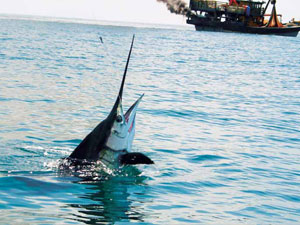
Nestled on the southern shores of Pahang State facing the South China Sea is the small sleepy town of Kuala Rompin. Its size belies its secret, however, for this is the Sailfish capital of Asia and one of the top three Sailfishing destinations in the world in terms of catches. Despite this KR remains relatively unknown to the outside world as a big game fishing centre. You are not going to get world records in the seas off KR but the Sailfish do run to between 25 and 50 kilograms, some even bigger. After my discovery of the Rompin Sailfish a decade ago, I am now a regular there. A typical trip entails two days’ fishing and three nights’ accommodation, departing Kuala Lumpur or Singapore early afternoon to arrive at KR for dinner. After dinner, there’s a get-to-know, question and answer session before retiring. The next day begins at about 7am with breakfast. Boarding begins at around 8am for the trip to the fishing grounds. The boats are 9-11 metre vessels equipped with powerful outboard engines and they reach the fishing grounds quickly. Normally, we make one or two stops along the way to catch live bait at local FADs (fish attracting devices). |
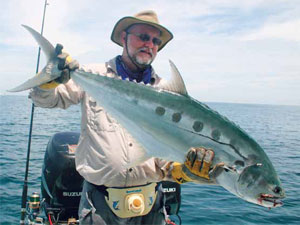
Each boat has a well for the live bait. There is not only sailfish - Narrowbarred Mackerel (Tenggiri), Cobia, Dorado, Barracuda, Trevally and others, including the odd juvenile Black Marlin, are also caught on a regular basis.
The season runs from mid-March through to mid-November. The Sailfish are still around from mid-November to March but the monsoon makes fishing impossible. Last season, 2008, was another excellent year for Sailfishing off KR but of the many fruitful trips three in particular stand out. The first was with a mixed group of Kiwis and Brits.
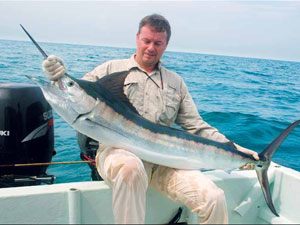
The organiser, Martin Wiles, had been communicating with me for about a year by e-mail to arrange the trip. Our first day out produced a number of Sails and a couple of Tenggiri (which served for dinner that night).
The Sails executed spectacular leaps with one performing an amazing tail-walk just three metres from our boat. Kiwi Noel, the trip’s self-proclaimed professional cameraman, failed to snap this fishing phenomenon and duly endured unending flak from his mates thereafter.
 |
It was the second day that the group really grew to respect the fish. Sailfish have been recorded travelling at speeds of about 110Km and are reputedly the fastest fish in the seas. Fortunately for the Sailfish and all those who enjoy sport fishing there is no market for the meat of these magnificent creatures of the deep – hence their numbers are still healthy. It is believed that the waters off KR are where the Sailfish come to breed, hence there are so many. A sail was hooked about 40m out from the stern. After its first leap, it headed towards the boat at full steam. Fortunately it veered off and ran right past us! David Halliwel, from Bolton in the UK, couldn’t reel in the line fast enough to keep up. We saw it – and we heard the line cutting through the water with David reeling as fast as he could, trying to get in contact with it. The next time the Sail broke surface again, less than five seconds later, it was about 200m away, and David was in contact again. The speed these fish travel is staggering. |
A regular visitor, Tomohide Kashwagi (Tomo), who has caught some excellent fish all over the world, returned last year with three friends from Japan for a one-week trip. Three of these days were spent fishing for Sails using lures and fly.
The first day produced nine Sails on casting but no hook-up on fly, although there were many Sails attacking the fly. The second day was much the same, Tomo could see the Sails attacking his fly on numerous occasions but a hook-up remained elusive. The final day was an altogether different picture. The Sails were in a feeding frenzy: 16 were caught on lures (mainly poppers) and double hook-ups were common and Tomo finally landed not one but three Sails on the fly!
Tomo’s first hook-up produced a long fight but when it ended, he reeled in the biggest fish of the trip at over 50kg. The most memorable trip last year for me was with Steve Burford and his 15-year-old son, Jamie. It was only for two days but it produced cracking results.
On the first day while we were having lunch after a successful couple of hours, one of the reels suddenly screamed and line spooled out at lightning speed. I dashed to the rear of the boat, picked up the rod and hooked up the fish. It turned towards the pressure, which is unusual for a Sailfish. And then it came at our boat like a torpedo! I was thinking ‘This is going to end up on the boat’ - a 2m Sailfish flying into the boat was a worrying prospect.
 |
Steve, Jamie and our skipper Ah Siong were all in the cabin eating when they saw the incoming missile. Both Steve and Jamie immediately dove for cover. I had nowhere to go and actually thought about jumping into the water. Ah Siong, initially blasé, jumped out of his skin, cursing in Bahasa, when the fish clattered into the side of the boat. The fish hit with a massive bang and it must have suffered a concussion because after that it gave up the battle entirely. On average, everyone should catch Sailfish. In 10 years of doing this, we have only ever had one day where we failed to catch a single Sail. Our record is 27 Sailfish landed to boat in one day, and that was in 2006. During the first week of November 2008, I thought the record would be broken when I was out with two childhood friends. By 12 noon on the first day we had landed 13. Kevin (Metcalfe) and David (Collision) both got a bit fed up, saying it was too much like hard work and decided to go for Snapper for the next few hours. By 4pm, however, they were back looking for Sails. |
Fighting the Sails can be leisurely if you have the right equipment and follow advice. Of course it’s also great fun and this exciting fishing adventure is right on our doorstep!
Fishing methods
There are three main ways of fishing for Sailfish. The first, the most popular and most productive, is using live bait. Live bait is caught at the FADs and also while drifting with bait out for Sails. Live bait is presented either on a free line or using a balloon tied to the line. The balloon acts both as an indicator of where your bait is and to keep bait at the correct depth. Balloon detaches when there is a strike.
The second method is by casting or trolling artificial lures. Casting large poppers that make a good surface splash on retrieval is the most productive. Trolling skirts can also be very good. The third is fly fishing and a minimum size12 equipment is required. The Sailfish are “teased” to the surface with artificials (no hooks) and then you cast your fly to the fish. All good quality equipment is provided, except for fly fishing equipment. Fishing for these denizens of the deep in Malaysia is probably about half the price of other known international destinations. Accommodation If it’s just anglers, we normally stay at the riverside chalets especially built to cater for anglers. The rooms are clean, air-conditioned and with attached bathroom and hot showers. The beauty of this is that you only have to walk 30m to your boat or to the restaurant. For those bringing non-angling family members, there are two beach hotels within about 15 minutes’ drive. One is a 4-star with lots of amenities including a freeform swimming pool and a variety of activities. The other is a 2/3-star hotel with a pool and basic facilities. Costs start at RM1,65per person (based on four sharing) for three nights with two whole days fishing and includes pick-up from KL or Singapore, all accommodation, food and use of all equipment and boats.
NOTE
All Sailfish are returned. Highcarbon circle hooks are used so that if a line breaks the hook will quickly decompose. Should the fish swallow a hook the circle shape will allow it to pass through without catching on the fish’s internal organs.
See www.hook-line-sinker.net for more information
  |
 |