In a limestone cliff above the Nenggiri River in Kelantan there’s a cave where elephants go for their final rest, Ashleigh Seow investigates
I had always thought that elephant graveyards were the stuff of legend in Victorian adventure books like Rider Haggard’s “King Solomon’s Mines”, or tales spun by boozy white hunters at riverside bars or Masai myths told around campfires.So when I received an invitation to join a three day river rafting expedition which would make a side trip to an elephant graveyard my interest was piqued. My friend John was working with a collective of Orang Asli and Malay villages on the Sungai Nenggiri to help them improve their “eco-tourism” potential. Often a misused expression it seems to be genuine in this case. The river is run by commercial operators as well but the Brotherhood of the River (Sahabat Sungai Nenggiri) definitely is a local affair.
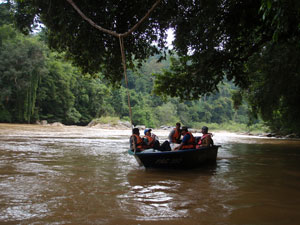
The trip started at Gua Musang in Kelantan which can be reached in four hours from Kuala Lumpur. Once there the group had breakfast and proceeded to Kg. Betis to start rafting. After a briefing of do’s and don’ts, life jackets and helmets were put on and the group began rafting down the Nenggiri. While it was certainly not hard core wild water there were enough exhilarating but moderate rapids to get the adrenalin going. The youngest members at six , nine and 14 years found it easy going and soon were riding the bow of the rafts to parental consternation.
At midday the rafts reached Gua Cha, where stiff legs were stretched to walk to a cave where archaeologists found several ancient skeletons testifying to the early presence of hunter gatherer humans during the Hoabinhian period (10,000 years ago) which corresponds to the Middle Stone Age. Evidence of the caves’ habitation includes stone tools and animal bones. The cave was also used in the Neolithic period, characterized by the development of agriculture and pottery, when it was a burial site. Over 40 skeletons were excavated here, the first by the legendary Pat Noone, Protector of Aborigines, who disappeared in 1943 after staying behind in the jungle to harass the Japanese. The bones are now in Cambridge University though others undoubtedly lie beneath the cave floor. Just this year Malaysia asked for the return of the skeletons as part of its heritage. These Neolithic people were the ancestors of the Senoi and Temiar peoples today and the Temiar still visit the cave today.
After a packed lunch, the rafts took to the water again for more whitewater fun till mid afternoon when the guides brought the raft to a stop at Kuala Jenera where a prepared camp site was waiting to accommodate weary travellers. A jungle kitchen was set up and a welcome meal was prepared by the cooks who accompanied the group in a boat.
The following morning the group set off to Pos Pulat, a Temiar settlement, stopping at a waterfall when the travellers got out to play in the natural jacuzzi. At Pos Pulat, there was another excellent campsite ready next to the bamboo jetty. We spent the rest of the day lazing around camp, fiddling with kit or talking with the Temiar.
Some of us tried our hand at tapping rubber with a tapper’s knife under the tutelage of Seli, the headman, who was a sheer delight to listen to. He has a rich basso voice like James Earl Jones (Mufasa in Lion King). The Temiar women prepared ubi, or tapioca, from their garden and herbs and offered it to us. They scorch and scrap off the outer skin repeatedly. It is quite nice this way.
I spend time by the river soaking in the tranquility and later joined the local boys swimming
Later, after a meal of barbecued chicken and mixed dishes, which we brought in so as not to tax their resources, we took part in a sewang, a traditional ceremony to celebrate practically anything it seems.
I am cultural show phobic and do not watch anything that smacks of tourist show but even I got into the act and became the first to join the women’s’ bamboo percussion octet. These women are hardy, they kept it up for nearly three hours (definitely not a culture show!) while my arms were getting tired after 20 minutes. The technique must be all in the wrist.
Temiar bamboo construction is impressive. The structures were supporting 30 people many of whom were jumping about while the others struck the floor. One little boy was rocked to sleep!
The next day we drifted down river enjoying the impressive scenery. The river was mild and I was content to take photos instead of paddle.
I just love the limestone formations. A large rock teeters on the edge of the river ready to cause a mini tsunami. Some remind me of a slice of cake. Another looks like an Easter Island statue of a proboscis monkey.
We see the site where the elephants drink and the police come to see that we are okay. On the first night they even camped nearby as well. Personal protection VIP style!
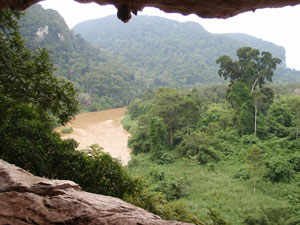
We glide to a stop under an overhang and tie up to a tree sticking out at 90 degrees to the cliff. We have arrived at the gateway to the Elephant graveyard. The “Gate” is high above the water so I wonder how anyone ever got up there.
We slip into caving mode. Instead of climbing those sheer ramparts, we take a back door into the graveyard. But our back door is a small cave requiring us to slither on our back so how did the elephants get there? Through the jungle on the other side it seems - a long trip for us to make.
We go to the Gate first to take in the views. It is splendid. I wish I could remain behind for a day or two to play caveman and watch the river and forest. The dawn and sunset must be magnificent.
On the way to the graveyard we see a strange sign made in charcoal in a small cave. No one has any idea what it means but charcoal stick figures are often seen in seen in early human caves.
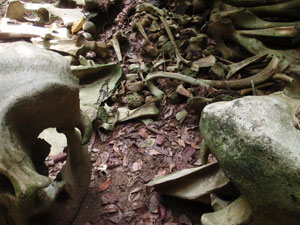
The graveyard is not an ancient graveyard littered with thousands of elephant bones as I half hoped to see though there are a couple of hundred bones. The Temiar say that they discovered the bones only two years ago but initially there was only one carcass. Several months later they found another only a few metres from the first.
I remember reading in that elephants would visit sites where their kin had fallen and spend time there stroking the bones, especially tusks. One report speaks of elephants making off with the tusks of deceased elephants.
The Temiar say that for several months they found tracks of a young elephant around the site, possibly the calf of the female who died. Eventually they decided to gather the bones together and the bones of the two elephants are neatly stacked side by side as close in death as they probably were in life.
Returning to the river we have lunch and then all but one decide to jump in to body raft down the river. We drift for a hour past some interesting scenery. It is cool and tranquil.
On the way back I see many logging trunks over the rest of the day a grim reminder what the politicians and timber barons have in store for the forest and the people who depend on it.
The Sahabat Sungai Nenggiri can be contacted through Malaysian Nature Society nature Guide John Chan (6016-3569 169) chankokaik@aol.com as it has no KL office. It is a cooperative of local people committed to preserving their way of life and is eco-tourism as it should be.
  |
 |