 Old Lace and New Religion
By Paula Tan
TAKE A WALK BACK IN TIME AS PAULA TAN
STROLLS THE STREETS OF PULAU TIKUS, A
CHARMING NEIGHBOURHOOD THAT MAY
HAVE SLOWLY DISAPPEARED UNDER HIGH-RISE
DEVELOPMENTS, BUT LIVES ON IN THE SPIRIT OF
THOSE WHO CAME BEFORE.
grew up in a magical neighbourhood, where trees whispered in the sun and relatives took on animal names, as children, to protect them from deities on the lookout for beautiful human infants. In Pulau Tikus in northeast George Town, a small community of different races has flourished over the decades, creating an eclectic blend of dialects, buildings and food.
EUROPEAN TOUCH
 Unglamorously translated from the Malay language as "rat island," central Pulau Tikus stretches from Cantonment Road to the Burma Road junction, incorporating Kelawei Road and its links. Taking its name from a small, rocky island two kilometers off the coast which, ironically, cannot be seen from the district, Pulau Tikus is believed to be a reference by Malays to the Portuguese traders who once moored their ships there for fresh supplies. At low tide, they crossed
the sand banks, which appeared like the backs of rats leading back to their vessels. Another story states that the name originates from Thai Eurasians who named the area in which they settled after the island where they had first disembarked. Intriguingly, the tiny island continues to house
a mysterious grave belonging to an unknown Seyad Mohamed Kuddoos Oliyullah.
Unglamorously translated from the Malay language as "rat island," central Pulau Tikus stretches from Cantonment Road to the Burma Road junction, incorporating Kelawei Road and its links. Taking its name from a small, rocky island two kilometers off the coast which, ironically, cannot be seen from the district, Pulau Tikus is believed to be a reference by Malays to the Portuguese traders who once moored their ships there for fresh supplies. At low tide, they crossed
the sand banks, which appeared like the backs of rats leading back to their vessels. Another story states that the name originates from Thai Eurasians who named the area in which they settled after the island where they had first disembarked. Intriguingly, the tiny island continues to house
a mysterious grave belonging to an unknown Seyad Mohamed Kuddoos Oliyullah.
From an early age, I learnt that the very ground under my feet had a captivating history. My parents' pre- war house in College Square - formerly the Eurasian Village, or Kampung Serani was set around a field, in one of two rows built in the pattern of a chess set by a colonial architect in the pre- war era of the late 30s and early 40s. A stone's throw away, the house in Pulau Tikus village, number 29A, where my father grew up, incorporated mud floors and an address which today, has been bestowed upon an elaborate bungalow in Cantonment Road proper.
Pulau Tikus village is no longer here, but Eurasian families of Portuguese descent who once lived there are represented by their present-day generations. Names like Augustin, Jeremiah, Gregory, and Joseph remain alive and well in the neighbourhood. Other familiar Pulau Tikus titles, such as Jalan Brother James and Leandro's Lane recall the once thriving Catholic Eurasian community that surrounded the area's institutions of the Roman Catholic church - the College General, St Joseph's Novitiate, Convent Pulau Tikus, St Xavier's Branch School, and the Church of the Immaculate Conception.
Founded in 1811 by Father John Baptist Pasqual, the stately Church of the Immaculate Conception along Jalan Burma also reflects a rich Eurasian legacy. When the Siamese reasserted their authority in Junk Ceylon (in Phuket), its Thai-Portuguese Catholic community fled to Port Queda (Kuala Kedah) when Phya Tak ordered the massacre of all Christians in 1778. From Kedah, their progression toward Penang was a natural one.
ASIAN INFLUENCE
 Apart from the Thai Eurasians who settled in Pulau Tikus, Thais and Burmese of Buddhist faith also made the area their home, structuring enclaves and erecting places of worship that have outlived the villages themselves.
These early settlements, further west along Kelawei Road, are now tourist destinations and surrounded by 19th- century historic temples, including the finely preserved Dhammikarama Temple (Wat Chaiyamangkalaram), built on land bequeathed by Queen Victoria in 1845, and Wat Buppharm.
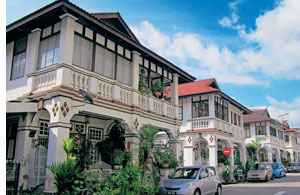
Behind Wat Chaiyamangkalaram lies Bangkok Lane, Pulau Tikus' most colonial street. Linking Kelawei Road and Burma Road, it is lined by two rows of forty semi-detached houses built in 1928 by entrepreneur, Cheah Leong Kah, for his family. These beautiful houses are still owned by the Cheah family trust, and those not occupied by descendants are rented to tenants. Although several have set up businesses on their premises in recent years, signboards are discreet and regulated by the trustees. The houses maintain a uniform colour scheme with no modifications permitted to neither exterior nor interior. The street is picturesque to behold, and three days a week, passersby can spot a hawker selling satay babi from his three-wheeled cart - a tasty traditional treat.
Nearby, along Kelawei Road, which runs parallel to Burma Road, is the Masjid Jamek Al-Munauwar Kelawei, which has since been rebuilt, with its origins firmly rooted in the street's centuries-old Malay settlement. Behind this mosque, a lane leads to Burma Road winding through Kampung Syed past an old Muslim cemetery, vintage Malay houses and gardens of fruit trees - lime, mango, and chiku. A mere kilometer further up from the mosque, is the Catholic cemetery where Father Pasqual first set up his church in a tent, around which the dead were buried, as was the custom of the day. Today, this final resting place faces the bustling Gurney Plaza, where shoppers throng throughout the week.
GONE BUT NOT FORGOTTEN
Beside Gurney Plaza is the site where the grand old College General once rose, housing St. Joseph's Novitiate.
Originally established in Ayuthia in 1665, it was revived here along Jalan Kelawei in 1808. Funds to build the seminary were apparently collected from as far as Mexico and the architecture and atmosphere "proclaimed discipline and absolute silence" for its training of novice priests.
At the time, the building was set against a lush jungle filled with mangosteen, coconut, durian, banana, and pineapple trees, huge angsana trees, and lallang. The nearby community maintained a respectful distance and access to the seaside was only via pathways beside the fences. Later, after many years as
the Uplands School, this respected monument too, eventually gave way to the pressures of the modern day.
Though beautifully restored, it is now St. Jo's, a façade for a multimillion- dollar condominium and shopping mall development.
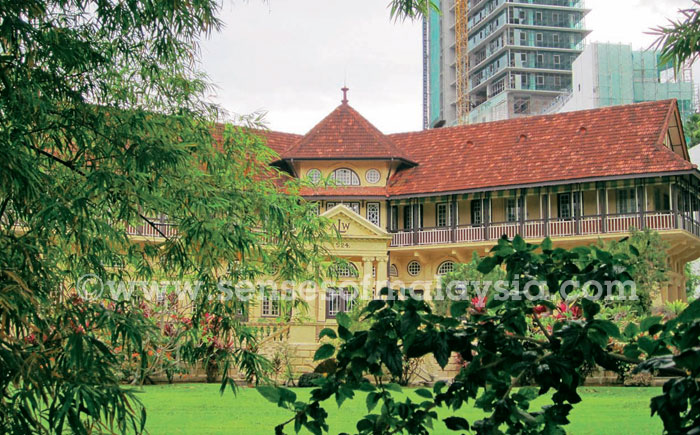
Neighbour to St. Jo's is the elegant Loke Mansion, built in the shape of a butterfly by millionaire Alan Loke in
1924. An architectural gem straight out of a Brontë novel, the building faces
the Gurney Drive seafront - named after Malaysian High Commissioner Sir Henry Gurney - and is one of the few stately homes lovingly maintained in its pristine original state.
At the end of the Drive, at the juncture of Kelawai Road, the extravagant home of Chung Thye Phin, the last Kapitan China
of Perak, once stood. Long demolished, the fabled mansion, which later became the famed Shanghai Hotel and, at one point, a club for German U-boat men, once graced the grounds on which the premier address condominium known as 1 Persiaran Gurney is located today.
COMMERCE AND PROPERTY
A set of traffic lights away, on Cantonment Road, two longstanding local banks have more recently been joined by a branch of the Bank of China, creating a small financial district. Next door to
the decades-old Maybank, the old post office remains, comfortably flanked by the local kedai tuak, or toddy shop. This is the official state-run toddy shop where fermented palm liquor is still sold and consumed on the premises
by blue-collared men in rather dingy surroundings.
Being more commercial than Kelawei Road, Burma Road maintains its quaint shophouses that date from the 1920s and 30s, in a lead up to the local police station. Here, motorcycle repair shops extend their services beside family-favoured coffee shops, and sundry stores. Just beyond Burma Road, the famous Pulau Tikus market, reputedly one of Penang's most expensive wet markets, enjoys its celebrity status, remaining a magnet for islanders due to its wealth of offerings - from tasty local delights, to farm produce and trinkets.
A far cry from its sedate past, today's Pulau Tikus is prime real estate and amidst its graceful fields and places of worship, high-rise buildings grow taller with every new development, a by-product of its central location and
scenic views. As our sentiments erode, along with the dignity of colonial homes converted into nail spas and jewellery boutiques - including a residence that once belonged to 50s musician and songwriter Jimmy Boyle - the painful fact sets in that everything has a shelf life. But when the ground is scattered with golden angsana flowers, those who built this haven flit across our minds, still a part of the living legacy of which we are now a part.
Each year, when the Thai community celebrates Loy Krathong with a parade along Cantonment Road to the sea, candles are floated out with prayers from
the original Pulau Tikus. It's an enchanting and charming ceremony, one that is always enjoyable to witness.
As I stand watching this spectacle of light, I recall the catchphrase of my grandfather, a pioneer of Pulau Tikus: "Eat and spend, God will send," he liked to say, and presumptuous though this may sound, our small community has undoubtedly been the recipient of these graces.


