 Festival Fever!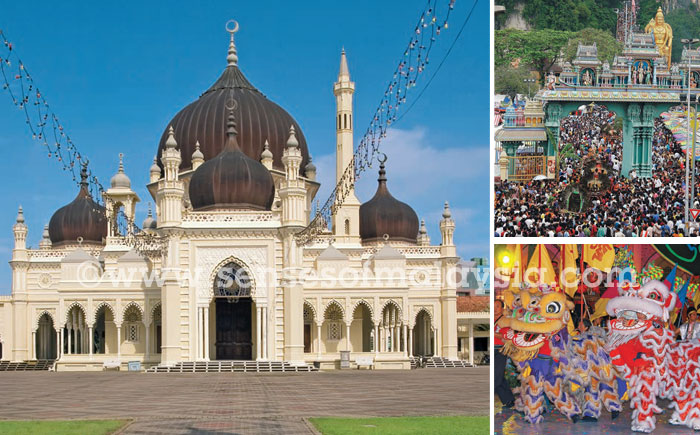
THREE HUGE EVENTS WILL SET ALL THREE MAJOR CULTURES OF THE COUNTRY CELEBRATING
DURING THE FIRST TWO MONTHS OF THE YEAR, AS MUSLIMS, HINDUS, AND CHINESE EACH GET A
SPECIAL DAY TO MARK AND THE ENTIRE NATION ENJOYS PUBLIC HOLIDAYS GALORE.
There is no clearer reminder of Malaysia's cultural diversity than during festival time. When each of the religious and cultural communities get into the party mood, the whole nation gets to share in the celebrations, learning a little more about an often foreign culture along the way and helping their fellow Malaysians to enter into the spirit of the special time.
PROPHET MUHAMMAD'S BIRTHDAY
The country will enjoy its first national public holiday of the year on 24 January to allow the Muslim community to celebrate the birthday of the Prophet Muhammad. Muhammad is seen as the last and most important prophet in the religion, having produced the Qur'an after instruction
from Allah (God) and is credited with successfully bringing together the various religious practices of the other prophets under one faith.
Muhammad is believed to have been born in Mecca in 670 CE and brought up by his uncle after having been orphaned at a young age. He worked as a merchant and
a shepherd, and spent portions of his time praying and meditating in a cave. It was during one such cave session, at the age of 40, God spoke to him for the first time, and around three years later Muhammad began preaching the word of Allah. Over the years that followed until his death in
632 CE, he succeeded in converting most of the Arabian Peninsula to Islam.
The observance of his birthday, or Mawlid, occurs in the third month of the Islamic calendar and became a public celebration four centuries after his death. Celebrations vary depending on the country – sometimes carnival processions are held, and often food is handed out
to the poor, and money or produce is donated to charity.
Islam is the largest practised religion in Malaysia, and around 60% of the population are Muslim, so this is a day that will be marked by the majority if the country. Prayers are a must during this day, and Muslims will flock to the mosque to pray and give thanks for Muhammad and all his works.
THAIPUSAM
Around 7% of the country's population are of the Hindu faith, but it will seem like many more to anyone who heads to Batu Caves on 27 January to witness one of the most spectacular events on the Hindu calendar.
Thaipusam is celebrated by Hindus all over the world, although Malaysia and Singapore are unique in their festive fervour as they mark the day dedicated to the Hindu god Murugan.
As the son of Shiva and Parvati, Murugan is sometimes known as the Tamil god of war, and Thaipusam celebrates the triumph of good over evil, and the victory that Murugan enjoyed after Goddess Parvati presented him with a lance that enabled him to defeat the evil demon army Tarakasura.
The date changes each year (as it falls on the full moon of the Tamil month
of Thai), but Thaipusam usually falls in late January or early February and is an opportunity for Hindus to implore for help from Murugan, showing their appreciation by offering a kavadi (burden) in return.
Those who are seeking help often abstain from meat for the 48 days leading to the date itself, and the most devout will also shave their heads. On the day, the devotees will undertake a pilgrimage to the temple, carrying their kavadi with them to offer to Murugan. Kavadis can be as simple as a pot of milk, but many show their devotion by piercing the flesh, which is done without anaesthetic while in a trance.
Batu Caves in KL sees thousands of devotees flocking to the temple on Thaipusam, but smaller crowds will gather to make their offerings at any Murugan temple in the country. Once the kavadi has been offered to Murugan, families will go home together to rest and continue to share in the day, often finally breaking their vegetarian diet with a meaty feast!
CHINESE NEW YEAR
Think your eyes are going red? Think again! Chinese New Year is already transforming the country into a frenzy of food and preparations as one of the
liveliest celebrations in the country arrives at the beginning of February.
The date of the new year commencing varies, based as it is on the lunisolar Chinese calendar, but for 2013, the 10th of February will be the first day of the Year
of the Snake, as the Dragon disappears into memory and the Chinese community all over the world herald a new year with new clothes and family feasting.
Chinese New Year has been celebrated for centuries, and the reasoning behind many of the customs is shrouded in myth and legend. One such tale credits the traditions of the season to the protective steps people used to take to prevent the mythical beast Nian eating them and
their livestock when he came to prowl on the first day of the new year. Nian would eat the food they left out instead of feasting on people, and then be frightened away by the colour red, which is still used to this day in decorations and in the colour of the money packets (ang pow) that are handed out by married couples to all their unmarried relatives and close friends.
While there are many traditions linked to this season, families vary in how strictly they adhere to the practices. One of the most common (and fun!) is the tradition of having a lion dance at your home or place of work to ward off evil spirits, and these can be noisy, daredevil affairs that see the lion jumping on high posts before rushing around the building.
Much like Christmas, it is the eve of the event that is most important, and the Reunion Dinner which takes place the day before the new year sees the family getting together to share a special meal.
The two public holidays for Chinese New Year (11 and 12 February) are often remarked on as many city dwellers find their usual habitats completely empty as Chinese families head balik kampung (back to their hometowns) to spend the whole week with their relatives.


