| Splendid Isolation By: Scott Davenport |
||||
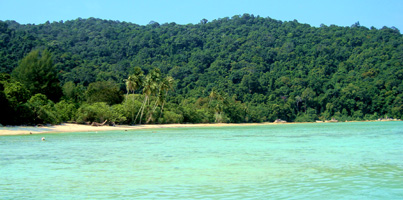
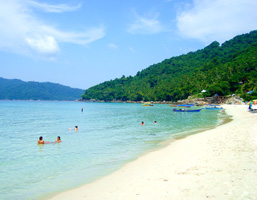
There’s a running joke amongst the Perhentian Islands’ locals. They love to ask travellers what they think of their pristine tropical landscape, but then lean in and whisper conspiratorially: “Shhhh, don’t tell too people!” before you have time to answer. The Perhentian Islands lie 25 km off the North East of Malaysia, not far from the Thai border. The Islands’ main attractions are their white sandy beaches, crystal clear waters and bohemian atmosphere. More people are discovering the islands yet they remain unspoiled and sparsely populated. The Perhentian Islands are striving to balance increasing commerce with their reputation as Malaysia’s best kept secret. The two islands Pulau Perhentian Kecil ( Small Island) and Pulau Perhentian Besar ( Big Island) offer a variety of accommodation and activities for most tastes and budgets. The Small Island is a back-packer favourite with its numerous moderately priced chalets with basic facilities. The Small Island has two beautiful beaches; Longbeach and Coral Bay. Longbeach boasts arguable the best beach with powdery white sand and shallow water ideal for sunbathing and swimming. Some familiar tourist beach sights can be found on Longbeach like volleyball, parasols and beach bars but Longbeach remains comparatively rustic and is a long way from becoming the Costa Del Sol. Coral Bay – a sleepier bay on the adjacent coast is the perfect place to watch a fiery sun set amid the wafts of freshly barbecued ‘catch of the day’. Both beaches are accessible via a 10 minute hike through the jungle. I stayed at Panorama Diving School Chalets on Longbeach, Small Island. Mohamed, the owner assured me that the islands are considered a 5 star diving resort where visitors can indulge in snorkeling, introductory diving trips or complete PADI diving training. The air conditioned chalet was basic but secure and cost RM95 a night including evening meal. The on-site shop, dive school and restaurant (with nightly barbecues) made for an easy all in one stop, though more attractive chalets can be found further up Longbeach. For a more luxurious stay BuBu on Longbeach offers higher quality rooms and the delicious Mahi-Mahi restaurant is a favorite among Western and Chinese Malaysian visitors willing to spend a little more. A standard room will set you back RM360, whilst a deluxe room costs RM 470. I spoke to Bin, who runs Bubu’s beach-front massage. He told me life is very different on the island compared to her native Thailand. “The local people live simple, hard working lives. Here we have tourists, but not too many. People are still people – sometimes Thailand is just about making money from the tourists.” The Big Island holds more appeal for families, honeymooners and those on a larger budget. Luxury rooms can be found at Arwana Eco Resort where beach-weary visitors benefit from a glistening pool and relaxing spa. The most attractive bay on the Big Island is Teluk Pauh in the north of the island, whereas Teluk Dalam is one of the quietest beaches for those seeking a peaceful sanctuary. The evenings on both islands are peaceful and the atmosphere is friendly and relaxed. Whereas some beach resorts have bustling nightclubs, most visitors to the Perhentians can be found eating al fresco or sitting chatting on beach mats by candle light. I found that wandering around chatting to people was the best way to find out what was going on on the islands. I quickly bonded with a number of travellers from Sweden, Finland, Switzerland, France and Vietnam – many of whom like myself had set off alone and stumbled upon a group to travel with. I spoke to Joanna, an expat from Surrey (near London) who worked in a beach bar. “I came to KL four years ago searching for a different life. I wanted to live in a tropical country and meet new people.” But working as an accountant in KL wasn’t quite the experience she was searching for. “I realised after a while that I’d re-created my life back home here in Malaysia. All my friends were Western, I watched Western movies and shopped in American clothes stores… after a while I just wanted to do something different. I came to the Perhentian Islands six months ago because I’d heard it was a beach resort for people who hate beach resorts. It’s paradise here - I can’t imagine ever leaving.” I asked her what she missed most about home. “Obviously family and friends, but realistically most of the food and TV I love back home are available in KL. Now I live like a local; I eat Roti and Keropok lekor (fish cake), I work, I swim, I meet people from all over the world – and I can also speak some Malay.” When asked about the biggest difference between KL and the Perhentians, Joanna smiled and said: “The wildlife. You can do an all day snorkelling trip here for RM40 here which practically guarantees you to see turtles, reef sharks, parrot fish… and the monitor lizards are amazing.” Monitor Lizards are plentiful on the islands. These indigenous giant reptiles can grow up to 2 meters long. Similar in form to a crocodile, Monitor Lizards are generally people-shy but always attract a crowd from locals and travellers alike when one ventures out into sight. Suhaimi, a local dive school instructor told me of his observations as more people learn about the Perhentian Islands. “My father was born on the island, I grew up on the mainland. I came here to work but also because it is my father’s home. When I arrived seven years ago, the island was quiet. There were a few places to stay and some restaurants and dive schools. Now there is more choice for visitors, but still our beaches are clean, our water is clear and our fish are still healthy.” One of Suhaimi’s colleagues at the dive centre is a British expat called John who learned to dive in the UK and worked as an instructor in Bournemouth for years. His decision to leave for Britain wasn’t a difficult one. “As much as I love England, one day I asked myself, what am I doing this in the freezing cold when I could be in clear blue waters somewhere hot with an all year round tan?” After a few weeks diving in Indonesia he learned about the Perhentians and has now made it a permanent base. My five night stay on the islands proved a relaxing beach holiday with a difference. Getting ‘back to nature’, jungle-trekking, swimming with giant turtles, meeting local people and tasting local cuisine allowed me to see a different Malaysia - an raw unspoiled Malaysia. But as the word spreads and tourism grows, in the words of the Perhentian people I urge you too ‘don’t tell too many people!’ Getting there The easiest way is to fly to Kota Bharu airport in the north east of Malaysia, easily accessible by Air Asia and Firefly airlines. There are no ATM machines on the island so make sure you get cash at the airport. From here take a taxi to the coastal town of Kuala Besut, one hour away from the airport. Depending on your bartering skills this should cost between RM50-70. Kuala Besut jetty is a short walk from the main street where you will find shops and restaurants to stock up on supplies for your island trip. Boats from Kuala Besut leave at various times depending on the season and demand but the last boat of the day is usually 4pm so it is advisable to take an earlier boat to avoid being stranded on the mainland. Taking a 40 minutes speed boat journey to the islands will cost you RM70 return, though slow boats are available at around RM40 return and take approximately 2-2.5 hours. The journey across the clear blue waters of the South China Sea are remarkable whichever boat you decide to take and each will drop you off at your preferred island. More expensive resorts allow you to pre-book, which is advisable in high season June – August. Most budget chalets operate on a walk-in basis but are bookable from agents at in Kuala Besut. |
||||
|
||||