| The Cat's Whiskers By: Gigi Ivanna |
||
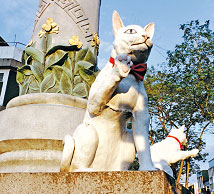
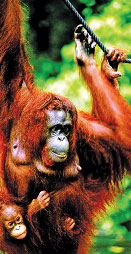
Kuching is the state capital of Sarawak. Take a weekend to visit and you will be amazed at how time has slowed compared to the busy city of Kuala Lumpur. People here are friendlier and more hospitable with time to stop for a chat. No visitor will be left ignored if they need help. Clearly, there’s a lot more to the place than the ubiquitous statues of cats that have been erected of late. Yes, it’s true that Kuching means ‘cat’ in Bahasa Melayu, but that hardly seems enough of a link to necessitate the ‘ Kuching Cat Museum’. No, even though the town itself has many attractions, the more interesting ones are located outside the centre. Some half-hour drive away from Kuching is the Semenggoh Wildlife Rehabilitation Centre, Sarawak’s first dedicated reserve for the endangered and protected creatures of Sarawak. Established in 1975, the centre aims to rehabilitate these creatures in the hope that perhaps one day they will be able to survive back in the wild again. While Sarawak is known as the Land of the Hornbills, the state is home to another magnificent creature – Asia’s only great ape, the orang-utan. Found on the islands of Borneo and Sumatra, these “men of the jungle” are in danger of fast becoming extinct due to development and deforestation of their habitat. Although much of their prime habitat has been converted to plantations, the good news is that the rate of habitat loss has declined in recent years due to stricter enforcement of laws. There is almost no hunting of this species and most of the remaining populations are found in forests that are protected or under natural forest management. The Semenggoh Wildlife Rehabilitation Centre houses orang-utans that were chased out of their habitat, have been injured, orphaned or rescued from villagers who kept them as pets. The Park Ranger says that it was difficult in the beginning as many villagers were reluctant to give up their pets but due to constant education and an important change of mindset, these incidences have reduced drastically.Sadly for the orang-utan, some have been kept in captivity for so long that they can not adapt to survive in the wild. These creatures will be permanently housed and taken care of in the Centre, for education purposes. The younger orang-utans have a better chance of adapting though as they learn fast and are not set in their ways. I must warn you that a visit to the centre does not guarantee orang-utan sightings (a good sign actually as this means that more and more orang-utans are slowly adjusting to the wilderness and are able to forage for food on their own) but visitors usually get to see them for a few minutes during feeding time. Ritchie was joined by a female with her baby clinging onto her. She was more cautious as she had a baby under her care. We watched in wonder as they ate, played among the branches and swung from tree to tree. The younger ones were a joy to watch as they were the most active. Orang-utans generally have brown and rust-coloured shaggy fur. Female orang-utans grow to about 1.1m in height and weigh 30-50kg while their male counterparts weigh 50-90kg and stand around 1.2-1.5m tall. The centre also features fascinating tropical trees, temporary animal shelters, a number of jungle trails, an information centre and a souvenir shop. You can donate some money to support the cause and sign the guestbook if you want.
After satisfying myself with photos of these wonderful creatures in action, I headed off to the Padawan Pitcher Plant & Wild Orchid Garden, a short drive away. The one-acre research and training centre is home to many carnivorous pitcher plants and wild orchids indigenous to Borneo. There are more than 25 species of pitcher plants and over 30 wild orchid species in the garden with colours ranging from red and green to spotted and purple. Like most carnivorous plants, pitcher plants are found in locations where the soil is too poor or acidic. Some of the pitchers were as tiny as my little finger, while others were more than 10cm in length, but they can grow up to 60cm in the wild. The pitchers here are mostly from Borneo including the Nepenthes rafflesiana, the biggest and most impressive species found in Sarawak. Being self-feeding plants, pitchers attract prey with their nectar and colourful pitchers. The insects trapped by the pitchers are gradually absorbed as an alternative source of nutrients. Pitcher plants feed on insects, but can even feed on small animals like birds and rats in the wild. Sarawak is famous for pottery craft and a stop at one of the pottery factories along 8th Mile, Penrissen Road on the way back is a must. Visitors can browse at the dazzling array of ceramic products, from huge pots and jars to coffee mugs and flower vases with Chinese and Dayak designs. If you want, you can observe skilled artisans behind the showroom busily transforming ordinary lumps of wet clay into beautiful creations in just a few minutes. I tried my hands at shaping the clay and found out how hard it is. After shaping the clay, the potters cut a design into the surface of the damp pot and paint it when it is dry. The pot is then glazed and fired. The state of Sarawak also produces 95% of Malaysian pepper with over 90% exported to some 40 countries around the world. At the moment Malaysia ranks fourth as a pepper producing nation. The tropical climate of Sarawak is ideal for pepper cultivation and harvesting stretches from April to September with the peak season in May and June. Seeing that pepper is such an important commodity in Sarawak, we visited a pepper plantation to see how pepper is grown. Pepper is usually planted by smallholders, mainly on fertile hill slopes. The pepper plants are supported by poles and can grow up to 4m high. The plants bear fruit from the fourth or fifth year, for up to seven years. Both black and white pepper are made from the same fruits but undergo different processes. Traditionally, 80% of the crop is processed into black pepper with the remainder being turned into white pepper. Black pepper is produced from unripe berries cooked briefly in hot water and then dried in the sun for several days, during which the fruit shrinks and darkens. White pepper is produced from ripe berries that are soaked in water for about a week until the flesh softens and decomposes, leaving only the seed which is then dried in the sun. Malaysia produces Specialty Pepper (creamy pepper, naturally clean black pepper and extra bold black pepper), Sarawak Green Pepper products (pepper sauce and pickle) and processed pepper products (sweets and perfume) to meet the growing demand of end-users. A treasure trove of knowledge can be found anywhere you go. All you have to do is look beyond the cats and leave the city. I’m sure you’ll have a purrfect time…
|
||
|