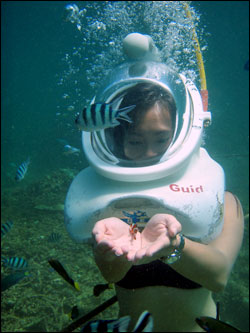
| Walk down under By: Gigi Ivana |
||
Seawalking is just as the name suggests – a walk in the sea. It is actually walking along a 10 metre dedicated seabed trail about five metres below sea level. In Malaysia, this activity is only available at Pulau Sapi, part of Sabah’s Tunku Abdul Rahman Marine Park, just off Kota Kinabalu. Non-divers will be thrilled to know that complicated scuba diving skills are not required. You don’t even need to know how to swim and children as young as age seven can partake in the activity. We were first led to the company’s office for a brief video presentation where a member of staff explained the various hand signals used under water. Thumbs up or down indicates going up or down, forming a circle with your thumb and first finger shows that you are alright and a flat, ‘so-so’ motion with your palm facing downwards means that you are experiencing some sort of problem. We were then taken to a small pontoon by boat, just a few minutes away from the jetty. What greeted us was the sight of several astronaut-looking bubble helmets and rubber shoes of various sizes. We were told to pick our shoes and walk towards the edge of the pontoon where a ladder was. I went first and started to climb down the ladder with my back facing the open sea. A member of staff placed the helmet on my shoulders as the water reached my armpits. And boy, was it heavy, 35 kilogram’s to be exact. The bulk sounds heavy but it won’t feel that weighty once you submerge your head into the water. The helmet’s thick foam shoulder pads help to ease the pressure as well. Compressed air enters the valve at the side of the helmet and pushes the water down to about shoulder level so that your face and hair will remain dry. You could even wear makeup or contact lens underwater if you wanted too. The air circulates through the helmet and goes out through holes in the back. A hose connected to the top of the helmet allows oxygen to flow inside. I found that I could breathe normally, just as I would breathe above water. Pressure began to build as I slowly descended and I remembered my short lesson earlier. I brought my hand under the helmet, pinched my nose and blew. You can also swallow or move your jaw to equalise pressure. I finally reached the seabed where a diver led me to some ropes anchored into the sand that marked the underwater trail. He told me to wait while he went to help my friend down the ladder. The sensation underwater was truly one-of-a-kind. I had a bit of problem standing straight in one spot as the slight underwater currents swayed me side to side. Luckily there were ropes to steady myself with. When my friend made it safely to the seabed, the diver began to point out the various marine life around us. I started taking photos of everything around me with my underwater digital compact camera. There were colourful soft and hard corals, starfishes, marine plants and plenty of fish. If you’re lucky, you will be able to spot seahorses, giant crabs, a sea turtle or even a whale shark. We were only allowed to touch certain marine life like shells and a few hard corals. I squealed in delight when I spotted the bright orange with white stripes clown fishes, more popularly known as ‘Nemo’ from the Disney cartoon. They were playing hide and seek among the sea anemone and didn’t seem bothered by our presence. The diver gave us a chunk of bread and told us to release the bread slowly for the fishes to feed. A school suddenly zoomed in and snapped every bit of bread up in a flash. Don’t expect a polite peck but brace yourself for a feeding frenzy. Although it was a little painful – some fishes do have sharp teeth - it was very fun to watch them fight for the bread. All good things had to come to an end and after half an hour underwater, the diver gave the thumbs up, signalling to us that it was time to head back up. We moved towards the ladder with a heavy heart, wishing we could stay for just a little while longer. It felt odd that my hair and face were only slightly damp after removing the helmet, whereas my entire body was wet. A young Japanese couple were waiting their turn on the pontoon, eager to dive straight in. I wish I could go again with them. Participants will be given a certificate together with some digital photos of themselves underwater. It cost RM250. For further information, please visit www.borneoseawalking.com |
||
|