| Traditional Tranquility By: Ashleigh Seow |
|||
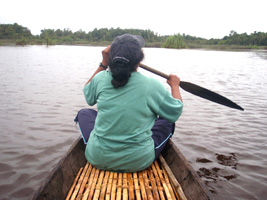
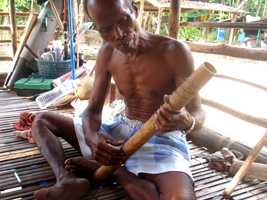
The flat, water-logged lands of the Tasek Bera are home to the Semelai people who still live using age old skills with unique traps, musical instruments and fire starters. “Tasek Bera! Why go there?” cried my friend Jan. “It’s flat like Holland”. Why indeed is the question that springs to mind for many people. The assumption that there is nothing interesting in a lake environment in Fort Iskandar, southern Pahang, has preserved this place and made it possibly the richest source of Orang Asli lore in Malaysia. ‘Discovered’ just a hundred years ago, the Semelai were forced into settling around Fort Iskandar during the Malayan Emergency to deny the Communists the opportunity of exploiting them. Many remain in small villages around the lake. The Semelai speak a Mon-Khmer language originating in ancient Indochina. Far from being simple jungle folk, they are a link to the pre-Hindu and pre-Islamic cultures of the region. They traded forest produce with the Mon, Thai, Chinese and Arab merchants who made their way inland via the rivers to the “Penarikan” - the East-West portage that linked the Indian and Pacific Oceans - for trade with aboriginal people as well as each other. So important was this access that Semelai stories tell of Siamese soldiers coming down to dredge the river channels to keep them open. The lake is at the heart of the Semelai people. It is a place of beauty and tranquility. Its moods are varied – a pale ethereal beauty in the misty morning light, cool calm and full of promise in the mid morning, sultry and sometimes tempestuous during afternoon storms and, finally, dusky, dark and mysterious in the evening. Motorboats are available but a dugout canoe is far better as you will not only see the lake and forest but feel and hear it as you glide through the narrow channels silently and your chance of encountering animals is far better. The dugouts are easy enough to handle if you have canoeing experience but if not get a guide. From your canoe you can see the high stilt fishing lodges in the forest that the Semelai use when fishing overnight. Water bird life is a bit hard to see due to the sedge and rasau (a pandanus) but the raptors and kingfishers are easy to spot. There are several reptiles – monitor lizards, terrapins, pythons and the false gharial (crocodile) which are probably best spotted at night. The Semelai insist that tiger, elephant and tapir are to be found as deforestation has caused them to concentrate in less area. Certainly there is evidence of elephants as orchards have been raided. The best chance of seeing wild elephants is if you go on a two day/one night patrol when you follow the trails used by Commonwealth soldiers to hunt Communist terrorists in the 1950s. There are a number of campsites around the lake which you may use if just interested in trekking. During the wet season the lake blooms with lotus, lilies and the purple water trumpet as well as other flora like pitcher plants and orchids. A visit to Kg Pathil, accessible by boat and car, at the northern part of the lake gives you the opportunity to learn about their use of plants. I was impressed how the sap from the “iodine” tree immediately stopped a wound on my friend’s foot. They have a great knowledge of herbs and plants and set up a jungle herb ‘garden’. They can tell you how potions are prepared and, if you ask nicely, sell you some. One of the forest products that they gather is keruing oil which comes from a tree. It is not a tar or a resin but oil form. It is used as a perfume base, for varnishing musical instruments, caulking boats and for torches. The trees are owned by families over generations. The way they extract it is unique – a tree furnace that does not kill the tree and can it be used repeatedly for a 150 years or more. A fire is started in the tree and put out after several minutes. The oil will drip for about a week then it can be collected. The tree can be flamed again in another week. Once you have had enough paddling and walking it is time to call in on the craft people. They happily display their mats, weavings and blow pipes which they hope to sell but never press you as that would be impolite. It is, however, polite to buy something since they have spent their time showing you how things are made. They do need the income from visitors as the diminishing forests and lake can no longer fully supply their needs and there is nowhere for them to go. In addition to the attractive mats and basketry, it is good to see that masculine crafts are in evidence as these tend to disappear first. There are paddle and fish trap makers and musical instruments as well. The most intriguing of these is a bowed lute similar to the Chinese erhu and Cambodian and Vietnamese hill tribe lutes which originated in Central Asia in pre-historic times. The sound box is made from a coconut shell and the skin of the puffer fish, which the Semelai eat as do the Japanese. The centre piece of Semelai technology is the fire piston, Stapik Bespak, which makes fire by gas compression using the Diesel principle. In so doing these aboriginal fire technologies were more advanced than any other civilizations until the Enlightenment when the laws of gas physics were discovered in Europe. It is also possible that the fire piston may have partly influenced Rudolph Diesel, the inventor of the Diesel engine, as his supervisor brought a fire piston back from Malaya in 1870. An artisan family lives in Kg Jelawat and they are the only known aboriginal fire pistons makers in the world. Their work is unique in that they use water to help make fire! The high point of Semelai art is their canoes. A perfect blend of form and function, these lean and clean lined craft are sculpture in wood and look like they were created by a Scandinavian artist. There is little decoration except a minimalist representation of the feminine at the bow and stern. Far from being rude it is an acknowledgement of the importance that many old cultures give to the female element. In fact, these canoes are traditionally steered by the women when the family travels. The canoe is a women’s tool as much as a man’s. Women line fish and gather plants from the lake with canoes and use the canoe both as a washing machine and as a container for washing cassava also. Children use it as a play tool in the way our children use swings and see-saws. Interestingly, women and men have visually distinctive paddle handles, the women’s being crescent shaped while the men’s is straight. I was very fortunate to see a canoe being made with traditional tools all the way from tree trunk to varnished finish with the keruing oil from the tree furnace. A good canoe of the correct wood may last 20-30 years. Their houses are a mixture of traditional bark and attap, sawn timber and tin roof hybrids and, sadly, even concrete and tile. However, I noticed that most ‘modern’ homes have traditional houses built beside them as they have the benefit of being cool and people prefer to sleep in them. Tasek Bera is a good place for anyone keen to observe the skills of traditional Orang Asli life whether it be plants and their uses or the making of dugout canoes and fire pistons. For those who enjoy walking in forests the level terrain is a welcome change from the steep slopes of usual jungle trekking and those who love being on water will be in their element. The Semelai are welcoming though somewhat shy and women and children avoid photographs so do ask first. The best thing is that most other people are dashing off to tourist traps so you will have the place to yourself. Tasek Bera is an approximately three hour drive from KL but it’s best to call ahead before you go. You can visit Tasek Bera by contacting Hijuan Eco Tours on (60)16 3569169. |
|||
|