In 1884, Ipoh became famous when tin was discovered in the Kinta Valley. The Perak capital is dissected by the Kinta Valley and surrounded by rounded, limestone hills, covered in unusual and unique vegetation. Some of the caves at the base of these hills are now used as religious temples and their colourful adornments are tourist attractions too.
While Ipoh maybe just a place to pass by along a road journey north, it’s well worth a closer look. Central Ipoh reveals several fascinating aspects of the city’s past and of the wealth that was generated here. Tin made Ipoh one of Malaysia’s wealthiest cities and its third largest.
Adventures of Tin Tin
While named after the tree used by the native Orang Asli to make their poisonous hunting darts, it’s a metal that placed the city in Malaysian history books (there’s an Ipoh tree in the parklands immediately in front of the Ipoh Train Station). The world’s richest tin deposits were discovered and mined in the Kinta Valley, and much of the land, especially around Batu Gajah to the south of the city, is pitted with lakes that were formed during the extraction of tin.
Limestone caves in the surrounding hills now house Buddhist and Hindu shrines. Sam Poh Tong just south of Ipoh, is the biggest cave temple in the district here and stop to look at the colourful temples and buy some pomelos from one of the many nearby stalls that line the old main road into town.
Historic Centre
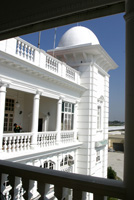
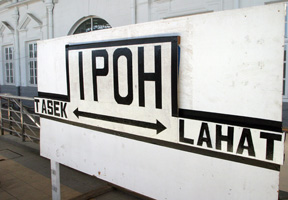
The old city, centred on the railway station is the best place to discover Ipoh historic and eclectic architecture. Ipoh Train Station is a wonderful colonial structure, known as the ‘Taj Mahal’ of northern Malaysia. Built in 1917 this grand edifice combines Moghul architecture with embellishments that were added later. Double tracking to Ipoh has necessitated the modernization of the station’s interior but the façade has been preserved and remains intact.
There’s an old hotel here that has seen better days but which will appeal to those interested in nostalgic charm. The Majestic Station Hotel Ipoh occupies the second and third floors with the Corridor Café on the third floor. Known in real estate parlance as a ‘renovator’s dream, the Majestic is in dire need of a make-over. However, one can just imagine this property with people lazing around its deep rattan chairs and sipping a Pimm’s No 1 Cup beneath slowly rotating fans.
Stand at one end of the hotel café and imagine the station in its heyday of the 1920s when train travel was the main mode of transportation in the peninsula. The station would have been the major hub in and out of the region and would have been brimming with travellers.
Travel writer Paul Theroux passed through here in the early 1970s and noted in his The Great Railway Bazaar: “It is the sort of hotel that has a skeleton in every closet and a register thick with the pseudonyms of adulterers.”
Train spotters should spend some time here taking in the ambience but they may have to wait a long time for that Pimm’s. Many of the station’s fixtures appear to date from this era. Rattan blinds hanging from the arches look a little dilapidated and the pressed iron ceiling is showing signs of wear and tear with fittings suspended above a motley collection of lounge furniture. Maybe one day someone will appreciate the heritage value of the hotel and renovate it into a truly great hotel.
Heritage Heartland
Ipoh Train Station overlooks Medan Stesen which is a pleasant gardened area and immediately beyond this is the all-white colonial-styled Town Hall. The Royal Ipoh Club is located just past the High Court on Jalan Panglima Bukit Gantang Wahab. Facing the padang, the sport fields and the black-and-white Tudor-style clubhouse resembles Kuala Lumpur’s Royal Selangor Club.
Opposite the Royal Ipoh Club, on Jalan S. P. Seenivasagam is the imposing three-storey St Michael’s School, a historical building of national significance. The school features decorated gables and wide arched verandahs along the length of the building. Next door is an Indian Mosque painted in emerald green with stark white trim. Nearby is the old FMS Bar painted in a vivid purple but sadly, looked permanently closed last time I visited. Continue along the eastern perimeter of the padang towards the stately, all-white HSBC building with its imposing columns. The area behind here was used as a backdrop for the 1992 French movie Indochine which attained notoriety as being awarded an Oscar for the Best Foreign Language Film in 1993. Malaysia’s first Oscar!
Getting There
Move visitors will drive to Ipoh along the North South Highway with the Simpang Pulai being the first of two exits into Ipoh. It’s a 200km journey or two hour’s drive from Kuala Lumpur. Another alternative is to catch one of several daily trains that make the journey. Despite the straight tracks, few stops and lack of traffic, the journey takes longer than driving. A pleasant days outing is to catch an early morning train to Ipoh, walk the historic centre, take refreshments in the Majestic Hotel and then return to Ipoh in the late afternoon by train.