| Malacca’s First Visitors By Mike Street |
||
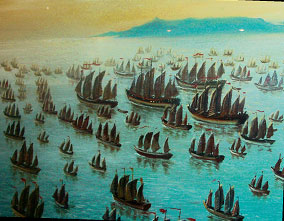
IT WAS 1405, on a spring dawn. Three short years after Parameswara founded his empire (where a mouse deer outwitted a dog), the Sultanate of Malacca was still in an unstable infancy. In the south, the expanding Majapahit Empire was a threat, as were the Siamese, who sought revenge for the death of their regent Temagi at Temasek (today’s Singapore). As day broke across Malacca’s natural harbour, an unspeakable dread must have swept over all on shore. Ships larger than anything afloat, as far as the eye could see, had arrived in the night. Hundreds of ships, a fleet crewed by over 27,000 men, silken sails set by a forest of teak masts across the horizon. Treasure ships, as much as 125m long and weighing 1,500 tons, securely guarded by five-masted Fuchuan warships and supported by a host of transports, supply ships, and patrol boats. The Chinese had arrived. Dread, however, soon must have turned to elation. The Chinese Admiral Zheng He (also known as Cheng Ho) hadn’t come to destroy the infant Sultanate, but to establish a secure and friendly base – a safe harbour to await the favourable monsoon winds on the long voyages to India and beyond. A deal was struck. Parameswara was presented with golden silk plait, lace veil, and an offer of protection from the Majapahit and the Siamese. No doubt awed and accepting, Parameswara agreed and set off with the fleet to meet the Chinese Emperor (Zhu Di, the Yongle Emperor). Meticulous record keepers, the Ming dynasty’s chronicles record that Parameswara graciously paid a traditional tributary (agate, pearls, coral, rhino horn, and other local items). In return, the Emperor proclaimed Parameswara as the king of Malacca and granted him the Imperial seal, assuring Malacca’s security for decades. Thus began Malacca’s entwined relationship with the Chinese. Admiral Zheng He and the Imperial fleet would return to the fledgling Sultanate on six more voyages, and by 1433 (Zheng He died on his seventh voyage) Malacca had grown to become a regional trading powerhouse. Settlers, mostly Chinese Muslims, had arrived with the Admiral, and by the time Hang Li Po and her 500 female attendants arrived in 1459, Bukit China was already an area of Chinese settlement. Were it not for an isolationist shift in China’s foreign policy after the Yongle Emperor’s death, Malacca might never have succumbed to Portuguese and later European influences. This is conjecture, of course, but can traces of Malacca’s first ‘tourists’ still be found today? You can start at Malacca’s waterfront, where Parameswara’s people first sighted the colossal fleet. There would’ve been ships as far as you can see across the Straits, with more teak than water in view, and except for the distant outline of an occasional supertanker, some of Zheng He’s ships were twice as big as those you see here today. Among the fleet were Japanese, Korean, and Muslim merchant junks and dhows that accompanied the Admiral on the long voyage to India and the Middle East. Even today, the fl eet would inspire a remarkable awe for anyone on shore (and perhaps for a moment, even an unspeakable dread). To see the fleet, however, you’d need to step back a fair distance from today’s shoreline – land reclamation projects have dramatically altered Malacca’s geography. Lunching on some ‘famous’ chicken rice balls at a shoreside café on a recent trip, I asked several Malaccans when the reclamations took place. No one was quite sure, but all agreed it was ‘decades and decades ago’. Bukit China (China Hill) is another obvious place to search for the original Chinese presence. As most historians agree, the main purpose of Zheng He’s voyages to the ‘ Great Western Ocean’ was to glorify the Emperor by means of trade, tribute, and influence. Settlement was one way to assure the Emperor’s influence, and settlers from Zheng He’s voyages were landed at Java and Sumatra, but in Malacca a Chinese settlement also assured a permanent base – essential for the long trips to and from India and the Middle East. Whether it was an agrarian settlement or military outpost is still undetermined. The basic topography of Bukit China likely hasn’t changed in the past 600 years, but its once lively settlement is now a Chinese cemetery – the largest outside of China. With some of the graves dating back to the Ming dynasty, it’s possible a few hold the remains of Zheng He’s less-fortunate crewmen. Most visitors today come to see the Chinese grave markers or the King’s Well (dug by Sultan Mansor Shah for Hang Li Po in 1459), but if you stare across the haze rising from the hill’s long grass, you might imagine daily life here in the early 1400s. At the base of Bukit China is Bao Shan Ting temple, named after a legendary fish that plugged a hole in the Admiral’s ship. In the courtyard you’ll fi nd a small statue of Zheng He; many visitors believe touching the statue’s head, chest and belly will bring good luck. Not much else remains of the Malacca from Zheng He’s time. The only traces of the prosperous guan chang (depot) that once networked most of the Asian continent are either buried or preserved in museums. Fortunately, Malacca is blessed with two such museums. The Stadthuys Museum Complex (beside the red Dutch Christ Church) has exhibits for all eras of Malacca’s history, including a sizable Zheng He display and an even larger Zheng He courtyard statue. You’ll see models of the Chinese fleet, displays of actual tin coins used during the time of Zheng He, as well as photos, drawings, and other interesting artefacts. Just off Jonkers Walk (on Lorong Hang Jebat) is the Cheng Ho Cultural Museum, which features an equally impressive exhibit dedicated to the Admiral, the fleet, and the early history of Malacca. Without these displays and their precious few artefacts, you might never know of Zheng He’s visits. Time seems to bury the past, and especially so in Malacca’s historical city. What wasn’t found was reclaimed or built over, with the Ming Chinese era obscured by Portuguese, Dutch, English, and always Malay influences. But even with these few artefacts, the grand scale of the Emperor’s past presence is obvious. The most significant Chinese relic in Malacca, however, is lost and will likely never be recovered. Brought to Malacca in 1409 by Zheng He and placed atop Bukit China, the Zheng Gou was an inscribed stone pillar that symbolized China’s protection of the young Sultanate. It reads: “All people of the hills and seas shall obey, as were the Imperial presence projected through thy skies. Hence a prosperous future will surely be observed. Blessings bestowed unto all thy flourishing generations.” |
||
|