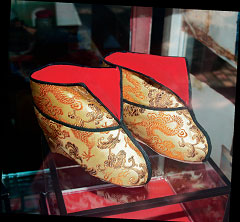
| Tiny Shoes for Golden Lilies By: David Lavoie |
||
He is intently focused as he follows a template bequeathed to him from generations past to cut a tiny leather sole. Before him on the scored work table is the ancient, partitioned wooden woolbox used by his grandfather when performing this same task, a part of the process of making three-inch-long shoes. The sole finished to his satisfaction, he begins carefully cutting the silken sides of each shoe. His name is Tony Yeo and he works with his brother, Raymond, the spokesman for the business, at a specialty shop called Wah Aik Shoemaker in Melaka. The two craftsmen, the last of their kind in Malaysia, are following thousand-year-old patterns to create shoes for women with bound feet. What is now a family business began with Yeo Eng Tong, Raymond and Tony’s grandfather, who arrived in what was then called Malaya from Hainin Province in China in the early 1900s. He settled in Melaka and opened a popular coffee shop, but soon he cannily recognised a niche market for these specialised shoes, a trade he had learned from a Hokkien shoemaker in the late 1800s, and which would provide employment income for his family for over a century. At that time many of the Chinese traders settling in Malaysia sought brides with bound feet from China and there were a number of such women in Melaka whose tiny bound feet were thought to be both elegant and erotic. Yeo Eng Tong’s business soon prospered with bound-feet women not only from Melaka, but also from Singapore and Kuala Lumpur, seeking out his shop. The practice of binding feet was finally banned in both China and Malaysia in 1911, but there were already a number of women with bound feet who continued to need the services provided by Yeo Eng Tong’s shop. Although officially illegal, footbinding continued long after its banning. In truth it did not completely disappear in rural China until quite a bit later, the last officially-recorded instance being in 1934. Since Malaysian Chinese did not practice foot-binding on their daughters, the business depended solely on immigrant women. Yeo Eng Tong bequeathed the business to his son, Yeo Sing Guat who, in turn, passed it on the Raymond and Tony Yeo. Although the business has stayed in the family, the clientele has changed. The last of the ladies with the “Golden Lilies”, as bound feet were called, is now gone, and the last factory making shoes for bound feet in China closed in the 1980s. But the shop remains, its clientele now tourists and visitors who buy the exquisite tiny shoes as an elegant piece of history. The practice of foot-binding appears to the modern sensibility to be inordinately cruel and painful. It is difficult, therefore, to believe not only that men encouraged it, but that many mothers imposed it on their daughters. In fact, many girls also asked to have their feet bound in the belief that it made them much more appealing and marriageable. Foot binding was the key to a good life and for many young girls it began as early as four to six years of age. Mothers would wrap silk bandages some twenty feet long tightly. around the small feet forcing all but the big toes under the soles of the feet. A large stone would often be placed on top of the foot to crush the arch. Eventually the toes were broken and the arches of the feet failed to grow and were pulled back toward the heels. The binding would be loosened only at night and then only temporarily. The stunted results were the “Golden Lilies” which made it difficult and painful for women to walk, but added to their mincing gait an alluring sway of the hips. An aside…it’s far too easy to condemn this practice as horrifying and barbaric unless one puts it in perspective. The experience of these Chinese women is little different from European women of the nineteenth century who achieved sexy “wasp waists” by having themselves painfully laced into whale-bone corsets, a fashion which sometimes resulted in damaged internal organs and broken ribs. And let’s not even talk about modern cosmetic surgery. Happily, foot-binding – like whale-bone corsets – has long since fallen out of fashion. The tiny shoes sold today are a curiosity and a reminder of what women once experienced in the pursuit of beauty. Raymond and Tony Yeo follow the traditional patterns taught to them by their father and grandfather. Each pair of shoes now takes a full day to make. The thin leather soles are added to colourful silk brocade tops in bright vibrant reds, emerald, turquoise and pink. A few are black with embroidered silver or gold decoration. All are lined with black velvet. Depending on the workmanship involved as well as the materials, a pair of shoes may cost between RM75 and RM250. Although these tiny shoes account for a large portion of the contemporary business, the brothers also hand-make full-sized beaded shoes and sandals. These lovely items are a little more expensive than the tiny shoes since each pair takes between three or four months to make, but they are sold as far away as Hong Kong and Japan, so don’t count on buying a pair off the shelf – they may not be there. Raymond Yee welcomes visitors to the shop and will happily show you about. Asked about the amazing popularity of his tiny shoes, Raymond likes to answer that people always want a piece of history and the shoes made by him and his brother are a part of that history. Wah Aik Shoemakers can now be found at No. 56 Jalan Tolong ( Temple Street) near one of Melaka’s most famous landmarks, Cheng Hoon Teng Temple. If you are interested in beaded shoes or sandals, you might try phoning the shop in advance at 06.284 9726 to check on availability. |
||
|