| Carcosa: A Colonial Gem By: Andrew Barber |
||
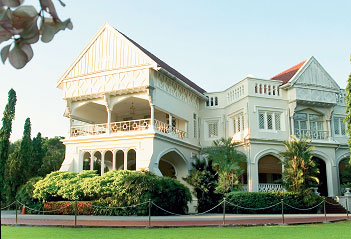
In 1896, Sir Frank Swettenham, Resident General of the newly created Federated Malay States, started the construction of Carcosa, his official state residence. Largely due to an influx of imported coolie workers drawn to work the Klang valley’s huge tin deposits, Kuala Lumpur was then a rough and ready frontier town, growing fast and primarily Chinese in character. Kuala Lumpur was, however, centrally located, of economic significance and was chosen as the site of government for the new Federated Malay States. Swettenham was determined to turn the city into a fitting symbol of British rule and the centerpiece of his plan was a majestic new official residence, designed to project a sense of grace, permanence and colonial authority. The site chosen for the residence was a prominent hill close to the Padang (today’s Merdeka Square) and near the meeting point of the two rivers, the Gombak and the Klang, that give Kuala Lumpur its name (in Malay, Kuala Lumpur means “muddy confl uence”). The Padang was the anchor of the city’s colonial growth. In 1887, St Mary’s Cathedral was built on its eastern flank. Serving the colonial need for more than purely religious sustenance, the Royal Selangor Club was already established, albeit a work in progress. On the opposite side of the Padang sat the then seat of colonial administration (the current High Court building), which was built in 1894 in a peculiarly “Moorish” style, including such flourishes as copper domes and external spiral stairways. (Kuala Lumpur’s other contribution to the unique colonial tropical-Moorish school of architecture, the city railway station, was built at the western end of the Padang, but was not completed until 1910). Between the Padang and Carcosa, the British sited their police and security barracks; Bukit Aman remains today the Federal Police headquarters. In looking for ideas for Carcosa, Swettenham did not turn to faux-Moorish inspiration, but rooted his building solidly in English traditions, albeit somewhat eclectic. The building itself is High Victorian, and would not look out of place as a industrial magnate’s hunting lodge on a Scottish grouse moor. The “villa” is complemented by a gable that is distinctly Elizabethan and an ornamental “medieval parapet” adorns several of its sides. The larger windows sport Anglo-Saxon cross lattices, topped off with lancet arches from the Regency period. Though something of a hodge podge, it works and the building has grace and balance. Swettenham’s greatest achievement was to offer a residence that was both domestic in scale but could also serve as a palpable symbol of colonial authority and power. He was helped in this regard by the site, a wooded hill overlooking the city and protected by forty acres of private, manicured, botanic gardens. The reason why Swettenham chose to name the building Carcosa is a little unclear. One theory states that it was inspired by a Gothic fantasy novel, “The King in Yellow”, published in 1895 by Robert W. Chambers, and set in the fictional city of Carcosa. Less prosaic, but probably more accurate, is the story that Swettenham simply liked the name, and that it is a construction from the Italian words “cara” and “cosa” meaning ‘desirable dwelling’. In 1913, the government constructed a sister property, the King’s House, which was a guest-house for the Governor of the Straits Settlements as well as other prominent guests of the Malay Federation. King’s House was later renamed “Seri Negara,” which means “Beautiful Country.” The history of Carcosa mirrors the ups and downs of colonial and post-colonial life. In the inter-war years, an invitation to Carcosa, for dinner or to a tea-party in the grounds, was the height of social ambition. It was the centre of a successful and wealthy colony. The British insisted that, where possible, colonies pay their own way. The wealthier and larger the colony, the greater the resources available to the colonial government. With tin and rubber backing the economy, Malaya was recognized as one of the gems of the empire and its civil servants knew it. But in 1941, the colonial deceits came crashing down as the Japanese decisively beat the British. During the Second World War, Carcosa was used as a Japanese officer’s mess and accommodation. In 1946, Carcosa reverted to the British. In the post-war years during the communist insurgency known as The Emergency, Carcosa was a heavily defended site. The British lost one Governor in a Communist ambush and were intent not to be embarrassed at the centre of their government. The days of gay tea parties had been replaced by barbed wire and revetments. Interestingly, with the end of The Emergency and on Malaysia’s independence in 1957, Carcosa did not go to the newly independent government. In September 1956, the Chief Minister of Malaya, Tunku Abdul Rahman, moved a resolution in the Federal Legislative Council that read, “this Council approves of the proposal to make a free gift of the house and buildings known as Carcosa, together with the gardens and land attached, as a token of the goodwill of the Malayan people to Her Majesty’s Government, for use as the residence and office of the future representative of that government in an Independent Federation.” Carcosa therefore stayed with the British government and housed successive British High Commissioners as a diplomatic residence. Inevitably, that such a prominent and resonant property should remain in British hands sparked resentment, and the Carcosa “issue” was taken up by young radical politicians, in particular one Anwar Ibrahim. Successive British High Commissioners committed themselves to “resolve” the Carcosa problem but, not altogether surprisingly, most were successful in maintaining their regal lifestyle while being forced to hand the “issue” to their successors. Finally in 1987, and much to the relief of the Foreign Office’s overseas estate office, for whom it was a bottomless pit, Carcosa was handed back to the Malaysian government. In 1989, after extensive refurbishment, its first official visitor was, appropriately, Her Majesty Queen Elizabeth II. Today, Carcosa is run as boutique hotel and restaurant and the Malaysian government uses it as a national guesthouse. In 1998, Queen Elizabeth returned once more to Carcosa while on a State Visit and for the opening of the Commonwealth Games. At the time, Carcosa’s then General Manager noted to the author that, previous to the Queen, Chairman Yasser Arafat had slept in the “royal bed”; though whether the General Manager had mentioned this to the Queen is unknown. What certainly isn’t in doubt, however, is that no matter what purpose the building serves in future years, it will always exist as a monument of Malaysia’s colonial past and Swettenham’s vision to have a haven that is part but distant from the city. |
||
|