The For 15 years Dato' Faridah Merican and her husband, Joe Hasham, have worked together to build up a Malaysian theatre community. The original Actors Studio was tiny, much longer than it was wide and buried under the world's tallest flagpole in Kuala Lumpur’s Dataran Merdeka. Rows were narrow, the ceiling low, and the hard chairs had little Actor’s Studio cushions on them. The cushions seemed to cry out, ‘we know it isn’t much, but we’re doing all we can’.
One of the things I missed when I moved to Malaysia was easy access to the arts. I saw my first of many Malaysian plays in that little theatre. Since theatre had seemed so conspicuously absent in Malaysia, I was as surprised as I was delighted by the high caliber of writing, acting and directing.
Faridah and Joe's little project grew. There was a miniscule cafe with a library, which included scripts by local writers. There was The Box, a theatre even smaller than the main one where the audience sat on tall wooden bleachers.
The Box was a space for new Malaysian talent to practice, learn and show. This was a young person's space, where some of the deepest, most insightful works took place.
Then in 2003 the rains came and they brought Malaysia's capital city to a standstill. People were stranded, there was millions of ringgit worth of damage caused to buildings and property across the city. For many, 2003 was the year the floods destroyed the Actors Studio.
The Building
“Losing the Actor’s Studio was like losing a child,” says Faridah, however, they put aside their grief and went to work finding a new place. They rallied support, got corporations and the public involved and so the Kuala Lumpur Centre of Performing Arts, or KLPac, was born.
Sentul West is an amazing little oasis of green in the middle of the city. During colonial times, this housed one of the region’s most sophisticated railway depot and workshops. This has now become the Actors Studio’s new home.
Instructions to the architect were specific. The design had to be functional, aesthetic and cost saving. KLPac was to look and feel welcoming and inspirational, a space that was both public and yet allowed residents and visitors to claim it as their own. It was to break down the barriers that traditionally exist between performers, crew, administrative staff and audience.
KLPac, finally opened its doors in 2006 and it is a testament to beauty and ingenuity. The front is glass and extends outwards. During the daytime sunlight keeps the electrical bills low. During the night, the building glows. Much of the original warehouse has been kept, much of the material has been recycled. The back and side walls are the original English bond brickwork. The metal roof has been retained, as has the cement floor.
In through the front doors, you walk into an enormous, open space. To your right is the Curtain Call Café with a lovely view of the lake. Look up to the second floor and sharing the space is the administrative area. In front of you, small in this huge hallway, is a grand piano. Deeper in, is the art gallery, resource center. KLPac has managed to give everything its own space without dividing walls.
Although the inside of KLPac has a definite industrial feel to it, it is impossible to mistake it for anything than it is; a place that celebrates creativity and creation.
Set production workshops are usually hidden inside a building. KLPac’s is at the front. Better than any marquee, the workshop is the first bit of the theatre world visitors notice upon approaching the building.
Besides its theatres and exhibition areas, KLPac has 10 studios of varying sizes where rehearsals and classes are held. Again there is transparency with glass windows that bring yet another aspect of performance closer to the visitors.
The People
Helena Foo graduated from college a few years ago. “I was one of four people at my college that year to get a diploma in performing arts.” Joe Hasham took her under his wing and she is now the resident director.
I take up way more time than I should talking to Mark Beau de Silva, whose career I’ve been following for years. This brilliant young playwright conducts writing workshops and writes several plays a year, all of them insightful, entertaining, exciting, often both painful and funny. He gets a lot of his material from inviting sidelined communities to come in and talk. He, like playwrights all over the world, tells the stories of individuals ignored by the mainstream.
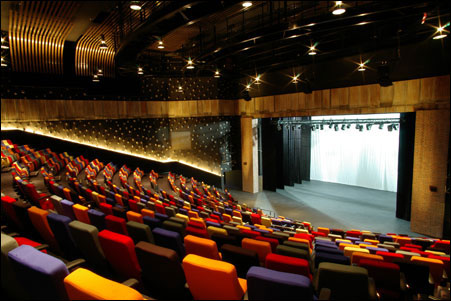
Theatre manager Ian Chow gives me a tour of KLPac. He is enthusiastic, almost reverent when he talks about the centre. He tells me about Pentas 1 (‘Pentas’ is the Bahasa word for ‘stage’). Everyone stops short the first time they enter this 500-seat theatre. It’s the chairs. They are in alternate colours – orange, blue, red, green, black.
“It’s a visual trick,” explains Ian. “Even if there are empty seats, there are no empty-looking spaces. To the audience and performers, it always looks like a full house.”
The Arts
Dance, drama, music, comedy acts, children’s theatre, exhibitions, festivals, film screenings – there is always something going on at KLPac.
Many of the shows display local talent. Many more are collaborations with theatre groups from around the world. The British Council, the Japan Foundation and the cultural sections of many foreign missions (April is Australian Month at KLPac) share their own culture by bringing in performers from their countries. I recently attended one of three sold-out shows of the outrageous Japanese all-male dance troupe, The Condors.
What’s more anyone can participate. KLPac offers courses for children, teenagers and adults in nearly everything pertaining to the performance arts.
The Need
If there is a downside to the success of the shows, it is the perception that financially, KLPac is doing well.
“Most people don’t know we are a non-profit,” says Faridah. “We need public and corporate support to survive. We don’t get any other help. Corporate bodies don’t feel that the arts are a worthwhile cause. When we need money, Joe and I go out and get jobs. We bring the money back here.”
Cost savings have been implemented so intelligently and artistically that you would think they for purely aesthetic reasons. Much of what is in and around KLPac make use of raw, unfinished materials. The seats outside are sculpted out of wire and the wooden floor is made of old railway sleepers. A curtain of climbing plants a few feet away from the windows serves as natural protection from the sun.
How to Help:
Go to a show
Especially one written and performed by locals. How well do you really know Malaysia? The arts express and reflect a nation. What better way to really understand a country’s soul than to listen to its people speak?
Hire the place
For functions, weddings, showings, classes. The Curtain Call Café is actually a very nice, table-clothed restaurant. There are the theatres, 10 classrooms which hold between 3-40 people. They have gallery space and IndiCine, a little cinema, all available for hire.
Attend a class
There are always classes for adults and children going on at KLPac, with longer workshops during school holidays.
Donate stuff
Books go to the library, old cereal boxes are used in kids workshops, and nearly everything else – from old spectacles to furniture – can be used as props. Of course, money is always needed and appreciated.
Become a friend
For RM100 (RM30 for students, RM5,000 for corporations) you become a friend of KLPac.
Spread the word
The toughest thing for many KLPac virgins is finding the place. Faridah has been working on getting directional signs but so far, no go. The first time you go there study a map, get good directions or follow a friend there. Go early. The first few times are a little tough but it’s worth becoming an old hand.
For more information on the latest events and a map, visit www.klpac.org.


