| You Can’t Fake the Charm By: Aida Ahmad |
||
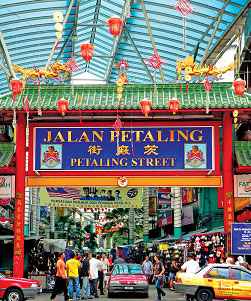
The sun is shining mercilessly down the alley of this bargain hunter’s paradise, unfettered by the huge stall umbrellas that look like colourful mushrooms from above. Voices of over-zealous traders selling their goods at “unbeatable” prices coupled with the determined haggling of their customers fill the air. It is a hive of activity here at Petaling Street . This is Chinatown deep in the hustle and bustle of Kuala Lumpur. The Malaysian Chinese community call it Chi Cheong Kai, meaning ‘starch factory street’ in Cantonese. Infamous for pirated clothes and accessories along with bootleg DVDs and CDs, the enclave of Petaling Street is abundant with small shops and stalls offering a multitude of imitation branded goods from Rolex to Louis Vuitton. The original Chinatown centred on Market Square. High Street, now known as Jalan Tun H.S. Lee, became increasingly popular as it was higher than the rest of the town and therefore less prone to floods. The wealthier and more ornate shop houses were built north of Jalan Cheng Lock, closer to the business centre. Kuala Lumpur was a typical “pioneer” town at the turn of the century, filled with a rough and tough population that was largely male. They were mostly Cantonese and Hakkas who came to the city because of the tin trade, worked as coolies in the mines and were governed by a Chinese Kapitan or headman. The most famous Chinese Kapitan is Yap Ah Loy, a Hakka. In 1870, civil war erupted and the Chinese community was split along partisan lines into the Cantonese Ghee Hin and the Hakka Hai San secret societies. The British were called in to help end the strife but many of the buildings in the settlement were burnt down or severely damaged. During the Selangor Civil War, the tin mines were abandoned. When the miners returned after the war, they found that the mines were flooded making it impossible for them to work. Yap Ah Loy persuaded the miners and coolies to remain in Kuala Lumpur, encouraging them to grow rice and other garden produce. He opened a Tapioca Mill in Petaling Street where the tubers from these farms were ground into flour. Located inside Petaling Street are business hotels and hostels such as Army Hostel, Hotel Malaya and Swiss Inn Hotel as well as the no-frills abode, Stayorange Hotel. Historical architecture also flanks Petaling Street – look out for the nearby Masjid Jamek, an old mosque of Moorish architecture. A famous tourist spot known as Central Market is within walking distance while one of the most famous landmarks, the Sri Mahamariamman Temple is located along Jalan Tun H.S. Lee – one of KL’s oldest and richest Hindu temples. In 2003, the road underwent a major RM11.3million facelift with two large Chinese arches placed at both ends of the street to welcome visitors. It still pulls in many tourists interested in architecture, counterfeit branded products and truly delicious Chinese cuisine. If you’re a foodie, you’ll definitely be feeling a bit peckish after all that walking and, of course, haggling. Within the busy tourist stalls of Petaling Street, you’ll discover two stalls which have been trading for more than 30 years in front of Madras Lane market selling Assam Laksa, Curry Laksa and Sotong Kangkung. Fear not, plenty of tables and chairs are placed at the entrance of the wet market and the side walkway of the shop next to the market. Although it is only available from the evening onwards, this is a popular stopover for people who work around the area before they head home. If you’re up for a feed, their Sotong Kangkung (blanched brown calamari and cooked spinach drenched in a black sauce with hints of sugar, prawn paste and sprinkled with a generous helping of ground peanuts) is a must-try. It may no longer be the smartest road in KL but with so much to offer, the one thing on Petaling Street that will never be counterfeit is its magic. |
||
|