| Kedah’s Mountain Beacon | ||
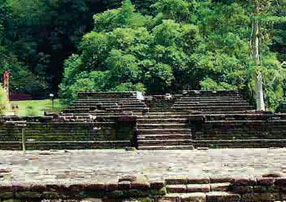
From ancient times, Gunung Jerai has been an important landmark for seafarers entering the Straits of Malacca from the Bay of Bengal. Standing at the mouth of the Merbok River, 25 miles to the north of George Town, the mountain beckoned travellers and traders to the settlements at its base. Sanskrit inscriptions on stones discovered in this area indicate that south Kedah was home to a rich civilization with extensive trade and communications links to the world beyond. The first of these antiquities was found in south Kedah by Colonel James Low of the East India Company in the 1840s. From the mid- 19th century other British explorers, as well as archeologists, began discovering temple ruins in the Bujang Valley on the southern fl ank of Kedah Peak. These ruins date from the pre-Islamic period of Hindu-Buddhist influence from about 500 AD to 1300 AD. In recent years many of the temple ruins have been excavated and moved for their preservation to a single site in the Bujang Valley where the Malaysian Museums Department has established an archeological park and an excellent museum, one of the best in the country. The park, about 16 kilometres from Sungai Petani, is centred on the site of the largest and best preserved of these temples, Candi Bukit Batu Pahat (“The Temple on the Hill of Cut Stone”), an 11th century stone temple, which like the others has been partially restored. (Candi, pronounced “chandi”, means temple or shrine.) Candi Bukit Batu Pahat dates from the period when Kedah was under the influence of the Chola kingdom of South India. What the visitor sees, however, are not massive temples like Angkor or Borobudur with their intricate friezes and carvings, but stone or brick bases on which wooden structures with multi-tiered thatched roofs were probably mounted, perhaps like the Hindu temples of Bali. In the nearby river can be seen the huge rocks from which ancient masons cut the stones to build these temples. The museum itself displays a vast array of antiquities – stone carvings, pottery, religious artifacts – discovered in the area, including relics from a temple site on the summit of Gunung Jerai which is thought to date from the 7th century. From the Bujang Valley Archeology Museum the main road goes west to the coast and round the mountain to Yan Besar and Yan Kecil on its northern side. A side road leads to a waterfall park at Seri Perigi from where intrepid climbers can brave the leeches and make a gruelling hike 3,300 feet to the mountain’s secondary summit. Alternatively, further to the east at Guar Chempedak there is a 13 kilometre paved road to the top, ascending through vegetation ever changing with the altitude and past a Forestry Museum. From a plateau at the secondary summit the view north along the Kedah coast and across the Kedah plain is outstanding, changing from green to gold with the paddy seasons. A small hotel with chalets, based on what was formerly a colonial government bungalow, caters to local tourists. Access to Gunung Jerai’s uppermost peak, however, is restricted because of telecommunications towers on the summit. Kedah Peak was also the scene of dramatic events in the early days of the Malayan Emergency, the communist insurrection of 1948-1960. However, peace now reigns on the jungle slopes of Gunung Jerai, broken only by the cries of the occasional gibbon or the chatter of bands of dusky leaf monkeys high in the forest canopy. The mountain remains a forest reserve protected from the bulldozers of developers. Away from the bustle of town and highway the temple sites of the Bujang Valley remind the visitor, however, that humankind has been drawn to the sanctity of this mountain for generations, first to erect shrines for worship and now to contemplate the past and the beauties of nature. |
||
|