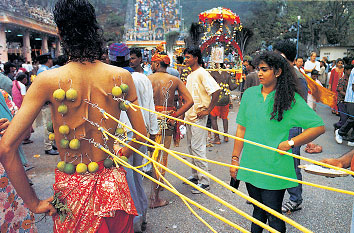
| The Batu Caves: Tolerance, Penance and Pain. By Aida Ahmad |
||
Every year, Malaysia’s Indian Tamils unite to mark Thaipusam, a Hindu festival. It is celebrated on the full moon of the tenth Tamil month of Thai (February) when the constellation of Pusam, the star of well being, rises over the eastern horizon. Thaipusam observes the birthday of Lord Murugan, the youngest son of Shiva and Parvati, and when Parvati presented Murugan with a vel (lance) to enable him to vanquish the demon Soorapadman. Prior to this holy day, devotees go through a cleansing ritual of prayers and fasting, and on the day itself, undergo a ritual of shaving their heads for a pilgrimage along a designated route carrying different types of Kavadi (burdens). Not all, especially women, are compelled to endure self inflicted pain - a simple task of carrying pots of milk can symbolise an act of devotion and penance. Amazing levels of endurance and tolerance are demonstrated during the astonishing vel kavadi, when a moveable two-metre altar, colourfully decorated with peacock feathers and other ornaments, are attached to devotees by over one hundred vels, steel rods some of which are a metre long, hooked on to the chest and back. It is a wonder how they withstand the pain of these piercings – at the touch of a vel, they enter into a trance whereupon they do not feel any pain, and rarely shed even a drop of blood. And there are no scars left after. Others show penance by walking over hot charcoals on bare feet. In Malaysia, the largest gathering – over a million devotees participate every year – takes place at a temple in the famous limestone Batu Caves of Selangor. Thousands of tourists also attend to view and record this spectacular and extraordinary procession, which starts at the Maha Mariamman Temple in KL and continues all the way for thirteen kilometres to the Caves. Once there, devotees endure another incredible eight-hour hike up the 272 steps to the top. The site has been known to the ‘Orang Asli’ (local aboriginal tribes called Jakun, Besisi and Sakai), since prehistoric times, but it was only after its discovery in 1878 by William Hornaday, an American Naturalist, that they became a famous landmark. The first cave temple was built in 1891, followed by wooden steps up to the Temple Cave in 1920. The largest and most famous cave is the Temple or Cathedral Cave, so-called because it encompasses many Hindu shrines under its 100-metre vaulted ceiling. There is a 42.7m high statue of Lord Murugan which was unveiled in Jan 2006 and took three years to build. Thaipusam can also be seen as a day which brings together other races in Malaysia as some of them, especially the Chinese, can be seen carrying the “kavadi”. Westerners and other foreigners have also been known to take part in this ritual, some having made a pact with Lord Murugan which they then honour on this holy day. Five states observe Thaipusam as a holiday – Johor, Negeri Sembilan, Perak, Penang and Selangor. In Penang, the festival is celebrated on a very large scale at the famous Sri Mariamman Temple in Jalan Waterfall, the oldest Hindu Temple in Penang.
|
||
|