 Wild Borneo
By David Bodwen
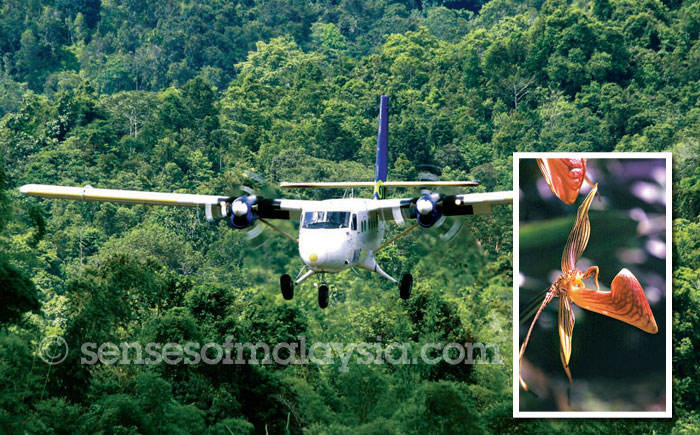
THE ISLAND OF BORNEO HOLDS MANY NATURAL TREASURES FOR THOSE ADVENTUROUS ENOUGH TO LEAVE THE CITIES FOR THE WILDS OF THE FORESTS, AND DAVID BOWDEN OFFERS HIS ADVICE TO THOSE KEEN TO VISIT.
For many, the island of Borneo is one blanketed in
impenetrable tropical forests which are home to many
weird and wonderful plants and animals, or one where
tribes of colourful natives would lop the heads off anyone
who looked at them the wrong way.The historic accounts
of adventurous exploration through Borneo still influence
the way many view the island. While there are still remote
parts of Borneo where elements of these romantic notions
still exist (minus the headhunters, who have long given up
the tendency to collect a memento of their enemies), the
world's third-largest island is, today, much more accessible, and much friendlier to
contemporary travellers than many realise.
Sabah and neighbouring Sarawak are the two East Malaysian states on Borneo,
with the sultanate of Brunei and Indonesian Kalimantan completing the territorial
configuration.While many hardcore adventurous activities are possible in the
wilds of Borneo, there are also various "soft" options for those who appreciate
their creature comforts. With so many natural attractions on offer, travellers need
to focus on specific parts of the island depending on their interests. Indonesian
Kalimantan, for example, is vast and less accessible than Sabah and Sarawak,
appealing to those who really want to get off the beaten track.
The interior of Sabah is still remote, as most of the state's settlements cling to the
coast around the capital of Kota Kinabalu and the former capital, Sandakan.While
many survive the tropical heat and humidity with air-conditioned buildings, the
climate becomes most apparent when outdoor adventures are undertaken. Despite
the cooling mountainous peaks and the surrounding, refreshing waters of parts
of Borneo, most adventures to be had are hot and sweaty activities. Visitors need
to moderate the way they respond to them by wearing protective clothing and
drinking lots of fluids. Bearing all this in mind, here are six wild
places in Sarawak and Sabah to explore.
THE CALL OF THE MOUNTAIN
 Mount Kinabalu towers over Sabah and is
frequently visible from destinations as
far away as Kota Kinabalu, 90km to the
west. At 4,101m tall, Kinabalu is often
mistakenly referred to as Southeast
Asia's highest mountain, but peaks such
as Hkakabo Razi in Myanmar (5,881m)
and Puncak Yunin in Papua, Indonesia
(4,595m) easily surpass it.
Mount Kinabalu towers over Sabah and is
frequently visible from destinations as
far away as Kota Kinabalu, 90km to the
west. At 4,101m tall, Kinabalu is often
mistakenly referred to as Southeast
Asia's highest mountain, but peaks such
as Hkakabo Razi in Myanmar (5,881m)
and Puncak Yunin in Papua, Indonesia
(4,595m) easily surpass it.
Don't be fooled, though, Mount
Kinabalu is still one heck of a climb.
Conquering the mountain has long
challenged those with an adventurous
spirit, and card carrying members of
the lunatic fringe run the 20km to
the summit and back in under three
hours during the annual October
Climbathon, while mere mortals opt
to take two days covering the distance.
In 2000, Kinabalu Park became the
first Malaysian site to be inscribed on
the UNESCO World Heritage List. This
inclusion was recognition of the park
being one of the world's most biologically
diverse areas, providing a habitat for
plants that cannot be found anywhere
else in the world. The rare slipper orchid,
Paphiopedilum rothschildianum, is one such
example, while the world's largest flower,
the Rafflesia - one of the most unusual
plants known to biology, with flowers
growing up to a metre in diameter - also
calls Kinabalu Park its home.
While the mountain ascent requires no
special abilities apart from endurance
and good health, it's no walk in the park.
Most climbers arrive in the park the
night before to complete paperwork and
arrange for a guide. (All climbers must
be authorised, insured, registered, and
guided.)
Most climbers will take two days to
conquer the peak, spending a night at
Laban Rata located a challenging, fivehour
walk from the park headquarters.
Climbers crawl from their beds in the
darkness of the next morning to make
the ascent to the Low's Peak summit in
time for sunrise. Packages covering meals,
guide, and accommodation at the halfway
stop of Laban Rata are available from
Sutera Sanctuary Lodges.
GOING APE IN SANDAKAN
Although destroyed by Allied bombs in
WWII, Sandakan was rebuilt and is now
a hub for travellers who want to get close
to nature. Most travel to Sandakan to see
the orang utans at Sepilok Rehabilitation
Centre, located on the city's outskirts.
This centre was established in 1964 to
rehabilitate captive or orphaned orang
utans, and there are visitor viewing
platforms to observe the animals learning
to feed themselves.
Sandakan is a pleasant city, with an
essential stop being the English Tea House
and Restaurant (www.englishteahouse.org), which could easily be the setting
for a Somerset Maugham novel. Diners can reminisce about the colonial past
while dining or enjoying delicious
scones, cream, and jam for morning and
afternoon tea.
TAKE ME TO THE RIVER
There are other "soft" adventures
located around Sandakan, and the Lower
Kinabatangan River, centred on the village
of Sukau, is just two hour's drive away.
The Lower Kinabatangan is Malaysia's
largest, forest-covered floodplain and
eco-activities can be found along the
Menanggul River.
Wildlife concentrations here are some
of Malaysia's highest, with the main
attraction being the proboscis monkeys
and orang utans that live in the forests
beside the narrow river. From the comfort
of small boats, visitors can observe
the monkeys swinging from branch to
branch. Found only on Borneo, proboscis
monkeys are identifiable by their large
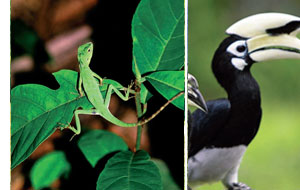
red noses. The forests are also a haven
for other monkeys, macaques, gibbons,
crocodiles, civet cats, and an extensive
bird population including hornbills.
TO THE BAT CAVE
 Mount Mulu National Park is one of
three Malaysian UNESCO World Heritage
Sites, selected for its astonishing caves
and limestone formations that include
stalactites and stalagmites. The list of
superlatives is as large as some of the
caves, with the four main ones being the
Deer, Lang, Clearwater, and Wind Caves.
The Deer Cave is the largest passage in
the world, while the Sarawak Chamber is
the world's largest chamber.
Mount Mulu National Park is one of
three Malaysian UNESCO World Heritage
Sites, selected for its astonishing caves
and limestone formations that include
stalactites and stalagmites. The list of
superlatives is as large as some of the
caves, with the four main ones being the
Deer, Lang, Clearwater, and Wind Caves.
The Deer Cave is the largest passage in
the world, while the Sarawak Chamber is
the world's largest chamber.
Boardwalks traverse the various cave
floors; this is for the best, as the ground
is an oozing mass of insects consuming
mounds of guano (bat droppings). Most
evenings, millions of bats fly from the
cave entrances over a period of hours to
create one of Malaysia's most stunning,
yet little-known natural spectacles. Boats
are used to reach some of the caves and
several other park attractions.
WALKING THE TALK
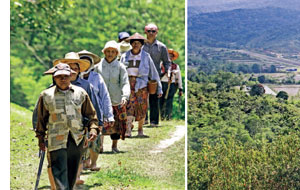
Ba'Kelalan is a remote community in the
Sarawak interior located near the border
with Indonesian Kalimantan. The people
here were once fierce headhunters before
Christian missionaries put a stop to their
wild ways. People here talk about walking,
but discussions are peppered with how
many days it takes to access various
destinations. Considering that much of the surrounding countryside is tropical
rainforest with undulating buttress roots
and rapidly flowing rivers, the difficulty in
moving around is significant. The nearest
main town is Lawas, a five hour's drive
away along a rugged 125-km logging trail.
Walking is the main activity for most
adventurous visitors, and being 1,000m
above sea level means it is a little cooler
than the lowlands. There are nine ricegrowing
communities in the valley, and
to walk to all takes a full day. Another
pleasant walk is to head up the hill
opposite the tiny airport to a viewpoint
above the flight path of the airport.
Watching aircraft landing in the valley
below offers the unusual perspective of
being above the planes as they land.
Keen walkers may want to consider
walking to other destinations such as the
Kalimantan border or Bario in the Kelabit
Highland. (From Bario, it's possible to fly
back to Miri.) Another possibility, with the
assistance of local guides, is to attempt
an ascent on Gunung Murud; Sarawak's
highest peak at 2,423m.
The Lun Bawang villagers are happy for
visitors to observe their daily routine of
growing rice (highland rice is known as
adan or Bario rice, and is highly prized
for its fragrance) and vegetables, hunting,
raising livestock, producing salt, and
making handicrafts. Being so isolated,
the residents are resourceful, finding
materials in the forest (such as bamboo) to
craft utilitarian items. Apple Lodge is the
best accommodation option and provides
comfortable beds, electricity (generated
by a micro hydro plant), solar-heated hot
water, and great local food.
This community of 1,500 people can be
reached by a one hour flight from Miri on
a 19-seater MASWings Twin Otter.When a
plane lands it can get downright hectic, as
most of the villagers come out to welcome
visitors.
BACK TO BAKO
Adventures in Borneo need not only be in
remote places. Bako National Park is one
of Sarawak's most accessible parks thanks
to being just one hour by road and boat
from the capital Kuching. (Boats depart
from Kampung Bako for the 20-minute
journey into the park.)
Bako is one of the state's most biologically
significant national parks despite,
compared to most parks in Sarawak and
Southeast Asia, being quite small (just
2,742ha). Despite its size, the park has
fascinated conservationists, naturalists,
and botanists for years thanks to its
ecological diversity.
Probably Bako's most unusual attribute
is its varied vegetation communities,
where examples of most major plant
communities from Borneo are found.
It is a miniature botanical garden for
those interested in discovering some of
Malaysia's bizarre botany.
These plant communities range from
mangrove, peat swamp, and heath
to mixed dipterocarp forests. On the
plateaus, the vegetation changes to a
heath-like scrub called kerangas. For
an island best known for its dense
rainforests, kerangas forests are dry, low
in height, and with an open canopy. Here
there are many varieties of carnivorous
flowers such as pitcher plants and
sundews. An extensive array of orchids is
also on display, though they may not be
that obvious.
Bako's picturesque coastline is lined with
sandstone cliffs, rocky headlands, and
sandy beaches. These beaches are popular
for weekend visitors who come to swim
in the warm shallow waters. Millions
of years of erosion have sculpted many
unique formations such as sea arches
and stone stacks situated off the coast.
Traces of iron minerals in the parent rock
have produced layers of hardened pink
ironstone. The sandstone also displays
unusual honeycomb weathering that gives the rock its unique texture and
appearance.
Observant nature lovers may spot
silvered leaf monkeys, long-tailed
macaques, bearded pigs, squirrels, and
mouse deer in the vegetation found
throughout Bako. The rare proboscis
monkey lives in the river mangroves,
especially around Telok Paku, Telok
Delima, and Ulu Assam. Bako is one of
the few places in the world where the
proboscis monkey can be easily seen.
Walking one of the sixteen trails is
probably the most popular activity for
park visitors, and the trails are colourcoded,
taking between two hours and two
days to complete. In all, there are about
30km of well-signposted trails, and those
planning to walk all need to allocate a
few days in the park. The park authorities
have excellent pamphlets and maps to
ensure visitors get to where they want
to and can learn about the vegetation
along the way. Some destinations are also
accessible by boat, or by a combination of
walking and boating.
The beach at the park headquarters at
Teluk Assam is safe for swimming as it
has a long shallow tidal range. The shaded
casaurina trees lining the beach are a
popular place to retreat from the sun.
TRAVEL PLANNER GETTING THERE
There are several gateway airports to
Borneo, with the mains ones being
Sabah (Kota Kinabalu, Sandakan
and Tawau), Sarawak (Kuching,
Miri, Bintulu and Sibu), Indonesian
Kalimantan (Balikpapan), and Brunei
(Bandar Seri Begawan).
ACCOMMODATION
Accommodation on Borneo can
range from simple park chalets to
luxury resorts. Park accommodation
is mostly in basic but comfortable
lodges. Accommodation in some
Sabah parks has been privatised
and is managed by Sutera Sanctuary
Lodges (www.suterasanctuarylodges. com.my).
CONTACTS
Brunei Tourism (www.bruneitourism.com), Forest Department Sarawak
(www.forestry.sarawak.gov.my),
Indonesian Tourism
(www.indonesia-tourism.com), Sabah
Parks (www.sabahparks.org.my),
Sabah Tourism (www.sabahtourism.
com), and Sarawak Tourism
(www.sarawaktourism.com).
David Bowden is the author of
Enchanting Borneo (see page 36)
distributed by John Beaufoy Publishing,
UK and sold in all good bookshops.


