 Where the Monkeys Come to Drink
By Frances Wilks
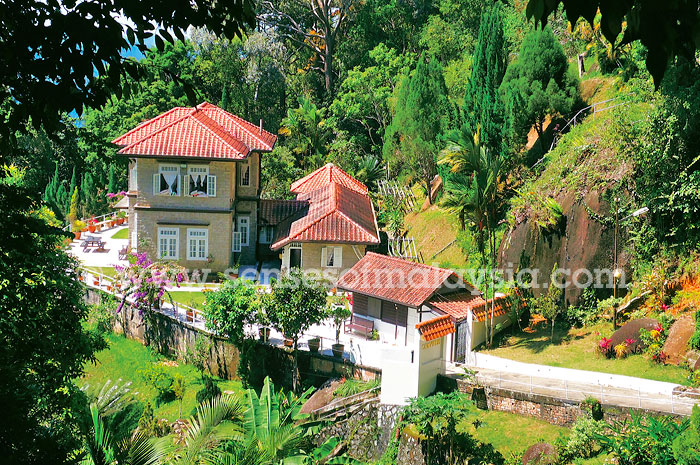
TOURISTS TEND TO FLOCK TO PENANG HILL FOR THE VIEW AND THE COOLER TEMPERATURES BUT, AS FRANCES WILKS
DISCOVERS, THIS COLLECTION OF HILLS HAS A HERITAGE GOING BACK A QUARTER OF A MILLENNIUM TO THE EARLIEST EXPATS AND THE FOUNDING OF PENANG.
Penang Hill, or Bukit Bendera (Flagstaff Hill) to give it its correct name, is the oldest hill station in Malaysia. Not only that, it actually has a Hill Station, the terminus of the exciting ride to the summit by rack-and-pinion railway, now nearly a hundred years old. Recently restored and carrying a super-fast train, it's capable of ferrying passengers to the top in five minutes at peak times, although it usually takes a more leisurely fifteen minutes.
The older train, originally with wooden carriages (the modern one has red and white metal ones) was even more laid-back. The journey took half an hour and required a change of trains at Middle Station, half way up. With more sophisticated cable technology, the two tracks have been made into one and Middle Station has been closed to all, except residents. It is possible, however, to alight at some of the other halts, such as Claremont, Moniot Road, or Upper Tunnel Station, by arrangement with the driver. They make great starting points for rambling along some of the many trails of Penang Hill.
HILLY HISTORY
 In Colonial days, hill stations were an important feature of expatriate life, as the great heat of the tropics, mitigated by neither electric fans nor air-conditioners, sapped the health of the settlers, who then required periodic escapes to cooler air for restoration. Although Penang Hill lacks the vice-regal majesty of Simla in Himalayan India or the cosy mock Tudor of Nuwara Eliya, the capital of Sri Lanka's tea plantations, it nevertheless has its own considerable charms.
Many bungalows - most with British- sounding names such as Edgecliff, Richmond, Fairmount and Southview - were built on the summit of Penang Hill to provide government servants and army officers with a change of scene. The most famous of these, Convalescent, now in a state of magnificent disrepair, is said to have housed soldiers convalescing from the Crimean War, who were brought to Penang from the Black Sea via the newly opened Suez Canal. As the Crimean War took place in the 1850s and the Suez Canal only opened in 1867, it is an unlikely but rather charming fable.
It is known for sure, however, that the founder of Penang, Francis Light, built himself a house on one of the peaks of the hill, now called Strawberry Hill on account of the strawberry plantation he created there. In those days, people travelled up and down the hill on foot or were carried in sedan chairs. After a while, Light gave Strawberry Hill to his good friend, David Brown, and moved to a nearby peak, Government Hill, where he built a magnificent house, Bel Retiro, now the Governor of Penang's retreat.
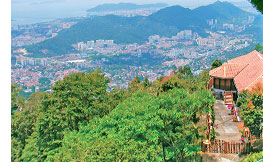
Although David Brown's house burnt down in the 19th century, the reconstruction which now houses a restaurant of the same name is said to be a close copy of it, lacking only the magnificent Anglo-Indian portico of the original. You can enjoy a quiet lunch in the garden or cocktails on the newly opened terrace, both of which boast amazing views of George Town and the Straits beyond. On a clear day you can see the entire length of the Penang Bridge snaking across the water and the foothills of the great chain of mountains which stretch down Peninsular Malaysia on the mainland.
KING OF THE HILL
I was met at the summit by Bukit Rajah, or the King of the Hill.
"Welcome to the many hills of Penang Hill," he said.
"I will show you Strawberry Hill, Halliburton Hill, Gun Hill and Crag Hill."
This was actually the second time I encountered Bukit Rajah. The first time I met him, some years ago, he was stripped to the waist and officiating in
a Hindi ceremony (the semi-nakedness is an act of homage for Hindu men) at the temple at the top of Gun Hill where he is the priest. Today he was dressed
in the crisp khakis of a hill guide. He pointed out the post office and the police station "left to us by the former British administration." There is also a modern food court and an owl museum, and the old wooden train is on display, although you can see another one of the same vintage in the Penang Museum.
MONKEY CUP GARDEN
 We walked the two kilometres to the Monkey Cup Garden over excellent tarred roads in the cool air. (N.B. Watch out for the golf buggies which ply the route for those unable or unwilling to walk, as the drivers haven't quite mastered the art of giving way to pedestrians.) The route passes many of the older bungalows, some of which are now in private ownership and well-restored. Look out for an old red pillar-box, with the initials VR, which was rescued from George Town by the Residents of Penang Hill, restored, and given a new home.
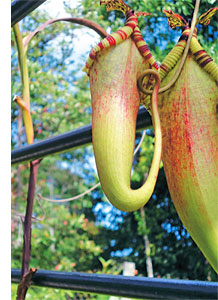
The Monkey Cup Garden has many species of the strangely shaped carnivorous plant that traps insects, which are then devoured. Technically known as nepenthes, the plants are called "monkey cups" because rain water collects in the pitchers that grow at the end of their leaves and monkeys are known to drink from them. It's a tranquil garden which attempts to recreate the shady, mossy environment in which monkey cups grow best. Bukit Rajah did confide that one visitor had complained that there were no actual monkeys! Beyond the garden, there are walks to further hills - Tiger Hill and Western Hill for the adventurous.
TIME FOR A REST
If you enjoy nature you may want to visit the Bellevue Hotel on Halliburton Hill, a stone's throw from Strawberry Hill. The hotel has the feeling of an old colonial rest house; unpretentious and slightly shabby, but very welcoming. Its eleven rooms currently offer the only overnight accommodation on the hill. The owner loves nature and even allows vipers to rest curled up on vegetation of the terrace, where they sleep undisturbed. He has also collected many different species of ginger plants and constructed an aviary for rare birds, many of which have been rescued from the wildlife trade.
We finished our tour at the most beautiful - and the most dilapidated - site on Penang Hill, Crag Hotel on Crag Hill. Opened in 1895, the hotel was later taken over by the Sarkies Brothers, who managed so many of the great heritage hotels of Asia such as the E&O in Penang, the Raffles in Singapore, and the Strand in Rangoon.
Between the wars, Crag Hotel was popular with honeymooners who loved its romantic setting. It was then, for twenty years, the home of Uplands School,
which was founded in the 1950s as a safe haven for the children of expatriate planters during the Emergency. Sadly, since the school left in the late 1970s, it has been empty except for a brief spell, 20 years ago, when it was used a film set for the movie Indochine. Although it is an interesting place to visit, it is also very overgrown and in too poor a condition to admit tourists at present.
Wherever your adventure on Penang Hill leads you, enjoy the scenery and invigorating air as you walk around Malaysia's most venerable Hill Station. Sometimes just being up there is enough to get a fresh perspective on life in Penang.
ASCENDING PENANG HILL
By railway from Ayer Itam:
RM30 (substantial discount available for MM2H and iPass/RP-T Pass holders)
By four wheel drive from the Botanical Gardens:
RM60 (the car can hold four people, so this could be a more economical option for tourists)
By foot:
Free! There are several routes, including the Moon Gate Route which starts at the Moon Gate in Waterfall Road (near the Botanical Gardens). A cooler route starts part way up the hill at the Ayer Itam Dam and winds through farms and small holdings. Yet another way begins in Teluk Bahang on the tarmac road (which can only be traversed on foot) next to the new green-themed adventure park, ESCAPE. If you want company on your hikes, join the Monday morning walking group organised by the International Women's Association.


