By Amy De Kanter
I am standing between the two largest and most important mosques in Islam. To my right is the Prophet’s Mosque where Prophet Mohamad’s body is buried under a green dome. To my right is the Al Haram Mosque in Mecca, the place Muslims worldwide face to pray.
Normally not even money, connections and access to helicopters could get you such a view. Luckily, here in KL, you don’t need any of those things.
If you have not yet visited the Islamic Arts Museum, Malaysia (IAMM), it may be because you have not heard of it. If you haven not visited the museum it might be because IAMM is one of Malaysia's best-kept secrets. If you have not yet visited IAMM, you are in for a treat.
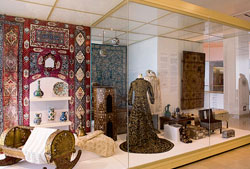
You will see nothing like IAMM in Malaysia. The collection spans centuries and continents. Many of the artefacts have been borrowed to be shown in exhibits overseas.
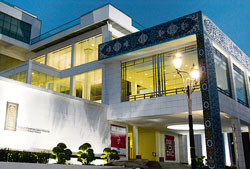
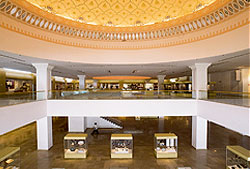
The building itself could but does not compete with the treasures it contains. Instead it frames them in its grand yet simple loveliness, in vast spaces lit by sunlight. Although it will be hard to tear your eyes away from the metalwork, the textiles, the ceramics, do remember to look up. The decorated domes, including an inverted one, will take your breath away.
The collections are divided within enormous halls. Beyond the Prophet’s Mosque and Al Haram Mosque are many more scale models of some of the most famous mosques in the world. Along the walls are descriptions of the architecture, the reason behind the designs and photographs of the buildings’ interiors.
You will see nothing like IAMM internationally. Acting Head Curator, Lucien De Guise, explained: “Although many of the finest museums have Islamic art collections, the number of dedicated Islamic art museums can still be counted on one hand.”
The collection comes from benefactors, auction houses and private collections. Much of the original collection belonged to JAKIM (the Malaysian Islamic Development Department). The collection needed a home and with the support of then-Prime Minister, Tun Dr Mahathir Mohamad, and through the generosity of Malaysia’s Albukhary Foundation, the IAMM was born.
That was 10 years ago and how the collection has grown since. Leaving the Architecture Gallery I am drawn to a voice. The voice is music, a recording of a famous Egyptian Imam reciting the Qur’an. On a screen a cursor follows the words on a page as he says them. That is on the left side of the screen and the cursor moves from right to left over words in Arabic. On the right is the English translation and here, in mirror image, the highlight moves left to right.
You will not see anything like IAMM even among other Islamic Art Museums. These focus almost exclusively on the Arab world, although one boasts that it includes artefacts from ‘as far east as India.’
IAMM is unique in the recognition it gives to the art of South East Asia and China. As the collection demonstrates and Lucien stresses: “Muslim art from this region is as valid as any art from any part of the world.”
Malay, Indian and Chinese Islamic art have their own galleries and also crop up among other collections. In the Architecture Gallery is the Taj Mahal (although it takes me a few minutes to recognise it without the reflecting pool) and a very Taoist-looking structure. A small golden crescent on the roof of the main building is one of the very few clues that this is not a temple, but a mosque.
There would be little point to having a model of Malaysia’s gorgeous National Mosque since the real thing is right across the street. Instead we are treated to a miniature of Malaysia’s first mosque, the Kampung Laut Mosque in Kelantan.
In the Qur’an and Manuscript Gallery there are gilded pages from the Ottoman Empire, miniature Qur’ans the size of a keychain (carried by soldiers for ‘protection and portability’) and ancient scientific texts are Malay Qur’ans decorated with plant tendrils and other greenery.
“We’re an ambassador for all that is great about Islam,” says Lucien. I do not need convincing. Nor did the Islamic Conference of Ministers of Culture 2006 in Libya, who this year declared Kuala Lumpur the Capital City of Islamic Culture.
If you are just visiting Malaysia, make the Islamic Arts museum a highlight. If you live here, you will find as I did, that you are lucky because one day is nowhere near enough.
  |
 |