 Two Cities, Two Streets
By Ivan Lee and James Springer
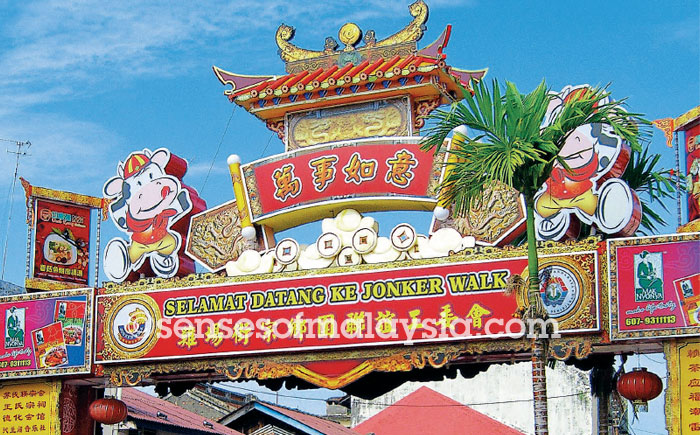
Ivan Lee takes a stroll down Jonker Street in his hometown of Melaka...
No two tourists would give you a similar description of Jonker Street, even if they visited on the same night.
Located in the heart of Melaka, Jonker Street is famous for its long line of tiny stalls selling all sorts of trinkets and street food. From quirky, egg-shaped ice creams and local designer t-shirts to local desserts such as Nyonya cendol;you name it, everything is available along the same street! Each visit promises a new experience as the look and pace of the busy street is constantly evolving and expanding. Every now and then, new stalls will sprout up to offer customers more quirky and creative products.
Barely 10 years ago, Jonker Street was a quaint little street with shops selling antique furniture to local collectors, dotted with just one or two coffee houses that residents would frequent. When a local minister declared Jonker Street to be one of Melaka's most iconic spots, the once-quiet street transformed in short order into a bustling hotspot for locals and tourists to visit. Centuries- old colonial houses were transformed into upscale boutique hotels for tourists to experience a taste of the "authentic traditional lifestyle" of the Baba and Nyonya community that once populated the street back in the 50s and 60s.
Other buildings have been turned into restaurants selling famous local foods that have given Melaka a strong identity; namely, the famous chicken rice balls
and Nyonya laksa. There are also colonial houses that have been turned into art galleries, backpacker lodges for budget- conscious tourists, and gift shops selling souvenirs, handicrafts, and jewellry.
On weekdays, Jonker Street is open to vehicles, and shops along the street run their businesses as usual. Even on off-peak days, Jonker Street is routinely jammed with slow traffic, as the road is rather narrow. On Friday evenings and weekends, however, a transformation takes place. As the sun drops from the sky on Friday, the road is closed to vehicles and all the roadside stalls quickly start their weekend business. In a matter of hours, the whole stretch of street is thronged with people, both local and tourists. Red lanterns brighten up the street when dusk falls, and the street remains a chaotic hive of activity until midnight when the shops and stalls close.
When you visit Jonker Street, you can expect to spend hours on the stretch of street without getting bored. Drop by at dinner time to savour various types of street food to your heart's content, or dine in a café if you prefer peace and quiet. Take a stroll along the street and see what it has to offer; with luck, you may just find something you fancy for a few ringgits! Once your dinner has been properly digested, drop by a dessert shop and try out Melaka's must-have after- dinner treats, Nyonya cendol and ais kacang. Nowadays, even these traditional desserts have been upgraded with a huge variety of different flavours, all tailored
to suit your taste buds: durian cendol for the more adventurous, or plain malt sugar flavour for those who love to keep it original.
Once you're done with dessert, head to the clubs just around the bend of the street and paint the town red! There are a few notable clubs on and near Jonker Street that come alive with great music, and most serve a blend of Western cocktails and local thirst quenchers. Whether you're keen to shake your
bon-bon on the dance floor or just chill out at an upstairs terrace while enjoying a bird's-eye view of the buzzing street, the pubs are the perfect place to end the evening! Among the more popular pubs located on Jonker Street are Geographer Café and the Eleven Bistro.
Aside from its busy tourist activities, Jonker Street is also a famous place of worship. Some of the state's oldest Buddhist temples are located in the heart of Jonker Street, and these venues still serve their original purpose on religious dates. In fact, there is a side street along the main road that has made a name for itself: look out for Jalan Tokong and you will see a true manifestation of Malaysia's multicultural identity. Jalan Tokong (Temple Street) is the only place in the country where you can find a Hindu temple, a Buddhist temple, and a Muslim mosque within the same stretch of street! Even a Methodist church is nearby!
On days when there are no ceremonial affairs going on, drop by at the doorstep of one of the temples and you'll be more tickled than surprised to see retired locals practicing line dancing to tunes from Lady Gaga and Katy Perry! Mind you, these retired dancers mean business when it comes to achieving perfection. The line dancers form a local club and these retirees come faithfully to rehearsals every week, dancing with doors wide open to the delight of curious onlookers. On ceremonial dates such as Chinese New Year or Christmas, they deliver their performance on a stage at the end of Jonker Street that has recently been made permanent. Performances are free to everyone, so do have a seat and show some support for the elderly folks who perform with so much passion!
All in all, Jonker Street is a spot not be missed if you ever drop by the colourful and historical port city of Melaka. It's the one place where you can enjoy
the contrast of the state's historical architecture as a backdrop to all sorts of modern trades. It doesn't matter if you're 18 or 80, Jonker Street is guaranteed to charm!
James Springer muses on the state of Gurney Drive in Penang...
 Gurney Drive is not the place it once was. No longer do the locals swim in the water, nor do the women gather an evening fare of prawn and fish in their shawls. Gone is the beach which, at night, was sparsely illuminated by the dim glow of humble fires sending trails of scented smoke into the air. Neither is there space nor silence. Long absent is the peaceful colonial neighbourhood in which influential families spent lazy afternoons in mansions housing a brood of children running, playing, exploring.
Penang today has no time to consider its past and is a place that seemingly aches to overtake its future self, one bounding leap after another. Hotels, malls, and condominiums are the new flora; Mercedes, BMWs, and Ferraris the new fauna. Sounds and sights have certainly changed. The ancient stars have all but given up competing with their artificial relatives as neon signs punctuate the night air.
Gurney Drive has become cosmopolitan, perhaps more so due to the lack of it in the rest of Penang, and this stretch has been developed with a determined sense of progress. Posh hotels and soaring condos dominate as the places to stay and live on this "new esplanade," taking pride in the services available and the
luxury offered. For those pursuing a more authentically local experience however, the stretch is also lined with that ultimate in Malaysian character - hawker stalls.
While providing predominantly mamak and Hokkien fare, the street vendors have a huge array of grilled, fried, and steamed cuisine bustling under the rhythmic beat of metal slaps and stamps as food seamlessly swirls amongst heat and steam. Under the lighted ambiance of their towering cousins, the hawker stall centres sit as makeshift shelters under tin roofs, billowing smoke into the night air.
What else is there? Gurney Plaza? Well… a nice, big shopping mall filled with designer outlets catering for all the consumers in Penang. It's decked out with every possible fashion imagination and the red and white of "sales" signs erupt all year round as part of the conglomerate taster into the celebrity fashion world. Perhaps the more important question is not what there is but, rather, why it is there? There is hardly anything left of what Gurney Drive used to be, apart from the Loke Mansion, which stands as a resolute salute to the bullied past. Like many places in the world (Dubai, Hong Kong, Singapore, or Jakarta for example), Gurney Drive in Penang is succumbing to "blind" modernism; an unnatural need to compete with global progress causing people to forget that the authentic culture, architecture, and heritage of a place holds more value than something created elsewhere. This could be attributed to the fact that every human being suffers from the self-deprecating view that the grass is always greener and therefore strives for something other than what they are used to.
 This realisation is particularly acute with regards to Penang. Considering that George Town only gained its UNESCO Heritage status in July 2008, one may
find it slightly alarming that it is already under considerable pressure to keep it. With all the development sprouting from its sandy beaches, Penang's commercial sector is seriously contributing to George Town's seclusion to the UNESCO "watch list," and continued brazen construction will be considered further dilution to the heritage UNESCO is honouring and trying to maintain. This is before you consider the consequence of erasing the identity of Malaysia's Pearl of the Orient.
This realisation is particularly acute with regards to Penang. Considering that George Town only gained its UNESCO Heritage status in July 2008, one may
find it slightly alarming that it is already under considerable pressure to keep it. With all the development sprouting from its sandy beaches, Penang's commercial sector is seriously contributing to George Town's seclusion to the UNESCO "watch list," and continued brazen construction will be considered further dilution to the heritage UNESCO is honouring and trying to maintain. This is before you consider the consequence of erasing the identity of Malaysia's Pearl of the Orient.
Gurney Drive is sitting as a halfway house in Penang and a confused mix of two sides of a coin. Heads: trying to make a presence as a swanky address on the island and in Malaysia; then tails: the local fare is too good to get rid of. Hawker stalls feed locals and tourists alike from dawn till dusk, diminishing the concrete monoliths behind into insignificance.
What Gurney Drive is destined to become, nobody knows. Maybe this sort of development will be forced to look in on itself and consider whether losing its UNESCO listing is worth the cost and prestige of luxury style and living. Maybe the idea of Gurney as it was will die a heroic death much like its namesake, Sir Henry Gurney, putting up a fight till the last. Let us hope it is not the latter, as the last it shall truly be.


