By Hugh Ujhazy
It’s typical day just above the equator, the sun blazes down upon a scattering of cotton puff clouds above an azure expanse that is reflected in the warm shallow sea below.
A sedate day that is now dominated by the sound of outboard engines and the slap, crash of the boat hull as it hits the water bound out of Sandakan on the east coast of Borneo island in the Malaysian state of Sabah. Destination? Pulau Selingan to visit the awe-inspiring ambassadors of the seas. Here, the great leatherback turtle and six of the seven known species of marine turtle rove unhindered through a six million square kilometer domain known loosely as the coral triangle.
Dusk has fallen and the tropical torpor is overlaid with a building sense of excitement as the sun dips quickly back to the sea from whence it came twelve hours before. Wandering the pristine sands of the island against the slushing rhythm of the waves washing the beach, multiple dented tracks rise from the water and meander to points on the sand before reversing direction back to the water. Here the turtles haul their bodies out of the water, heaving on flippers one slow lunge at a time until they reach some point (only they seem to know when its right) above the high tide mark and dig to begin the lengthy process of depositing their eggs in the warm sand.
Life doesn’t come easy for turtle eggs and juveniles. Birds, fish, plastic bags and crabs all conspire to challenge those who don’t get dug up and snatched from the egg to survive. In the warm, shallow and relatively sheltered waters of the Coral Triangle, the turtles can roam from the far coast of Malaysia around the rich coral and fish filled waters off Indonesia across to the Solomon Islands and south as far as the coast of Papua New Guinea.
Those that do survive to grow the maturity take decades to arrive their and the hazards of the sea threaten their development, as they become accidental casualties in the cycle of fishing and feeding that dominates the coastal populations around the region.
Malaysian islands are usually visited by four species of turtles – the leatherbacks, green, hawksbill and olive ridley turtles. This particular evening after some hours of subdued conversation and escalating tension, the cycle of the waves is broken by a new sound as a large leatherback emerges to labor up the beach. Solitary animals by nature, the turtles are defined by their grace in the water, their size and presence and the threat they face. Some populations have declined by over 90% in the last thirty years and have become precarious members of the ocean community.
A hush falls upon the group of fortunate people observing the egg laying. The turtle ignores everyone, getting on with the arduous job. Once completed and eggs covered she retraces her steps and disappears in the lapping of the surf, the night unbroken by the grunts of the turtle, eggs a-laying.
Night has fallen and the sky is speckled with stars, fewer visible than in other latitudes but beautiful for their proximity and intensity. The group of twenty wanders back to the visitors’ center, each absorbing the experience of a lifetime. The largest leatherback recorded weighed almost one tonne and they have been known to dive over a kilometer deep in the ocean. This group has seen something that becomes rarer every year but the majesty doesn’t fade. Groups like the World Wildlife Federation (WWF) in conjunction with Malaysian conservation and government groups are protecting eggs and nurturing the population to try and preserve this sight for us and our children. It’s a rare moment, a perfect view in a wild place at the edge of the ocean nursery known as the Coral Triangle.
TURTLES IN MALAYSIA
Four of the seven species of marine turtles call Malaysia home – the leatherback, olive ridely, green turtle and hawksbill. A recognized example of the green turtle was the character Crush is Disney’s ‘Finding Nemo’ back in 2003. The cruising, surfer-dude attitude of the group of turtles migrating down the East Australia Current (‘EAC’) has become an iconic part of movie folklore.
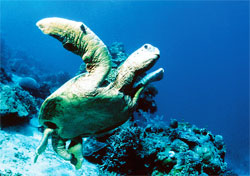
The leatherback is the largest of all the marine turtles and the fourth largest reptile behind the big crocodiles (also has far less teeth and a better attitude!). Like all the marine turtles, they roam freely across the world’s oceans, with the largest example of a leatherback (at 3m from head to tail and weighing over 900kg) being found on a beach in Wales! The leatherback is the fastest moving reptile, the marine equivalent of the cheetah, having been clocked traveling over 35 km/h. Malaysia once had the largest population of nesting leatherbacks with an estimate of 10,000 nests per year. In 2008, only two nests were reported and the eggs were infertile. The decrease has been attributed to the collection of eggs for food.
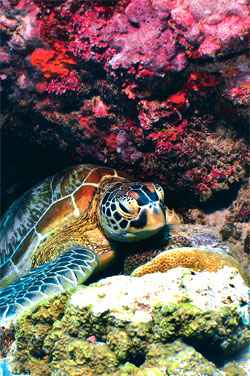
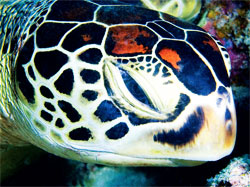
The green turtle is so named because of green fat found beneath the shell, not the color of the shell itself. The green turtle is widely distributed and nests from Mexico to Malaysia and, like the leatherback, is endangered due to collection of eggs for food and turtles being caught in fishing nets and drowning.
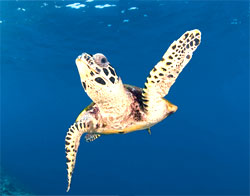
The news doesn’t get any better for the hawksbill which is listed as critically endangered for similar reasons to the other two Malaysian nesting species of turtles. The hawksbill is distinguished by its sharp, curving beak and saw tooth like edges of its shell. Hawksbill suffer from being considered a delicacy in China and Japan and the fact that their shell is used for tortoise shell decorations (quite ironic since a tortoise is a land based animal!)
The Olive Ridley is the smallest of the four marine turtles and considered the most numerous, even though their population has fallen by around 30% in the last 20 years. Again found all over the world, this group is distinguished by mass nestings, where thousands of turtles will converge on specific nesting beaches to lay their eggs within a short period. In 1991, over 600,000 turtles nested on a beach in Mexico over the course of one week.
Sadly, these amazing creatures are fading from the ocean. They grow and mature slowly, their young are challenged from the moment they are laid in the nest and the list of predators must be dominated by us. The ambassadors on the sea are disappearing and our world will be a poorer place for their passing.
Refer to the World Wildlife Fund website at http://www.wwf.org for more information on turtles and the steps being taken to protect and preserve them.
  |
 |