By Ashleigh Seow
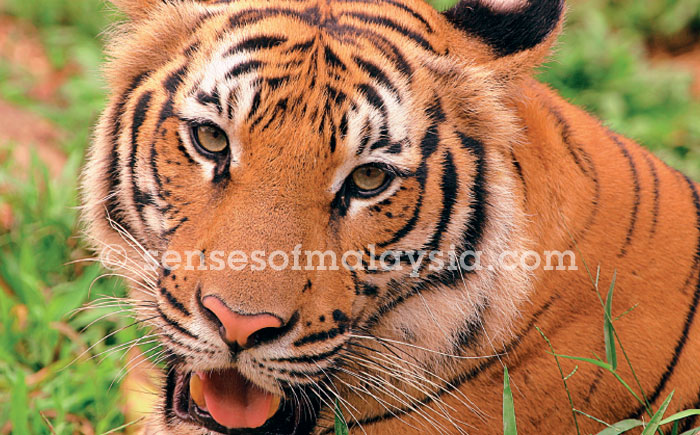
Citizens Action for Tigers, or “cat” walks, serve the dual purpose of helping authorities track and conserve wildlife populations and enabling participants to enjoy the wonders of nature. Ashleigh Seow takes a “cat” walk on the wild side.
“What about
that?” says
Shirley,
pointing to
the deadly
trap at the base of a small tree. We turn
and look. It is a cunning snare designed to
slip over then grip an animal’s neck. The
tightened noose chokes the animal by a
homemade bungee cord of rubber strips
connected to the wire when it tries to
escape. The bait is a salt water drip made
from a bamboo tube that keeps some fruit
moist and salty.
We record the time and location then
photograph the trap before Shirley
deactivates it and Azura hurls the salt
dispenser far into the forest. Had it not
been found it could have taken the life
of a tapir, wild pig, barking deer or even
a tiger. We cut the wire into short useless
lengths and scatter it in the forest.
I have joined volunteers on a CAT
(Citizens Action for Tigers) walk. It is a
“recreational walk with a difference”
enabling ordinary people concerned about
declining tiger and wildlife populations
to actively participate in conservation.
 Research shows recreational use of
wilderness areas can be beneficial to
wildlife in a number of ways. Apart
from jobs for guides, spending in local
economies, and providing locals with a
stake in conservation, the presence of
hikers protects wildlife from poaching
indirectly. Poachers are disturbed by
seeing people around who might notice
them and their traps so they move further
away. But many are local people and do
not travel far. If it becomes inconvenient
to do so, some will look to other sources
of income.
Research shows recreational use of
wilderness areas can be beneficial to
wildlife in a number of ways. Apart
from jobs for guides, spending in local
economies, and providing locals with a
stake in conservation, the presence of
hikers protects wildlife from poaching
indirectly. Poachers are disturbed by
seeing people around who might notice
them and their traps so they move further
away. But many are local people and do
not travel far. If it becomes inconvenient
to do so, some will look to other sources
of income.
CAT walks go beyond establishing
a presence and deactivating traps.
Volunteers also learn to recognise and
measure animal tracks and scat (faeces)
and record their location. Data is sent to
the Malaysian Conservation Alliance for
Tigers (MYCAT). Volunteers who see signs
of illegal human activity report through
the Wildlife Crime Hotline. Plotting the
sites and signs enables MYCAT and the
authorities to understand the human and
animal activity in the area.
The snare Shirley found led to the
discovery of 51 others, some with
decomposing carcasses, by Wildlife
officers following up. This carnage is
not rare. In another area I found a 5km
trapline. That’s what is facing wildlife
today – not a villager catching dinner but
poaching on a near industrial scale.
We head for a rocky outcrop that juts into
a lovely small river and have a leisurely
picnic, compare impressions and swap
stories about places we’ve been. There is
enough time for a refreshing dip in the
creek and even a short snooze and sun
bathing. The Sungai Yu (Yu River) wildlife
corridor links the Main Range to Taman
Negara National Park like the cross stroke
in a capital H. It is a vital route for wildlife,
particularly big mammals like elephants,
gaur, tigers, bears and tapirs, moving
between those two large tiger landscapes
(habitats) and also serves as a genetic
corridor for their long term survival.
It is however too late for sambar, the
largest deer in Malaysia. Due to its highly
prized meat, the sambar have virtually
disappeared outside the park. Highway
8 from Bentong to Gua Musang runs
North- South and development from both
directions has left a 12 km wide forest
linkage. This might seem like a lot, but
effectively it is even narrower as there is
sporadic settlement along that stretch and
metal railings, steep embankments and
wide drains are barriers to many species.
The corridor is a choke point conveniently
concentrating wildlife for poachers.
Buoyed by our success, we continue
walking along the Sungai Yu looking for
tracks by the river bank. Since animals
have to drink, the soft soil around water
sources is an excellent place to observe
signs.We do not see any on the bank but
several metres away someone finds a cat
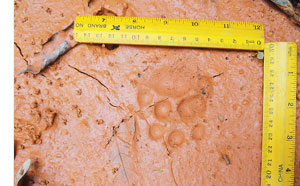
print. I lay out the rulers in an L - shape
and photograph the paw print while
another volunteer saves the coordinates to
the GPS.We decide the print is too small to
be a tiger – it was probably a leopard.
Tracking is exciting work. At a small
stream, we see many tracks and our guide
explains what happened: at night a moon
rat came down to look around and left;
two otters walked on the bank then went
into the stream; later a monitor lizard
came out but some dogs harassed it and
it ran back into the water. On another trip,
we found the main prize. While following
an elephant trail with its unmistakable
footprints, we saw tiger tracks and record
them. The tracks went on about 4 km and
we realised they were also following the
elephants’ route to a river. But the track
size differed and it seemed there were
two tigers, perhaps a mother and her cub.
After we handed in our co-ordinates, a
MYCAT team installed cameras on that
trail and within a few weeks a “new” tiger
was photographed. Its stripe pattern did
not match any of the tigers already on the
database so it was a new arrival. This is
good news.
What about risk? We do not want to be
eaten by a tiger or fall into a poacher’s
trap and get impaled by spikes.These
are common misconceptions. A tiger will
avoid us and will dash into the jungle,
especially during the day; noisy people are
intimidating. So far volunteers have been
attacked by wildlife only once - by wasps.
The snares we find are variants of the
simple noose and are not set on human
paths but near the intersection with
game trails.They are also quite obvious
to another human since the poacher also
needs to find them.They are designed to
snare a paw or a neck and, in the latter
case, the noose is no higher than knee
height, and none of us are crawling around
the jungle on all fours anyway. Pit or box
traps are labour intensive compared to
snares (how many deep pits could you dig
in a day?).There is also no need to fear
battering rams or nets that lift you upside
down into the trees like in the movies!
MYCAT does not seek adversarial relations
with villagers. It is looking for more
volunteers for its Outreach programmes
with communities and schools recognising
that a “poacher-turned-gamekeeper”
strategy is the best way to eliminate the
problem.This is their most successful
programme and their presence at local
markets has been invaluable in finding
supporters and useful intelligence on
poaching activity.
Besides the CAT walks, MYCAT also
conducts Trailblazer – a 5-day boundary
trek in Taman Negara to check the
boundary markers of the park, clear an
inspection path and look out for illegal
entrance sites.This is a tougher, but
immensely rewarding, undertaking done
with Wildlife Department officers.
CAT walks are a way to wander the forests
and streams, not as a tourist, but as a
contributor to the conservation of wildlife
by helping to monitor the tiger population.
It’s not all work as the walks combine
recreational activities like bird watching,
trekking, camping or visiting caves as well.
It is also great fun and a chance to meet
new friends or bond again with the old
one- Mother Nature.
----------------------------------------------------------------------------------------------------------------------------------------
Note: Those interested should contact MYCAT at
mycat.so@malayantiger.net,
find them at www.facebook.com/themalayantiger or visit
www.malayantiger.net


