By Helen Ong
In July 2008, the citizens of Melaka and George Town
had cause to celebrate. They were jointly declared
UNESCO World Heritage Sites because, according to the
Nomination Dossier:
• The cities and ports of Melaka and George Town are the products of
500 years of trading and cultural contacts between East and West.
• Immigration and influences from many parts of Asia and
Europe have created a specific multicultural identity, manifested
in both tangible and intangible heritage, such as areas for
different ethnic groups and functions, religious pluralism, and
streets lined with typical shophouses and religious buildings.
• Melaka demonstrates the early stages of this history, originating
in the 15th century Malay sultanate and the Portuguese and
Dutch periods beginning in 1511; while George Town represents
the British era from the end of the 18th century.
In George Town, the World Heritage Site comprises the core
110-hectare historic city centre situated on the north-east of the
island, which is surrounded by the 150-hectare buffer zone. In
Melaka, the 172-hectare World Heritage Site covers St. Paul’s Hill
and the Historic Residential and Commercial Zone.
Melaka
Melaka bears influences from the various Asian and European
forces which colonised it over the last five or six centuries.
Arguably the most famous building is the imposing red
49,000-sq-ft Stadthuys – the old Municipal Town Hall and
Civic Centre – which is now the home of the Museum of
Ethnology, the History Museum and the Literature Museum.
It is the oldest (construction began in 1641) and largest Dutch
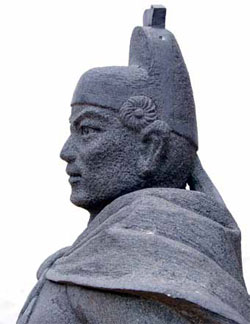
colonial building in Southeast Asia. In the courtyard stands
the statue of Chinese explorer Admiral Zheng He (or Cheng
Ho), erected in 2005 to mark the 600th anniversary of his
voyages. The Cheng Ho Cultural Museum along Lorong Hang
Jebat, formerly Jonker Street, which runs parallel to Jalan Tun
Tan Cheng Lock, illuminates the great explorer’s connection
to Melaka.
Admiral Zheng He brought with him the first Chinese to settle
in Malaysia, who became known as the Peranakan (local-born
or Straits Chinese). The men were called Babas and the women
Nyonyas. With trade and commerce they became affluent, and
many settled in the townhouses along Heeren Street (Dutch
for “gentlemen”), renamed Jalan Tun Tan Cheng Lock. The
Baba Nyonya Heritage Museum at No.48-50 is a wonderful and
interesting way of finding more about this unique culture.
The Cheng Hoon Teng Temple, founded in the 1600s by Kapitan
Cina Tay Kie Ki, claims to be the oldest traditional Chinese temple
in Malaysia. Within are displays of old stone tablets called stelae
which commemorate special events. The temple also, incidentally,
owns the famous Bukit China (China Hill) burial ground situated
to the south-east of Melaka town, believed to be the oldest and
largest traditional Chinese cemetery outside China. The 12,500
graves include those of early Chinese immigrants and traders.
During early Melakan history, five great warriors served during
the reign of Sultan Mansur Shah (1456-1477): Hang Kasturi, Hang
Tuah, Hang Jebat, Hang Lekiu and Hang Lekir. Two mausoleums
in Jalan Hang Jebat and Lorong Tukang Kuli supposedly belong
to two of them, although this has apparently not been verified.
Along Jalan Kota, at the foot of St Paul’s Hill in Bandar Hilir there
are many museums which all tell their own story of Melaka’s
rich history.
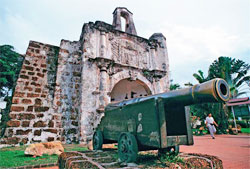
A visit to Melaka would not be complete without a walk through
the ruins of A Famosa, a fortress built by the conquering
Portuguese in 1511 which was later overrun and nearly destroyed
by the invading Dutch and British.
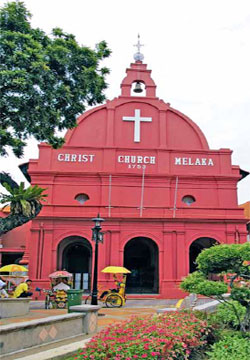
Melaka’s churches also serve as reminders of its complex and
colonial past. Among them are St. Francis Xavier’s Church
(built in 1949) which overlooks most of the town, St. Peter’s
Church (constructed in 1710 by the Portuguese) which is the
oldest functioning Catholic church in Malaysia, and Christ
Church (built in 1753) which is a testament to the region’s
Dutch heritage.
To visit Melaka is to take a fascinating stroll through Malaysia’s
history. For more information on the state’s attractions, visit
www.melaka.org.my
George Town, Penang
George Town, Penang, was founded in 1786 by a trader for the
East India Company, Captain Sir Francis Light, who used the
settlement as a base for his commercial operations in the
Malay States.
Like Melaka, George Town was awarded heritage status not
just because of its unique status as a multi-cultural trading
town but also its heritage architecture, of which, fortunately,
many fine examples still exist. One notable example of colonial
architecture is Fort Cornwallis, an imposing structure built
by Indian convict labour out of bricks and stones in the early
1800s. Another colonial monument is the majestic 60-foot
Queen Victoria clock tower, built in 1897 to commemorate the
queen’s diamond jubilee.
Other heritage structures include banks, private residences,
mansions, churches, temples and shophouses. A walk along the
financial district of Lebuh Pantai (Beach Street) reveals a few
interesting buildings which used to be or are still banks. The
ABN Amro Building at No.9 was completed at the beginning
of the 20th Century, and currently houses the Royal Bank of
Scotland. No.43, designed by the first Chinese architect in
Penang, was the Ban Hin Lee Bank Building. The bank was
founded by philanthropist Yeap Chor Ee.
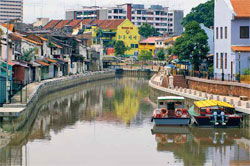
Halfway down, the Anson Bridge, named after a former
Lieutenant Governor of Penang, Major General Archibald Anson,
crosses the Prangin Canal and links Beach Street to Jalan C Y Choy
(Bridge Street). In the 19th Century, it would have provided the
main link between George Town and the surrounding vicinity.
Tucked away in a little corner of old George Town, a part of
Penang’s history is still being lived on a daily basis: the Clan
Jetties of Weld Quay. The sprawling settlement was built in the
late 19th Century by Chinese labourers from the Fujian (Hokkien)
province who had come to work in the then bustling docks. They
settled down around the jetties and each eventually became a
little village housing a separate clan. At its peak in the 1960s
when Penang, then a free port, was a thriving harbour providing
sufficient work, it was home to some four or five thousand
inhabitants. Numbers have slowly dwindled to about three
thousand or so in recent years.
Originally eight, six remain: the Lee, Lim, Tan, Y eoh, Mixed Clans
and Chew Jetty. The latter is the oldest and, with over a thousand
people, the biggest, and the only one prepared to allow outsiders
in to have a peep at life as it has been lived for the past century.
These wooden houses require constant and costly maintenance.
A bit further along, the heritage Church Street Pier built in 1897 on
the waterfront now houses a few popular restaurants.
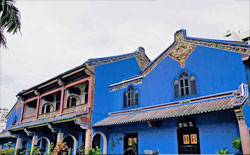
The indigo-coloured Cheong Fatt Tze Mansion
(www.cheongfatttzemansion.com) in Leith Street must be one of
the most distinctive buildings in Penang. Named after the penniless
Hakka Water Bearer who became one of the richest men in Asia, the
sprawling mansion, spread over 56,000 sq ft, was built according to the
principles of feng shui (geomancy) and reputed to be one of only two
such buildings of its size outside China. The award-winning building is
now a bed-and-breakfast “exclusive heritage home stay” for travellers.
Speaking of B&B’s, the elegant Eastern & O riental Hotel
(www.e-o-hotel.com) along Farquhar Street, affectionately known as
the “E&O”, must be one of the most famous in Malaysia. Founded by
Armenians the Sarkies Brothers, it started life in 1884 as two hotels the
Eastern and the Oriental. The two hotels were merged, creating one of
the best hotels in Asia, and boasting famous personalities who stayed
there like Noel Coward and Rudyard Kipling. Also not to be missed is
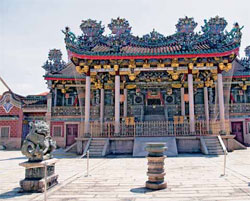
the spectacular Khoo Kongsi (www.khookongsi.com.my) clanhouse
with its highly intricate and lavishly ornamented architecture. The
structure was built in 1850 on Cannon Street by members of the Khoo
clan, wealthy Straits Chinese traders of 17th century.
The Penang Heritage Trust conducts walking tours during
which guests can explore the numerous architectural and
cultural treasures of George Town. For more information, visit
www.pht.org.my or call +604 264 2631.
  |
 |