 The Bubble Keeps Growing
By Ali Zara

PROPERTY WRITER ALI ZARA OFFERS HER VERDICT ON THE STATE OF THE PROPERTY MARKET AND
SUGGESTS THAT THE MALAYSIAN PROPERTY BUBBLE IS NOT SET TO BURST ANY TIME SOON.
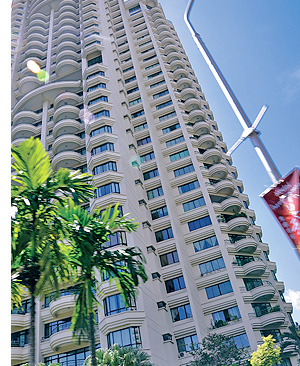 The Malaysian real estate market has
been chalking up solid growth
year after year. The government
has relaxed homeownership
rules for foreigners, including Malaysia My
Second Home programme participants,
and introduced new tax incentives, as well.
Those eligible can buy any number of
residential properties in the country,
subject to minimum rates set by the
different states, with RM500,000 as the
minimum purchase price in most states.
The Malaysian real estate market has
been chalking up solid growth
year after year. The government
has relaxed homeownership
rules for foreigners, including Malaysia My
Second Home programme participants,
and introduced new tax incentives, as well.
Those eligible can buy any number of
residential properties in the country,
subject to minimum rates set by the
different states, with RM500,000 as the
minimum purchase price in most states.
Foreigners may also buy existing
commercial properties in their own
names or under their company name. For
purchase of land, however, the rules vary,
so foreigners should be sure to check state
laws before making any commitment.
Financing is available to buyers through
both local and foreign-based banks
operating here and attractive loan
packages are usually on offer.
While Malaysia – with its exotic locations,
rich culture, and natural beauty – has
long been a magnet for individual
international investors, conglomerates
from China and the Middle East have
now begun to park their money with
confidence in multibillion-ringgit projects,
spurred by the country's rapid economic
development, infrastructure expansion,
and growing foreign investments.
In early March, the RM22 billion Mersing
Laguna in Johor – a high-end international
eco-tourism destination to be completed
by 2019 – was launched with the signing
of agreements between the master
developer, Radiant Starfish Development
Bhd, and its four partners, Chinese
construction conglomerate Sinohydro
Group, China-based theme park developer
Shengrong Company International, Johor
education foundation YPJ Holdings, and
CIMB Insurance brokers.
RETAIL GROWTH
On the retail property front, Parkson
Holdings Bhd, a Lion group company with
over 105 Parkson department stores in
Asia and seven shopping malls in China,
plans to have a total of 10 malls carrying
the Festival City brand name in Malaysia
alone within 10 years. It recently unveiled
its first, the KL Festival City in Setapak, a
1.1-million square foot mall planned to
contain various outlets, with a total net
lettable area of 500,000 square feet.
Despite the uncertain global economy,
Malaysian retailers in 2011 sold
RM83.2 billion worth of items ranging
from clothing and jewellery to F&B and
souvenirs, and exceeded the projected
8.1 percent growth, reflecting the vibrant
retail and tourism sectors.
According to United Nations World
Tourism Organisation-sanctioned figures,
Malaysia ranked ninth in tourist arrivals
marked by earnings of RM58.3 billion in
2011. For 2012, the Ministry of Tourism
is looking at 25 million tourist arrivals
generating an estimated RM60 billion in
revenue.
A RESILIENT ECONOMY
Malaysia is not overly dependent
on Europe and the United States for
investments in its manufacturing sector,
the leading contributor to its economy.
According to Minister of International
Trade and Industry Datuk Mustapa
Mohamed, Malaysia is expected to
equal or surpass the RM56 billion in
manufacturing investments attained
in 2011, of which 70 percent came from
Asian countries such as China, India,
Japan, and Korea, and from ASEAN.
Although the world economic
environment is getting tougher and China
has reduced its growth figures, Mustapa
remarked, China's growth forecast of
7.5 percent for 2012 is still high and will
cushion Malaysia's investment figures.
Moreover, Malaysia is getting new
investments in Johor for upstream and
downstream businesses in the oil and gas
sector – new investments that will further
boost the 2012 figures.
Also ensuring economic stability is the
government's Economic Transformation
Programme (ETP), involves many new
projects designed to enhance the
country's economy by stimulating
private sector-led growth and private
investments; implementation has already
begun for some projects.
Minister in the Prime Minister's
Department Datuk Seri Idris Jala said
Malaysia has exceeded most first-year
targets of the ETP.Among them, the gross
national income where the ultimate goal
is to raise it to RM1.7 trillion by year 2020,
the 2011 figure of RM841 billion surpassed
the RM797 billion target.
The Statistics Department is expected to
release the full 2011 figures in April.
At the same time, the government is
optimistic on achieving RM113 billion
(after factoring in the current global
scenario) in private investments in 2012,
said Mustapa, noting that the RM94
billion in private investments achieved in
2011 surpassed the RM83 billion target by
a considerable margin.
"We now have a strong foundation with
some projects already taking off. There
will be more to come and announcements
will be made," Mustapa stated, adding that
the country is targeting an average private
investment of RM115 billion every year
for five consecutive years under the 10th
Malaysia Plan.
Meanwhile, Jala, who is also chief
executive officer of the Performance
Management and Delivery Unit, said no
companies had cancelled their investment
plans in the country despite the uncertain
global economy.
Meanwhile, central Bank Negara Malaysia
(BNM) expects the local economy to
moderate to between four and five percent
growth for 2012 after expanding 5.1
percent in 2011, pointing out its pace of
growth will largely depend on how the
global economy performs, which for now
remains challenging.
Should the improvements in the US and
resolution of the debt issues in Europe
which have resulted in more stabilised
financial markets continue, BNM said
Malaysia's economic growth would then
be at the upper end of the range. If these
developments take a turn for the worse,
growth would then be closer to the lower
end of the range.
STEADY KEY INTEREST RATE
BNM announced in the second week of
March that it has maintained the overnight
policy rate at three percent after weighing
growth concerns against inflationary
pressures, noting high global commodity
prices continued to pose risks to inflation.
It said latest indicators and surveys of
businesses point to continued expansion
in private consumption and business
spending. However, it cautioned that
while global financial conditions have
improved, downside risks to the global
economy remain.
Economists expect BNM to have at least
one rate cut this year in view of the
uneven growth in Malaysia's key export
markets, and based on the fact that
growth momentum in Asia is still easing
in 2012.
BLESS: BUSINESS MADE SIMPLE
As time is of the essence in the
business world, the Business Licensing
Electronic Support System (BLESS) was
developed to streamline the process
of acquiring licences, permits, and
approvals to make Malaysia a better
place for business.
It improves investment and business
by simplifying the entire process of
gathering information, applying for
licences, permits, and approvals, tracking
applications, feedback, and payment for
investors and the business community.
This has resulted in a substantial
reduction in the time required for
approval in various agencies and
departments. Moreover, businesses can
use a "one-stop" approach to apply for
all licences, permits, and approvals online
instead of going through individual
channels.
As a directory, BLESS provides all the
necessary information and a checklist of
items required for each licence, permit
or approval. This 24-hour business
licensing and resource portal (www.bless.gov.my) is valuable for Malaysia's aims
to be a progressively seamless business
nation that constantly improves to
better compete with other industrialised
countries.
SAFEST IN SOUTHEAST ASIA
Malaysia's success in reducing its
crime index (its overall crime index has
decreased 11 percent) makes it Southeast
Asia's safest and most peaceful country.
It also gains international recognition
with the Global Peace Index 2011 ranking
it 19th out of 153 countries, up from 26th
spot in 2009.
The increase in the level of security
and peace, thanks to the joint efforts of
police and local authorities, has led to a
higher confidence level among foreign
investors with foreign investments up
by RM33 billion in 2011 compared to the
RM29 billion achieved before the world
economic crunch in 2007, according to
Deputy Prime Minister Tan Sri Muhyiddin
Yassin at the launch of the Johor-level safe
city programme in early March 2012.


