By Ravinder Kaur
In northern Perak, deep within the forests of Temengor,
getting food on the table is not as simple as going to the
supermarket.Those that reside there go into the forest at the
break of dawn to hunt for their meal. What they will have for
dinner depends on luck and whatever that is caught will be
consumed within the day as there are no means of refrigeration in
their world. If they are lucky, they will eat today.
As a wildlife researcher, I have been
most fortunate to spend time with the
indigenous people in the Temengor
Forest. Known as the Jahais, these people
rely heavily on the forest and lake that
surrounds them for their food and
income. Many Jahai people possess boats,
either with or without engines, mostly
donated by the government. They use
these boats to fish for fresh water fishes
such as Kaloi (Giant Gourami) through the
use of nets or fishing lines.
Hunting activities are usually carried
out in a small group, to reduce noise.
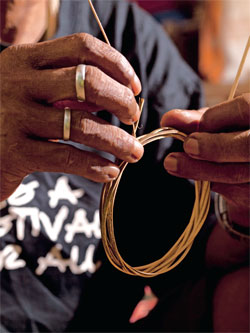
The weapons are handmade blow
pipes, crafted from the slender bamboo
plants known locally as Buluh Sumpitan
(Bambusa wrayi). A blowpipe is a small
but intricately decorated tube and
shoots out poisonous darts. The long,
thin dart is also made of bamboo and
the tip is sharpened and dipped inpoison.
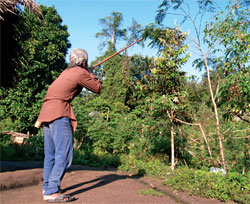
Once the Jahai hunter has
come across its target, the poisonous
dart is inserted inside the pipe
and blown out using the hunter’s
considerable lung power.
THE POISONOUS DARTS
To make the darts deadly, the Jahai use
the sap of the Ipoh tree (Antiaris toxicaris).
The sap of the Ipoh tree is collected by
cutting a “V” shape into the bark of the
tree. This process is carried out cautiously,
as the spurt of the poisonous tree sap
may come into contact with the eyes or
mouth of the person collecting it. Once
collected, the sap requires a bit of cooking
over fire, which gradually changes the
color of the sap from light to dark brown.
Then, the tips of the darts are rolled into
the poison and placed upright to dry,
leaning against a log, with its deadly tips
facing upwards. When the poison is in a
dry form, the darts become safe to handle
by the hunter.
The Jahai have a rather precarious way
of keeping these poisonous darts while
hunting.Though they usually have bamboo
containers to keep these darts safely, the
Jahai find that the darts are more easily
accessible, when they are inserted into the
coarse hair on their heads!
MAKING BLOWPIPES
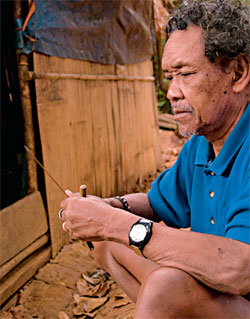
In Kampong Cuweh, Mr. Ahim, an elderly
man diligently makes blowpipes for those
that hunt. No longer strong enough to
join the hunters, he now enjoys crafting
these beautiful yet lethal weapons in his
spare time.
Most tourists that visit this village are
most intrigued by the blow pipes he
creates, and they often purchase these
crafts directly from him. He uses this
income to buy livestock so if you’d like to
purchase a blowpipe from this man, make
a visit to Kampung Cuweh, Temengor.
Poisonous darts not included!.
  |
 |