By Hugh Ujhazy

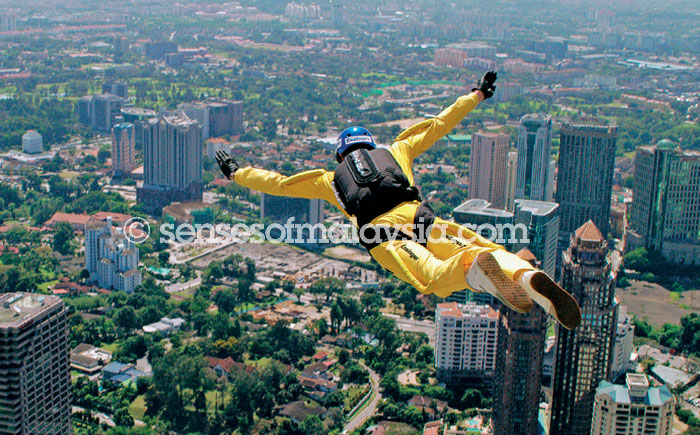
Hugh Ujhazy tells us about the best places to behold KL from up high and appreciate this miraculous growth.
Seventy percent of the world's
seven billion inhabitants live
in cities. While Kuala Lumpur
doesn't make it on the top
cities by population (Shanghai
takes top honors in that category with
over 17 million within its borders), it does
rank number 25 by population density,
with just over 7,300 people per square
kilometer (ahead of both Shanghai and
Singapore). From its origins just over 150
years ago with the arrival of a motley
crew of Chinese miners searching for tin,
the population has skyrocketed to 7.2
million people in an areas of 243 square
kilometers. It's no wonder that "build
higher" is the cockerel cry for developers
everywhere.
PETRONAS TWIN TOWERS
There's plenty to chase in this city ringed
by jungle decked limestone crags. The
world's tallest twin towers, the PETRONAS
Twin Towers, loom large over the heart of
KL at 452 meters and from 1998 to 2000
were the tallest buildings in the world
(now dwarfed by Burj Khalifi in Dubai at
829 meters). Around the skirts of these
behemoths, a swirl of condos and office
buildings scrape the tropical skies around
the Kuala Lumpur city center.
Getting up close and personal requires an
early trip to the base of the KLCC towers to
get a ticket to the Sky Bridge. Perched 170
meters up the PETRONAS Twin Towers, the
sky bridge spans the 57 meter gap between
the two towers on the 41st and 42nd floors.
Open from 9am to 5pm, it is probably at
its most spectacular as one of the daily
rainstorms bears down on KL. Reopening
in January 2012 after renovation, tickets
are RM10 and can be purchased on the day
at the base of the towers.
KL TOWER
Standing off to one side atop Bukit
Nanas, the edifice that started the "reach
for the skies" mentality remains aloof.
Completed in 1994, KL Tower (Menara
KL) rises on a slender gleaming white
concrete stem before flowering to the
bronzed base of the observation tower,
telecommunications level and revolving
restaurant. At 276 meters from the base
of the tower, the public observation deck
is the tallest accessible viewing platform
in the city. Offering panoramic views over
the PETRONAS towers and the entirety
of the city, clear days allow for views out
toward Genting Highlands and beyond.
From the top of the seventh tallest
telecommunications tower in the
world, the bowl in which KL sits can be
appreciated. Ringed by sheer jagged cliffs
cast with a blanket of variegated greenery,
condo towers, roads and all the signs of
human population lap at the skirts of the
limestone cliffs as the city swells toward
these stone barriers.
Construction litters the landscape as
old buildings fall and new rise in their
place, higher, brighter, all adding to the
significant reflective index that is the city
of KL.
Some brazen souls bungee jump off the
observation deck; hurtling from high up
with rubber band around their ankles
creates an adrenaline rush that is hard
to match. From 250 meters above ground,
it is 7 seconds of fall time to the ground
with the assistance of gravity.
Feeling a little less adventurous or with an
allergy to rubber, base jumpers also like
tall structures. Strapping a bit of silk and
string to their backs (a.k.a parachute) they
leap off the conveniently wide top of the
telecommunications tower and manage a
controlled descent via steering vanes built
into their parachutes. Nice.
Another excellent way to appreciate
the heights of Kuala Lumpur is to take
a sightseeing ride on a helicopter. Along
with an experienced pilot, you and a few
of your friends can cruise over the city
for an hour or so, getting up close and
personal with the skyscrapers of the
KL skyline.
FURTHER AFIELD
Heights are to be had further from
town, though better suited to those who
prefer their platforms to be geologically
ancient. Driving through the old town
of Ampang out toward the waterfall at
Hulu Langat, a quick stop beside the road
offers vistas across Ampang and down
into the heart of the city. The highlights
of KLCC and Menara KL are readily
visible from the viewing platform as
layer upon layer of habitation marches
back toward the horizon like waves
assaulting a beach.
To block this out, head to the FRIM
(Forest Research Institute Malaysia)
forestry reserve and feel small at the
feet of growing towers. Taking the short
trail out of the parking lot to the base of
the canopy walk, view the city of KL in
the distance from between broad shiny
leaves and the rustle of branches many
meters from the ground.
For the ultimate high near the capital, climb
1,860 meters above sea level to the Genting
Highlands complex. Travel time of around
45 minutes (due to new expressways
taking travelers out of city), the hotel and
casino complex atop this peak near the
city has been in operation since 1965. Also
accessible via a cable car called the Genting
Skyway which covers 3.38km to reach the
peak. Often shrouded in cloud, the climb
navigates steep hairpin turns past an
amazing Chinese-pagoda-topped temple
and awe inspiring views at every turn.
The 87 miners who staggered through the
jungle stopped at the delta of two rivers to
begin their quest for tin. Since then, their
stories have been submerged beneath the
steady march of Malaysian development.
Climbing steadily higher, the underpinnings
of this growing city remain visible. Seek
them out from ground level then climb the
heights to see this Asian dragon from a new
angle. It will not disappoint.


