By Mary Margaret
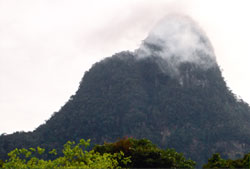
There it stands. The mountain of mystery and myths remains on duty at the mouth of the Santubong River and it dominates the landscape of the peninsula. It was probably a beacon in the vastness of the ocean for the early traders who navigated its watery expanses. As a hesitant ocean goer, I am always relieved to have the mountain showing the way home.
Waves lap at the white sand beaches and crash at the rocky coastline that skirts the 810 metre mountain. But the mountain holds the eye.
Like many peaks around the world, Santubong is enveloped in myths. According to one myth Santubong and her sister mountain Sejingang are the result of a quarrel.
Two princesses, yes, Santubong and Sejingang, had a falling out because of a man – a man they both fell in love with. Santubong was an expert weaver, while Sejingang excelled in pounding padi (rice) and their weapons of choice were the tools of their trade. The King of the Heaven was so angry about their quarrel that he cursed them and they became the mountains that bear their names. From a distance, the profile of Santubong does resemble that of a lady lying down.
This forest-clad mountain, which was recently gazetted as a national park, is a 30 to 45 minute drive from Kuching, the Sarawakian capital. It rises to a height of 810 metres and is clothed in mainly lowland dipterocarp forests with patches of Kerangas. Kerangas is an Iban word that literally means soil that will not grow rice, the Iban being one of the many indigenous groups in Sarawak
This nutrient poor sandy soil is the perfect place for pitcher plants Nepenthes. Another distinctive plant on the mountain’s slopes is the Selusor (Tristaniopis sp). This beautiful tree is easily recognized because its reddish bark peels off in strips.
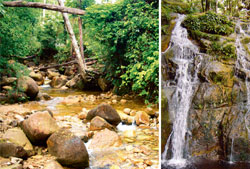
Well marked trails can guide visitors on their voyage of discovery around Santubong Mountain with the most challenging trail being, of course, the one that heads to the summit. This requires climbers to scale the rock faces on ladders. Other trails wind around the lower slopes. And even here you can feel the beauty of the mountain. Rivers tumble over rocks and ravines, are the natural pathway for rain water.
Several possible explanations for the name abound. Si - antu - abang means spirit boat or coffin in Iban and in Sarawak Malay. This vessel is hollowed out from a single log and represents the transport that will take the spirit to the next world.
There are more possibilities. ‘San Choo Bang’ means wild pig King in Hakka, mountain of Wild pig in Hokkien and King of the Jungle in Kueh; all are Chinese dialects. Whatever the origins, there is archaeological evidence (but no written records) that a thriving port existed at the mouth of the Sarawak River, which is at the foot of Santubong Mountain. Trade items, that would have included bird’s nests, rhinoceros horns, damar and other goods from the jungle, were transported to larger regional centres. Iron slag intermingled with pottery fragments dating from The Tang dynasty have been located. Hindu and Buddhist relics and artefacts have been unearthed. This includes the Bongkisian, a Tartaric Shrine dated from between 1000 to 1300 BC was uncovered by a former curator of the local museum, Tom Harrisson.
A bas-relief figuring of a sprawling human or bird can be found at Sungai (River) Jalong, which is not far from Santubong Village. A copy of this can also be seen at the Sarawak Museum in Kuching.
For more information see www.museum.sarawak.gov.my
  |
 |