By Andrew Barber
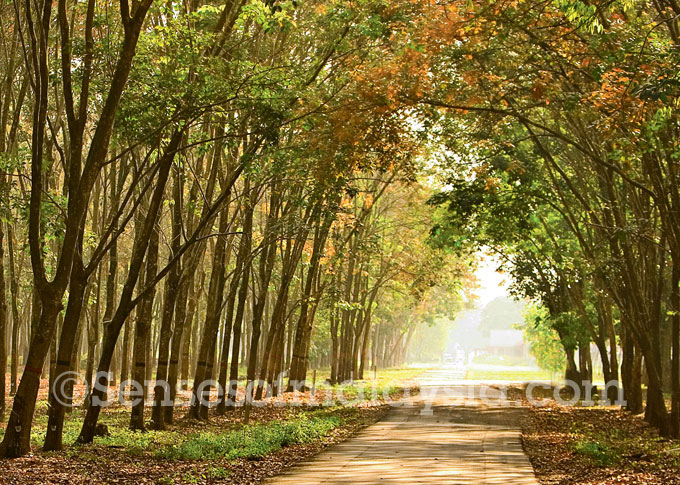
The rubber industry, once one of the pillars of the economy, started with the theft of some seeds.
Over the space of a
single generation,
starting in the
last decades of
the nineteenth
century, the rubber
tree transformed
the landscape, economy, geo-political
standing and demographic composition of
what was then Malaya.The upheaval and
change was huge and the consequences
of the “rubber revolution” can still be felt
in modern Malaysia.
The introduction of the rubber tree was
not some chance botanical experiment
or an opportunistic planting by an
enthusiastic amateur. Rather, it was part
of a carefully planned and constructed
botanical theft devised by powerful
industrial interests in London and actively
supported by the British government and
its agencies. It was part of a national effort
to secure control and dominance over a
key natural resource.The plan worked
beyond its architect’s wildest dreams.
Demand for rubber had grown
enormously during the nineteenth
century. Though the rubber industry had
yet to feel the turbo-charged impact of
the motor industry, by 1876 technical
developments had already made it a
raw material of central importance to
industrial production and demand. In
the 1820s, British inventors Thomas
Hancock and Charles Macintosh (of the
raincoat fame) had invented a machine
that allowed a rubber solution to coat
and waterproof cloth. This spawned a
whole market for waterproof clothing
and materials. In 1839, Charles Goodyear
in the US found - by accident - that raw
rubber when mixed with sulpher, was
not affected by temperature change:
vulcanized rubber was born and with
it the age of the rubber tire, insulated
wire, conveyor belts, rubber footwear and
flooring. The only problem was that the
raw material for this growing range of
consumer products could only be found
- expensively and unreliably - in the hot,
wet jungles of South America and the
Congo – inconveniently countries not
under the control of the British.
And so a plot was hatched.Thomas
Hancock, by now a wealthy and powerful
rubber industry magnate, recognized
that plantation agriculture offered the
only means by which the industry could
expect consistent and regular supplies
of raw material – and by definition
these plantations should be under the
control of the British Crown. Hancock
accordingly devised a scheme to acquire
the seeds of Hevea Brasilinesis, a prolific
and productive rubber tree native to
Brazil. Under his patronage, a number of
British agents attempted to smuggle seeds
from under the noses of the protective
Brazilians. But it was not until 1876 that
Sir Henry Wickham, a British trader
working in the lower Amazon region,
secretly exported 70,000 Hevea Brasilinesis
seeds to the Royal Botanical Gardens at
Kew in London. The results of this heist
were planted and propagated in the
specially constructed Tropical Herbarium
hot houses (they can still be seen today
at Kew Gardens in West London). In 1877,
22 seedlings from this progeny were sent
to Ceylon (modern day Sri Lanka), and
from there eleven seedlings were sent
to Henry Ridley, Singapore Botanical
Garden’s recently appointed Director. He
compared Hevea Brasilinesis with other
rubber producing plants, recognized its
superiority and promoted its cultivation.
He also devised a method known as “bud
grafting”, essentially a cloning technique
allowing the rapid reproduction of
genetically identical trees in limitless
numbers. In the benign environment of
Southeast Asia (huge plantations were to
be established in the Dutch East Indies),
the botanic basis for plantation agriculture
of rubber was in place. In the same year,
Ridley sent the first rubber trees to Malaya.
These were planted in the grounds of
Hugh Low, the British Resident of the
embryonic colonial administration at
Kuala Kangsar, Perak. From the nine trees
planted by Low, one survives to this day – a
solitary and rather bedraggled survivor
of the original 70,000 seeds smuggled by
Wickham out of Brazil over 120 years ago.
While Ridely had overcome the botanic
hurdles to the plantation growth of rubber,
successful industrial scale production
necessitated huge in-puts of land, capital,
expertise and labour. Once these were
in place, rubber began to transform
the landscape of Malaya, as virgin
jungle was ruthlessly scrubbed to be
replaced by serried rows of rubber trees,
plantation roads, water sources, factories,
accommodation blocks and the bungalows
of the British managers. What had, until
recently, been a countryside focused
on the ageless rhythms of jungle and
subsistence farming was now marching to
the tune of international finance.
This became ever more true as the impact
John Boyd Dunlop’s invention of the
pneumatic tyre and the development of
the motor industry rocketed demand. At
the end of the nineteenth century, there
were 2500 hectares of rubber plantation
in Malaya. Ten years later, and in step
with Henry Ford, there were half a million
hectares. Southeast Asia (the Dutch
East Indies was also in the throes of the
same revolution) had become the world’s
dominant source of a vital raw material,
mostly from plantations (there was a
parallel rise in smallholder production,
which over time became a major
aggregate contributor to supply).
The money for all this was raised in
the London capital markets and Malaya
became an integral component of the
imperial capitalist system. In the space
of a few very short years it was locked
into the cycles of the world economy;
the wartime boom years brought huge
wealth, though Malaya was later to suffer
badly during the depression of the 1930s.
A far cry from the timeless subsistence
economy so recently left behind.
The British looked to its Indian empire
to provide the managerial know-how
necessary to run these complex operations.
Indian tea plantations frequently
provided the rugged, independent – and
often Scottish – managers that drove
the revolution forward. It was also to
India that the plantations looked for
the cheap, resilient labour needed to
perform the grinding work of pre-dawn
rubber “tapping”; the Malays deciding
this form of exploitative toil was not for
them, and Chinese immigrant labourers
drawn to tin mining. The British turned
to the destitute landless labourers of the
southern Indian Tamilnadu to provide the
bulk of the work force. The arrival of large
numbers of indentured Tamil workers
had a long lasting impact on the
demography of Malaysia. The Indian
Tamil community currently comprises
about 9% of the Malaysian population,
or over 1.5 million people.
As Southeast Asia came to dominate
the production of rubber, along with
its tin and oil reserves it became a key
component in the inter-war period’s
geo-political struggle. To control raw
material assets gave strategic advantage;
to deny them to the enemy was almost
as important. It was not surprising,
therefore, that Malaya and the Dutch East
Indies (Indonesia) were key targets for
the Japanese as they sought to develop
an Asian Economic Prosperity Zone, one
of the main drivers behind Japanese
militaristic expansion. It is often forgotten
that the unprovoked attack on Kota Baru
came some hours before Japanese fighters
struck at Pearl Harbour.
Since the war, rubber has remained
one of the pillars of the Malaysian
economy, and it is still one of the world’s
dominant producers – feeding a range
of rubber and latex industries. But the
rubber plantation sector has reduced
considerably in overall size and relative
national economic importance.
While new rubber types have hugely
increased yield, and developments in
tapping techniques have reduced the
need for daily tapping, competition
from cheaper neighbours, such as
Indonesia, has undermined Malaysian
competitiveness. The Malaysian
plantation sector as a whole has taken
a dramatic shift towards oil palm. One
positive, however, has been a boom in
the rubber wood furniture industry,
which draws on the vast reserves
of former plantation stock for this
attractive semi-hardwood timber.
So, an audacious theft of seeds and the
successful transference of an Amazonian
tree to Southeast Asia when combined
with industrial-scale propagation,
growing demand, access to international
finance, vast areas of virgin territory,
managerial know-how and cheap
indentured labour resulted in a “rubber
revolution”, catapulting a sleepy, tropical
nation into a significant niche-player
on the international stage. Thomas
Hancock, the architect of the original
heist, could scarcely have believed that
his little plan would have such a vast
and sustained impact.


