By David Bowden
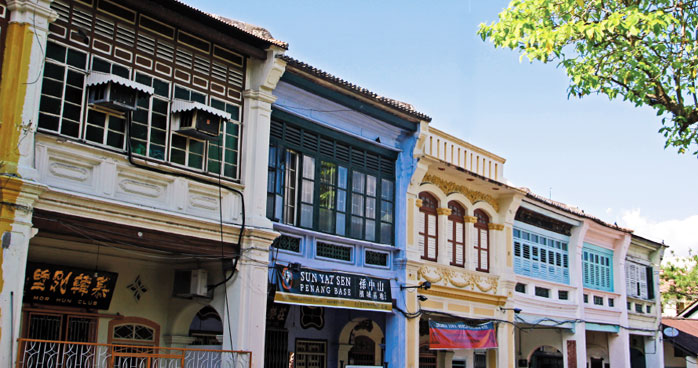
MALAYSIA HAS MANY FASCINATING AND WONDROUS SIGHTS. SOME OF THESE CAN BE VERY LOCALISED AND IN SOME URBAN AREAS CERTAIN STREETS HAVE BECOME FAMOUS TOURIST DESTINATIONS. DAVID BOWDEN HEADS TO ARMENIAN STREET ON THE ISLAND OF PENANG.
Anyone who knows their Asian heritage has
heard of Penang’s Eastern & Oriental Hotel
situated by the waterfront on Farquhar Street.
They also may know that the founders of the
hotel were the Sarkies Brothers who were
also responsible for establishing the equally famous hotels of
Raffles in Singapore and The Strand in Rangoon, Burma (now
Yangon, Myanmar).
The Sarkies are rarely mentioned without some qualifying
statement that they were Armenian as if that were a
prerequisite in operating a great hotel. Now, Armenia is not
near the top of my “must visit” list so it has always intrigued
me how these brothers ended up in Asia and established
three of the region’s most noted heritage hotels.
Armenia is a small landlocked and mountainous nation of
just three million people (some eight million live abroad
which says a lot about what living in Armenia must be
like) and it is surrounded by Turkey, Iran, Georgia and
Azerbaijan. It was once part of the Soviet Union but attained
independence in 1991.
Armenian traders have been in Asia for centuries and it’s
not surprising some, like the Sarkies, ended up in Penang.
Armenians migrated to Persia (now Iran) and then onto India
from where they started trading with the Spice Islands of
Southeast Asia. Being mostly Christians (Armenia was the
first nation to adopt Christianity in the 4th century) they
established their churches of worship in Penang but there
seems no evidence of Armenian activity in the street now
named after them, Lebuh Armenian (Armenian Street) in
historic downtown George Town.
HISTORIC STREET
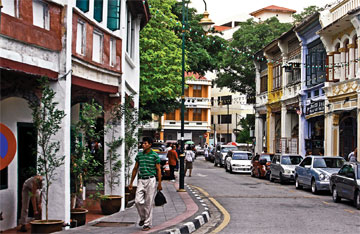
It’s important to have some historical reference as you stroll down this small street now protected by UNESCO World Heritage status. George Town is a warren of streets, heritage buildings and narrow passageways where the paths and walls would all have an intriguing story to tell if only they could talk. However, the traditional artisans such as carvers, goldsmiths and joss-stick makers are fading away as their offspring appear reluctant to learn what are seen by many as dying trades. WALK THE TALK Just locating Armenian Street can be a challenge as I found out last time I caught a taxi from the airport with a taxi driver who had enough grey hair to suggest he should have known where it was. Through a process of ever-diminishing circles we honed in on the street located close to Kapitan Kling Mosque. My suggestion is to start exploring the area from near the little park where each evening, the makeshift flea market will have interest for those seeking a bargain or an unusual photograph. From here, walk the length of the street southward, across Lebuh Cannon, down Gat Lebuh Armenian to Pengkalen Weld and the clan jetties. The whole walk covers less than one kilometre with the beginning being more fascinating than the end if you exclude the clan jetties. The area is a maze of small streets and terraced shoplots and houses in various states of repair.There are now some very smartly decorated buildings offering boutique accommodation, bars, restaurants and designer shops in addition to those yet to be renovated. At the beginning of the street (actually the end as the street numbering ends here) stands the beautifully-renovated Syed Alatas Mansion at No 128. This mansion is now the Penang Islamic Museum (www.penangislamicmuseum.net) with interesting displays and an entrance fee. The Hokkien-led secret society called Khain Teik established their base in the nearby Tua Khian Teik Temple located on Armenian Street and the surrounding area became a tightly secured clan enclave for the five great Hokkien clans of the island – Khoo, Tan, Lim, Yeoh and Cheah.
At 7 Armenian Street, Cheah Kongsi has stood for almost 140 years. It is known for its eclectic design which is inspired by European, Malay and Chinese architectural styles. Continue up to No 71 near the Cannon Street intersection for Yap Kongsi and its ornate red-pillared entrance. Between 1910 and1911, No 120 was a hotbed of Chinese revolutionary politics as it was the Southeast Asian base for the nationalist revolutionary organisation, Tung Meng Hooi. Chinese national Dr. Sun Yat Sen (the “father of modern China”) was based here and planned the Canton March which was an important event in the Chinese Revolution that led to the overthrow of the Ching Dynasty. The building has been converted into a museum that’s now open to the public (www.lestariheritage.net). Several new shops have opened along the street and visitors can take a peek in a traditional Chinese beaded shoemaker (No 4), art galleries, silverware and jewellery shops (Jonathan Yun, No 88), glass artistry (Fuan Wong Gallery, No 88) an excellent photographic gallery (StudioHoward at No 88) and even a tattoo artist. Shop at the two shops belonging to The Straits Collection - Bon Ton The Shop (89 Armenian St) and China Joes (95 Armenian St) for designer pieces sourced from around the region as well as many Chinese and stylish Penang souvenirs. EAT YOUR HEART OUT
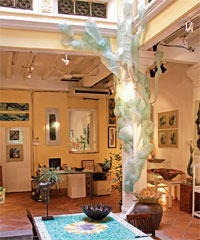
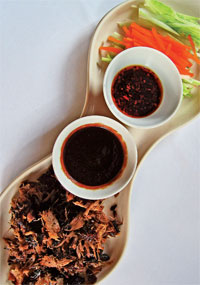
Take a break from the delights of local hawker food and enjoy delicious Swiss/ German specialties at Edelweiss Cafe (No 38). This renovated but old-styled Chinese kopitiam features period furniture and enticing dishes such as pork knuckle, fondue (Swiss “steamboat”) and sausages accompanied by several local and imported German beers. SLEEPWALKING When you’ve had enough walking, eating and drinking and it’s time for sleeping, check into Straits Collection (www.straitscollection.com.my) which includes five properties located in Armenian Street (Nos 89 to 95) and another five in nearby Stewart Lane. While the façades of the terrace houses have been retained and renovated all have been uniquely decorated with designer interiors that combine antiques with contemporary functionality. No two rooms are the same and for those who want to support the concept of heritage renovation while relaxing in designer interiors, the Straits Collection offers an excellent alternative to the conventional hotels in the historic heartland of Penang. UNESCO World Heritage protection of Penang’s waterfront, Fort Cornwallis, Little India, Acheen Street, Weld Quay and the various clan houses are setting a new direction for Penang’s tourism. Contacts: The Heritage Centre, 128 Armenian Street (behind Syed Alatas Mansion), www.penangheritagecity.com Penang Heritage Trust, 26 Church Street, www.pht.com.my. |
  |
 |