By Ashleigh Seow
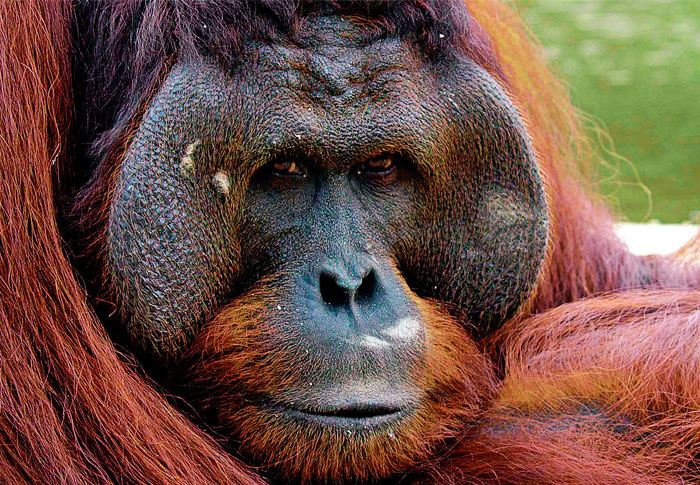
IS THERE A“BIGFOOT”ROAMING THE JUNGLES OF MALAYSIA? ASHLEIGH SEOW VISITS JOHOR’S ENDAU ROMPIN AND UNRAVELS THE MYSTERY
Quietly and surely he moved alone along the river bank, paused and crossed
the swift water to follow a small tributary upstream. A cloudless starlit sky
gave sufficient illumination for his night adapted eyes, even when he moved
under the jungle canopy of the Endau Rompin rainforest.
Broad splayed feet and toes gripped the tree roots, slick wet volcanic rock by the bank
of loose earth in the forest, providing traction and a feel for the ground that our feet,
desensitized by sidewalks and clumsy shoes, could never match. At a steep rocky bend,
he turned into the forest to cut across to the other side where a natural fishing hole
had been created by the scouring motion of swirling pebbles over thousands of years.
This, and the fish inside, was his destination. He moved using the trunks of saplings for
assistance as he swung up slope to the small spur. Near the top he paused: something
was wrong. He smelt a strong odour and he realised he was not alone, a silhouetted head
and shoulders blocked his way; a shaggy outline indicated hair.
Din stood petrified for a moment before he understood what it was – Orang Serjarang Gigi – the Gap Toothed giant - Malaysia’s Bigfoot. He turned and ran. And ran and ran and, like a character in a fairy tale, did not stop. He abandoned his precious canoe where he had concealed it. He ran over rocks, through shrubs and around trees without heed throughout the night. Only a jungle bred person with intimate familiarity of the forests and streams could have done it without injury. Just before dawn, he reached his village, stumbled into his hut and gasped the tale to his horrified family. As word spread, neighbours came by. All were aware of how very, very lucky he was to have survived an encounter with a Serjarang Gigi. According to legend, these hairy giants tower over the short Orang Asli Jakun and in the past they hunted and ate people especially near rivers and streams: until one resourceful Jakun, abducted by a Sejarang Gigi, used his fire piston to set fire to the creature’s shaggy coat. Since then the creatures have tended to avoid man and be wary of his mastery of fire but one should never be complacent about such a clever and powerful creature capable of crushing a man. Din (name changed to protect the guilty) was one of our guides on our annual trip to the Endau Rompin National Park to commemorate the original year-long 1985-86 MNS expedition which led to the establishment of the park. A campfire conversation with the guides had somehow turned to “Orang Serjarang Gigi” or “Mawas” as it is known to the Malays of Johor. The others laughingly called out Din, telling me that he had had a close encounter. A quiet, strongly built man in his 20’s reluctantly came forth. I extracted the story out of him. He had an open honest face and was a credible witness; there was no dramatic embellishment to his story, he was matter-of-fact and he confessed, after my probing, that his purpose that night had been to poach the fry (baby fish) of an endangered and valuable aquarium species and sell them to wildlife traders. He was not out to profit from the tale and indeed the teasing he received from the other guides indicated that seeing a Mawas was not a reputation enhancer. I believe that he had genuinely seen something that scared him, not least because two years previously along the Jasin River, a few hours distant from his encounter, I had come across a footprint which we could not identify. In the past hundred years or so, ‘modern’ people have, increasingly, ventured into the area and sightings of the Mawas are no longer confined to the Jakun. Either there is a Malaysian Bigfoot around or the stories are contagious! Recently a fish researcher claims to have seen one in the forest as does a PR consultant driving on the North South Highway in broad daylight. Three workers building a pond on the lower Kinchin River saw a Mawas family of three. Villagers in the Kota Tinggi area and in the suspiciously eponymous Kampong Mawai report encounters or footprints, as have campers as far north as Selangor. Sadly many of these are patent misidentifications: the shaky campers’ video shows a sun bear and the Kota Tinggi footprints are obviously made by an elephant. In 2006, there was a proliferation of reports sufficient to attract interest from abroad. Even the BBC and Sci-Fi channel TV crypto-zoologist Joshua Gates came to trek and find a footprint. Other groups, such as the Asia Paranormal Investigators, the Singapore Paranormals, and the Malaysian “UNCLE investigators” turned up to tramp into the Endau Rompin park. Almost any sign - broken saplings, uprooted palms, torn lianas and footprints - was attributed to Bigfoot; it seemed like Bigfoot had obligingly gone on a rampage to ensure that everybody got photos. One print, curiously similar to the one I photographed, was cast in plaster and supposedly offered to the Johor Government. Later it turned up for auction with a reserve price of RM 100,000! These charades aside, one thing is certain; stories of similar large hominids are world-wide: the Sasquatch, the Skookum, Yeren or the Mapinguari of South America but especially the Yeti. What could the Yeti possibly have to do with the Mawas? Much of the mega fauna of the Himalayan region and South East Asia are similar, especially the mammals. So the Yeti and Mawas, if they exist, are very likely cousins, if not brothers, on the same evolutionary tree. Some of the people who have seen signs are quite famous. Edmund Hillary and Sherpa Tenzing Norgay saw footprints at 6000 metres on the shoulder of Everest. Eric Shipton and his companions photographed unidentified prints two years before also on Everest. The naturalist Houghton Hodgson, discoverer of the Tibetan antelope, saw a tall bi-pedal creature, with long dark fur in Nepal in 1832. Reinhold Messner, solo conqueror of Everest without oxygen, and with experience of over 50 Himalayan journeys, saw a strange bipedal animal in the montane forests. The writer Peter Matthiessen, while travelling in Nepal with biologist George Schaller, believed he saw a yeti while they were looking for the snow leopard. The list goes on till 2001 when, according to the New Scientist magazine, an English evolutionary biologist Rob McCall found hairs on a tree close to “yeti’ footprints which leading geneticist Prof. Bryan Sykes at the Oxford genetics laboratory was unable to match to the DNA of bear or any other known animal. It seems that only those completely secure in their reputation are willing to encourage further Bigfoot research. Schaller, reputedly the finest field biologist of the 20th century, says that a hard look is needed at the remaining evidence once the hoaxes and mistaken IDs are discounted. Schaller should know: he was the first to properly study the mountain gorilla once thought to be a cryptic (unseen) species; he rediscovered the Tibetan red deer and the Vietnamese Warty pig previously considered extinct; he forecast the discovery of the Saola, a large antelope as heavy as a big man, and completely unknown to the world, based on encounters with local hunters in Laos. Late in 2010 the first live Saola was captured. The list of recently discovered, or rediscovered, species is long and convincing proof that animals can exist unseen by modern people for a very long time – 163 million years in the case of the coelacanth! The majority of reports are misidentifications or hoaxes. The tragedy is that fringe enthusiasts discourage many real researchers from investigating the few cases where the reports are not easily explicable. This is the case of Jeffrey Meldrum, a professor of primate anatomy and movement, who found that some bigfoot prints were not made by foot shaped pieces of plywood stamped on the ground but displayed articulation, or joint movements, consistent with a real limb function as well as containing skin and fur impressions – lines, cracks and whorls. For his trouble he was shunned by peers and denied promotions. One place that is conspicuous by the lack of Bigfoot sightings is Borneo. A trawl through the record shows only one report, just after the excitement in Johor, when a pair of massive 47 inch prints were found next to an orchard. Certainly a prankster’s hoax since 4-foot feet translate to a 22-24 foot tall creature; an anatomically impossible load for hominid skeletons. Even the Bigfoot websites did not believe it. But Borneo has the Mawas. Really! For the Mawas (alternatively maias or mias) And so, for many Borneo people, a mawas is an animal which is very much alive, present and not cryptic at all. A mawas sighting is a natural event and not a glimpse of a legend. What do I think? I am happy to go with the chimpanzee primatologist Jane Goodall who says “maybe they don’t exist, but I want them to”. |
  |
 |