By Aida Ahmad
It was at my cousin’s wedding in January that I witnessed the jittersand other trimmings that come with getting hitched. Redza is the oldest son of my aunt Salima and uncle Kassim. His bride to be was Nelly, a lovely school teacher. This wedding was a pretty big deal in my family. We all had a turn at babysitting him and coddling him when he was a baby. The time had come, however, for him to leave the nest and start a new life with his other half.
In Malaysia, traditional weddings within the Malay, Chinese, Indian and other communities have their own customs and charm. Malay weddings start way before the official solemnisation ceremony; at the adat merisik (asking ceremony) to be exact, followed by the engagement. We now take a trip back to January 2009. The place? Batu Pahat in Johor where Nelly was from.
The Engagement - 18 January 2009
The adat merisik (“asking ceremony,” or more literally “spying custom”) is the traditional Malay system for arranging marriages. In Malaysia, a Malay person is by religion a Muslim. When it is time for a young man to get married, his family will look around to identify a number of potential brides. In our case, the entire family was fully aware of Redza and Nelly’s courtship, hence it was pretty much written in stone that their big day was looming. Contrary to the western style where the guy gets down on one knee to propose, it is more of a family affair on this side of the globe.
Nowadays, the man might tell his family who he would like them to consider, though a romantic link may already exist between the man and woman. On the other hand, arranged marriages (where the parents look for a suitable partner for their son or daughter) still take place in this day and age within the Malay and Indian communities. While some call it meddling it is quite customary for the folks to find a Mr or Ms Right for their offspring. Having decided upon one particular woman, the merisik, or investigation process, takes place. For this ceremony one or more representatives (wakil) of the man’s family pay a friendly visit to the family of the woman whom they have in mind as his potential bride. Needless to say we were all quite excited that the strapping young lad was getting hitched so about 15 of us from Redza’s side convoyed from KL to Batu Pahat. Talk about sending in the troops!
The real reason for the visit is so that the man’s family can see the woman. Of course a hint is dropped regarding the purpose of the visit and the woman’s parents may also give some idea as to whether or not their daughter might be interested in the match. The merisik does not constitute a formal proposal as it is supposed to give time for both sides to come to a decision. In our case it was a two-in-one event (the merisik followed by the engagement) to speed up the process.
After an exchange of pleasantries, both families gathered in the living room for a friendly discussion. Mind you, the groomto- be is not involved in this and my cousin stayed out in the garden with his brothers and friends talking about whatever guys their age talk about.
Back in the house, the conversation centred on auspicious dates for the big day. The date agreed upon was the first day of 2010. With that matter solved, my aunt - with her sisters and us nieces in tow - made her way to Nelly’s room upstairs and presented her with an engagement ring. Nelly, all dolled up in her traditional Malay baju kurung waited daintily in anticipation. With an audience of close family relatives, Redza’s mum placed the ring on Nelly’s finger, and the deal was sealed for the betrothed couple.
The Wedding Day – 1 January 2010
After months of preparations, it was finally New Year’s Eve. Those of us in KL packed up and headed south. Like most grooms-to-be, my cousin was ordered to rest for his big day ahead.
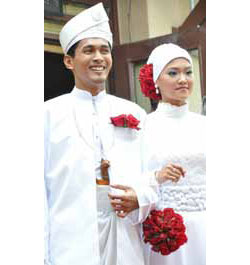
The akad nikah (wedding contract ceremony or solemnisation) was to begin at 9.30am at the bride’s house. Usually this also takes place at the mosque. Redza was up at dawn and donned his traditional baju melayu (Malay costume) while the arduous task of tying the kain sampin (half the size of a normal sarong and worn by men over the baju melayu) fell on Redza’s father. Right then. Groom? Check. We then headed off to the bride’s house with the assigned duties of carrying the mas kahwin (dowry) and hantaran (gifts comprising sweets, a Quran and accessories) for the bride. In Malaysia, the dowry is stipulated by the state government and different states have different dowry amounts.
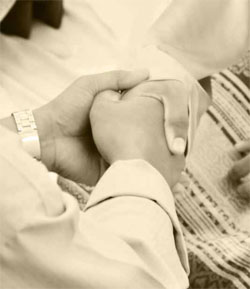
The akad nikah ceremony is done before an authorised religious officer - usually an imam from a mosque - and as Muslims the couple is legally married only after the groom recites his vows and signs the marriage contract. Seated in the living room in front of the imam and flanked by the bride’s wali (male person closely related to the bride, in this case Nelly’s father, or a person delegated by a religious official) as well as witnesses, Redza was ready. Before citing the vows the imam advises the groom on his duties as a good husband. Holding the groom’s hand as in a handshake, the imam says: “Redza, I wed you with Nelly with a dowry of RM --- cash” to which the groom will reply “I, Redza, accept Nelly as my wife with a dowry of RM --- cash.”
The groom has to recite the vows clearly in one breath, otherwise it has to be repeated. Most of the time the groom is overwhelmed by jitters so it is common for him to stumble. The final say on whether the vows are uttered clearly is determined by the witnesses. Redza did it on his first attempt which was followed by happy cheers by family members. This is followed by a prayer of thanks by the imam.
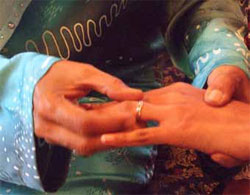
The eagerly awaiting bride can now meet her husband. Nelly, in a light silver dress and sequined kebaya top, blushed as the two exchanged rings and she kissed her husband’s hand.
The Bersanding Ceremony
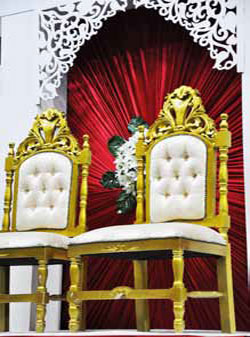
During the Malay wedding, the bersanding ceremony is a celebratory lunch or dinner in honour of the happy couple. The couple walks hand-in-hand into the designated venue (usually the bride’s house or a hall, hotel or restaurant). They take their seats on the raised dais (pelamin), flanked by the best man and bridesmaid, and are sprinkled with rose water by their parents and relatives. The newlyweds then take their place at the main table as a signal to commence the lunch or dinner. After dinner, there is a photography session and then, of course, the groom is allowed to spend that night at the bride’s house.
The end of this wedding day did not mean the end of festivities. The bride’s family was to join us the following week for a lunch hosted by the groom’s parents. It was something to look forward to as we bid goodbye to the happy couple.
  |
 |