By Ravinder Kaur
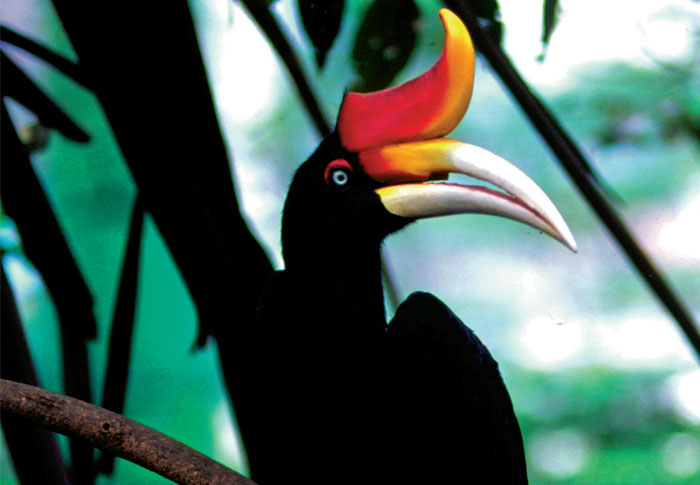
WITH A NAME THAT MIRRORS THEIR APPEARANCE, HORNBILLS GRACE THE SKIES OF BOTH PENINSULAR AND EAST MALAYSIA. RAVINDER KAUR LEARNS ANDWRITES ABOUT THESE GIANT, STRANGE-BUT-BEAUTIFUL BIRDS.
When people think of hornbills the automatic
geographical association is with Borneo. In fact,
Sarawak, one of two Malaysian states in Borneo is
known as the “Land of the Hornbills”.
However, while Borneo has
eight hornbill species, the Belum-Temengor Forest Complex in
Perak is home to all ten of the Malaysian hornbill species.
Hornbills are fascinating creatures as they are vociferous,
vibrant and full of character. They have unique features such as
a long decurved bill, long eye lashes and a protruding casque.
Throughout the world, hornbills thrive in sub-Saharan Africa,
India and the islands of the Malaysian archipelago, to as far east
as New Guinea and the Solomon islands.
In both the tropical rainforests of Africa and Asia, hornbills are
regarded as nature’s gardener. Due to their size they can swallow
large fruits whole, including the seed, undamaged. They then
cover great distances in their search for more fruiting trees, and in
the process, scatter seeds all over the forest area.
Hornbills are hole-nesters. Incapable of excavating their own
nests, hornbills use natural cavities found in trees and in rock
crevice, often reusing the same nest cavity year after year.
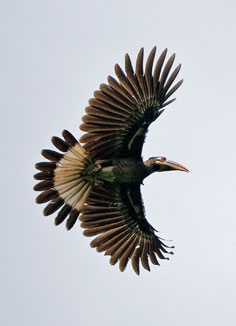
CONSERVATION AND DOCUMENTATION During scientific expeditions conducted at the end of the 20th Century by the Malaysian Nature Society’s (MNS) Hornbill Conservation Project an unusual occurrence was observed. At dawn and dusk, thousands of hornbills would fly by in a steady stream. It took time, but eventually the birds that made up this strange flock was identified as plain-pouched hornbills. These became the 10th species of hornbills in Malaysia. Mainly seen during their dawn and evening flights, these hornbills move in continuous “waves” that generally lasted between one and a half to two hours. At that time, the hornbill population was estimated to be about 2,500 individuals. Their behaviour of communal roosting, choosing the same tree to retire in every night in large groups just like city crows, are the reason for their dawn and evening movements. At dawn, these hornbills are seen flying from a certain area of forest and then dispersing into many different directions. In the evening, small groups of Plain-pouched hornbills merge with larger flocks and head home. The exact location of their roosting site is still unknown due to the challenging conditions of the rainforest. It is vital to have this location pinpointed exactly, and move towards conserving this block of forest to save this awe-inspiring phenomenon. The mass movements of the Plain-pouched hornbills in Temengor Forest Reserve are an annual occurrence. In 2008, when it became apparent that more people were needed to monitor and document their numbers, MNS initiated the MNS Hornbill Conservation Volunteer Program. The first program received a total of 34 volunteers and, under the supervision of four experienced MNS coordinators, counted 3,261 plain-pouched hornbills during two hours in the morning on 14 September 2008. HELMETED HORNBILLS Ugly to some, beautiful to others, the Helmeted Hornbill can measure up to 120 cm from bill to tip of its tail. Its neck and head are featherless and it possesses a rather awkward solid and broad casque. In the wild, these hornbills have been observed to use their casque to crash into each other, head to head in midair. The manner in which most hornbills choose their life partner is rather romantic. Generally males offer fruit to a female as if it were a proposal and once she has selected her mate, she only accepts fruit from him. Once this “marriage” ceremony has taken place, the pair remains together monogamously for the rest of their lives. Hornbills tend to breed every year and they lay up to two eggs, though usually only one offspring survives to adulthood. The Helmeted Hornbills are choosier than most when it comes to the selection of nest cavities. Unlike other hornbills, they prefer a knob/stump like cavity, one they can perch on, without the need to hook onto. Most other hornbills such as the Rhinoceros Hornbill hook onto a nest cavity during feeds. After mating, most female move into the nest cavity and the male and female participate in nest sealing of the entrance, using mud, fruit and faeces as sealing material. They will then seal the rim and leave a gap in the nest cavity big enough to allow the male to feed the female. Now imprisoned, the female lays her eggs and is entirely dependent on her mate to find and provide food. Helmeted and Red-knobbed Hornbills have the longest nesting period, spanning as long as five to six months. The female may even shed its flight feathers, to line the nest cavity. In the beginning, the devoted male will move back and forth the nest site perhaps twice a day to feed the female. Once the chick has hatched, these trips increase to up to five times a day. The growing chick requires protein and so besides figs, the most common food source of the Helmeted Hornbills, the male hunts for insects, snakes, nestlings or rodents. As the male flies into the nest area, its wings flap loudly, announcing its presence to the chick. The chick begins to call, coarsely, and the male flies to perch on the rim of the nest cavity.
When the male flies away, the chick may still be heard calling, demanding for more. The male flies away from the nest area in search of more food and usually returns within several hours. At times, after feeding, the male perches on the nest tree and begins calling loudly. The calls of the Helmeted Hornbills are rather odd. It begins with a single note call, slow in the beginning and then becoming more rapid, “tuk… tuk… tuk, tuk, tuk” then it ends its call with a sort of maniac laughter, echoing throughout the rainforest. Usually by the fifth month, the nest becomes more cramped, and so the female breaks the nest sealing and leaves the nest cavity. For now the female is too weak to feed the chick and leaves that job to the male until she regains her strength. In order to persuade his mate and chick to leave the next, the male gently tempts them with fruits. It holds fruit in its bill and perches on the nest cavity but does not share it, flying away instead as it calls softly. Hunger eventually drives the inmates from the nest. At the very end of the nesting period, anytime between the fifth or sixth month, the well formed chick will squeeze its way out of the nest cavity, and take flight for the very first time through the forest. THREATS TO HORNBILLS Helmeted Hornbills are hunted for their “golden jade” as the keratinous layers that make up their casque is called. The golden jade is carved into small ornaments such as brooches and buckles. In Borneo, the casque is used traditionally as earring and worn by those that have taken a human head. However, the main threat faced by hornbills in Belum-Temengor Forest Complex is deforestation.Though the northern region of this forested area, the Royal Belum State Park, is currently protected, there is a great need to extend the protection to Temengor Forest Reserve, the southern region. Unsustainably logging affects the survival of the hornbills as these birds require large mature trees to nest in and vast foraging areas. For more information about hornbills, to hear their calls and to learn more about the MNS conservation project, visit www.hornbills.org. |

  |
 |