By Hugh Ujhazy
Put the soundtrack
from “Blue Lagoon” in
the CD player, close
your eyes and conjure
the perfect tropical
island. The sky is a
powdery azure, the
sea the color of young
jade, the sand a flawless untouched
expanse of powder, its perimeter broken
only by seashells and the rhythmic
caress of water flecked with foam. In the
background, palm trees sway gently and
lithesome natives relax beneath thatched
huts near the water. Can this be too
perfect, a vision unrealized in practice?
Perhaps, but the island archipelago on
Langkawi comes close.
The ninety-nine islands making up
the group, most of them uninhabited,
allow the sun-seeker to pursue their
own particular ideal, be it experiencing
unique wildlife and ecosystems up
close and personal or lying beneath a
palm matching pictures in the clouds.
Occupying a land area of some 420 square
kilometers, Langkawi is just over half
the size of Singapore. Only 51 kilometers
off the coast of Malaysia, it is possible to
easily see Thailand from the north end of
the island.
The island group itself also suffered
its fair share of mishaps. The beautiful
daughter of a Siamese family, Mashuri,
was unjustly accused of adultery by her
mother-in-law who was jealous of her
beauty and popularity. Sentenced to
death, she was stabbed with a sacred
keris dagger (instantly recognizable from
its wavy shaped blade and significance
in all Malaysian ceremonial customs).
Her blood flowed white, signifying her
innocence. Before dying dramatically, she
placed a curse on the island, denying it
prosperity for seven generations. Shortly
afterward, the island was invaded and
crops destroyed. The island group has
apparently shrugged off the curse in
recent years and prospers contentedly
beneath the tropical sun. Mashuri’s tomb
can be visited by following the clearly sign
posted road to a grassy field outside of the
main town of Kuah.
Covered with a well maintained and easily
navigated series of roads, moving around
Pulau Langkawi (the largest of the islands
and home to most of its population) is easy.
The relaxed nature of island life extends to
traffic so visitors renting mopeds can putter
from one end to the other with little fear of
getting lost or stuck in a jam.
The northern end of the island boasts a
wide variety of restaurants and hotels.
Tour operators abound and popular
activities like island hopping, snorkeling,
fishing, mangrove tours and eagle feeding
can all be arranged for reasonable prices.
My three day visit to the island started
with a one hour flight out of the Kuala
Lumpur Low Cost Commuter Terminal
(LCCT). Serviced by Malaysian Airlines,
AirAsia and Firefly, getting to the island
can also be accomplished by driving to
Alor Star and taking a one hour ferry
across to the main town of Kuah.
Day one of the trip was occupied with
a tour through the mangroves. The
periphery of the northern part of the
island is home to an extensive network
of them. The plants themselves are
actually part of one large organism,
with mangroves being the largest living
creatures on the planet. Growing in salt
water or brackish water, the plants act
as filters for the water, catching and
removing toxins through their network
of stems and roots poking up above the
waterline. Puttering through the narrow
inlets in the covered boat, our guide
Bidden is a fountain of knowledge about
the plants and animals that occupy this
part of the island. One of a group of
naturalists on Langkawi, Bidden hails
from Terrenganu but has spent much of
his life studying the flora of Langkawi.
Beside a mud bank jutting into the water,
he calls a stop to the boat and beckons. In
the mud, a giant mud skipper is basking
in the shallow water. “These are quite
rare,” he tells us as we watch the mud
skipper parade up and down before us.
Moving on, we pause once more to watch
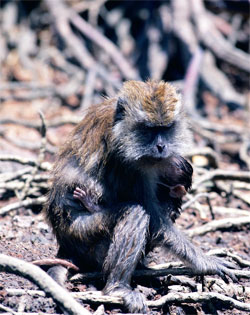
monkeys pulling crabs and small fish out
of holes in the bank.
Further up, Biddin points out a tree with
what looks like a bowling ball hanging
from it. “This is the fruit of the cannon
ball tree. It has a collection of seeds that
fit inside - the children make puzzles
from them as they can only go back in
the shell in one arrangement”.
Nearer to the sea, the boat emerges
into a wide area of water. In the sky
above, Langkawi eagles flash their red,
brown and white plumage. “The white
ones are the sea eagles – they will only
come for larger food.” Throwing some
chicken meat in the water, the eagles
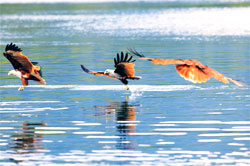
launch themselves down towards it. “There are small fish coming to the surface here, so the red eagles will go for them,” Bidden explains. During the ten minutes of exquisite choreography that follow, eagles dive to the water, extend their talons to grab fish and duck their heads to eat their prey while flapping back to altitude. The much larger sea eagles join the fray, grabbing the biggest pieces of meat before retiring to view proceedings from a tree at the edge of the lake.
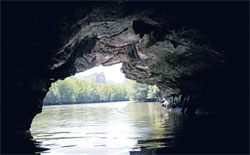
The river opens and narrows, as the boatman navigates by landmark and memory. Coming to a particularly narrow section, we pass through the hillside via a cave that just allows the boat to pass. Lining the roof of the cave are hordes of fruit eating bats, their soft chatter reflecting off the water as we pass.
Heading away for lunch, a visit to a fish farm floating beside a small island allows up close viewing of manta rays, spitting fish and barracuda. An excellent lunch with a view of islands and the slow swell of the ocean on a floating platform made the food even more enjoyable. Returning to the main island, a lazy Blue Lagoon afternoon beckoned, capped by a magnificent sunset across the beach at the resort, the small islands on the horizon lit up with oranges, pinks and mauves all reflecting from the ocean.
Watching the sunset over the ocean of Langkawi, it is important to give thanks to the absent Phoenix. Legend has it that the emperors of Rome and China wished to form an alliance by marrying their children. The Phoenix objected to this consolidation of power, abducted the Chinese princess and brought her to a pavilion on Langkawi. Rushing to her side, the Roman prince was attacked at sea by the Phoenix and his boat sunk. Washing ashore on Langkawi, he managed to reunite with the princess. Realizing the union was destined, the Phoenix left the world, providing sunsets and rainbows as memories of this beautiful creature.
Next day took us into the interior of the island. If the standard tropical island palette is dominated with blues from the sky and ocean, the interior is a kaleidoscope of green. Every imaginable tone and hue is present as the canopy closes in overhead and the narrow path moves between ferns, sassafras trees, cinnamon, rattan plants and dangling lianas. Trunks of trees are decorated with orchids and the pathway beneath is littered with torn up wild ginger, termite mounds and the determined trails of soldier ants. Leaf litter covers the ground beneath the canopy with a brown hued carpet, providing relief from the endless green light around.
Rustles through the trees signify the presence of wild hornbills. The smaller of the birds perch in nearby trees, their rattling calls vibrating through the foliage. The broken ground signifies predations from wild boar, searching for roots and grubs in the soft ground. A clatter in the distance welcomes a troop of monkeys hauling through the canopy in search of fruits and young shoots. During our slow journey through the forest, our guide highlights the constant wealth of plants which serve as sources of food and medicine to be found within.
Breaking our trip beside a small stream, the canopy gives way and fresh water flowing from the central spine of the mountain is crisp and cold. “This is fresh and can be drunk,” notes our guide, “since no-one lives upstream from here”. Bathed in sweat from the humid air, a dip in the water is a pleasant pick me up for the walk out. Pausing on the drive back to the hotel, a walk through the symmetrically arranged rubber trees displays the small buckets tapping the rubber sap. Though the growing of rubber is declining generally in Malaysia in place of palm oil, plantations still exist on Langkawi with the farmer’s house strategically located
in the midst of the trees. The wood is now being reclaimed for the making of strong, light and weather resistant furniture, most of it being shipped overseas.
We stop for lunch at an area know as Pantai Cenang, which boasts a wide variety of restaurants catering for all tastes from local Malaysian to Indian to Mediterranean. A soft rain during the evening washes the hotel and beach front, cooling the air and providing another spectacular slow motion light show as the sun dips down into the ocean.
My final day in Langkawi is all about the surrounding islands, moving off Pulau Langkawi and onto the watery trails of the archipelago. A boatman collects us early and a frothy trail of foam highlights our journey past the steep sides of small islands rising from water the color of aged jade.
A short ride from the jetty, we pause to view the silhouette of the pregnant maiden. Her face in profile, her swollen belly beneath her hands folded across her chest, she looks serenely toward the heavens. Rounding the headland, a jetty precedes a quick walk over the hill to be greeted by the vista of the Dayang Bunting lake. This oval shaped lake is surrounding by towering peaks and contains clean fresh water. An average of fourteen meters deep even at the edge, the lake was formed when a dolmite cave collapsed thousands of years ago. The resulting depression in the middle of the island filled with rainwater and formed the lake.
Legend has it that a celestial princess would come and bathe in the lake. One day, a mortal prince from the region chanced upon her and was smitten with her beauty. Extensive wooing ensued, involving songs and poetry, but all in vain.
A wise man offered that if the prince washed his face in the tears of a mermaid, the princess would fall for him. Having obtained the necessary mermaid through much labour, he succeeded in winning her favour and married the princess. She subsequently gave birth to a baby boy who died shortly after. Her husband revealed to be mortal, she buried the baby in the lake, bestowing it with magical fertility powers and returned to the heavens.
The beauty of the area is unsurpassed. The fresh clear water is welcoming as the heat of the morning develops. The water is buoyant and clear and a variety of small paddle or solar-powered boats allow for exploration by means other than arms and legs. For those so inclined, helicopter tours out of nearby Langkawi airport can be arranged that will provide a stunning view of the lake and island.
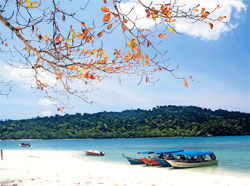
Leaving Dayang Bunting, we paused for a picnic on the sands of Beras Basah island. Small, with a wide sandy beach and shallow warm water, it provides another opportunity to soak up the rays and swim before heading back to the main island. A small resort offering a few rooms to lucky travellers and a satay picnic wards off hunger. Mature trees shade the beach and provide respite from the heat. The pulled up boats of travellers from the main island provide a splash of colour on the unspoiled stretch of sand. For those more adventurous, rocks and nearby island beckon. Pausing for only an hour or so, then it’s back on board the boat to head back to Telaga Harbor. On the way in, a cruise ship looms above the dock, serviced by a stream of shuttle buses taking tourists to the duty free shopping and other sights of the island.
Boarding the plane for Kuala Lumpur next morning is a sombre affair. Trying to cram in this magnificent archipelago in three short days only whets the appetite. The variety of vistas and the complexity of the islands call us back. The cable car (closed for maintenance in April), the Seven Wells, the Tujuh Telaga falls, the rice paddies baking in the sun but soon to be planted, parasailing and even a helicopter ride. The book of adventures to be fulfilled has only a few items ticked off and many more to bring us back time and time again.
Getting to Langkawi
Malaysia Airlines and AirAsia service Langkawi direct out of either KLIA or the LCCT. Firefly provides twice daily service out
of Subang airport. Bus or car to Kuala Kedah or Kuala Perlis to catch a ferry out the island. Ferries run frequently.
Getting around on Langkawi
Rental cars can be arranged for a daily rate either with or without a driver. Mopeds can also be rented for self drive on the island for a minimal amount. Roads are excellent and the network is easy to understand. Taxis are abundant and go to most locations.
  |
 |