By David Bowden
First-time visitors to Kuala Lumpur are usually
fascinated by the eclectic blend of architectural styles from
the old to contemporary, East to West, ornate to simple and
sometimes, stylish to garish. Even those who have lived here for
a long time constantly confront something new and if one of the
aims of architecture is to challenge the senses, there are many
buildings in the capital that do this either by design or default.
For a city that really only dug its first foundations in the 1850’s
with the discovery of fluvial tin in the Gombak and Klang Rivers
that pass through what is now the city centre, Kuala Lumpur
looks older than it really is. While many other parts of Malaysia
have a longer history, the KL landscape is only recent and one
that is constantly changing from simple villages or kampungs
to the nation’s pride and joy; the 421m-high Petronas Twin Towers.
The city evolved from makeshift mining camps and was
influenced by Malaysia’s multiculturalism and colonial
governance through to independence and then, the nation’s
emergence as an important regional economic tiger. Each era
has left its mark on the city’s architecture and because Kuala
Lumpur’s history has had so many influences, the structures that
line the cityscape are an expression of this diversity and variety.
In some parts of the city, mosques, temples and churches of
varied architectural styles are located in close proximity.
A Walk Through History
Despite the heat and humidity one of the best ways to take in
Kuala Lumpur is via a well-structured, self-guided walk or series
of walks. Alternatively, jump on the ‘KL Hop-On Hop-Off City
Tour Bus’ (www.myhoponhopoff.com) which travels the city
from 8.30am to 8.30pm and takes in the main sights including
architectural landmarks and precincts such as the Twin Towers,
Merdeka Square, Chinatown, Central Markets and Kampung Baru.
For those interested in the preservation of Malaysia’s built heritage, a visit to Badan Warisan (Malaysia’s National Trust) in downtown KL is an essential stop. The trust provides excellent information, a bookshop and daily (Mon-Sat) inspections at 11am and 3pm of a delightful antique, wooden Malay house, Rumah Pengulu Abu Seman located in the gardens of their headquarters. This Malay headman’s house dates back to 1910 from the state of Kedah and was acquired by Badan Warisan before being relocated to KL for all to admire. Typically, traditional Malay houses have a private space for women in the household and a public area for entertaining male visitors.
Badan Warisan is located at 2 Jalan Stoner (T: +603 2144 9273, www.badanwarisan.org.my) opposite the Royale Chulan Kuala Lumpur Hotel.
Traditional East Coast Architect ure in
the City
The Royale Chulan is also an interesting
building that is typical of several others in
KL as it incorporates elements of vernacular
architecture into its modern design. The
hotel’s architects have incorporated East
Coast styles from the state of Terengganu
noted for their sharp, elaborate exterior
profiles and excellent decorative detailing.
From the front of the hotel, twelve columns
are featured (referred to as Rumah tiang
duabelas); the same number of pillars
traditionally used in the design of ornate
wooden palaces of Terengganu.
The most distinctive feature of the hotel’s
exterior is the wide roof fascia boards that
decorate each gable end and which rise to a
sharp apex. Tiles were typically used on the
East Coast too whereas in many other parts
of Malaysia, attap or thatching was more
common. The houses of the East Coast
reveal a lot about climate of the area which
can be extreme from heavy monsoonal
rainfall followed by high temperatures.
Structures were typically constructed high
off the ground on a series of pillars to
enable the circulation of air and to keep the
house above any floodwaters.
Elaborate carvings are a feature of
East Coast buildings and as a general
rule; the royal buildings were more
complex and ornate than those of
commoners. Wall panels are intricately
carved often in the shape of plants,
flowers and foliage. Nails were rarely
in the construction of buildings but
rather were fitted together like a jigsaw
puzzle through the use of mortises and
tenons. This meant the buildings could
be dismantled and moved to another
location if the need arose.
A walk through the Royale Chulan Hotel
shows how some modern architecture
in the city borrows from the past. Look
out for details such as internal columns
that are thicker at the base than the top,
carved fascia boards, ornate supportingbrackets, Arabesque geometric tiles,
wood-carved flower motifs and
chandeliers in the shape of lotus flowers.
Padang Precinct
On August 31, 1957 Malaysia came of
age when independence was declared
at Merdeka Square or the Padang in
front of the Tudor-styled Royal Selangor
Club. Each day scores of tour buses
stop here for camera-totting tourists
to fire off a few frames of the imposing
buildings that line the streets. This is
arguably the best location to take in the
city’s eclectic architecture.
It is also the centre of colonial KL
although the construction of new
buildings on the fringe is presenting
a new face for the city. The black and
white facade of the Royal Selangor Club
lines one side of the field (padang) where
cricket was once played. On the other
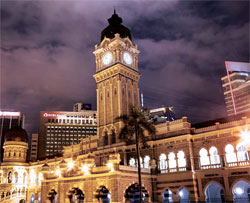
side is the beautiful copper-domed Sultan
Abdul Samad Building that dates back
to 1897. This brick building with arched
colonnades and parapets is one of the
most photographed buildings in the
city and stands in marked contrast to
the modern, Islamic-inspired Dayabumi
Building that adjoins it. In the evening,
twinkling fairy lights make the view even
more impressive.
The Sultan Abdul Samad Building was one
of the first Mughal-styled buildings to be
constructed in the city and set the trend
for other similar-styled structures. It was
originally to be designed along Renaissance
architectural lines until the State Engineer
C.E. Spooner intervened to insist upon a
building that was more appropriate to the
Islamic-dominated community.
Continue down Jalan Sultan
Hishamuddin to the famous Kuala
Lumpur Rail Station which still operates
as a train station but is now underutilised
as the city’s rail hub has moved to KL
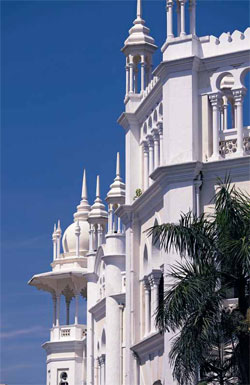
Sentral; one stop down the line. Its
architecture and that of the more sombre
grey Railway Headquarters located
opposite looks like it’s straight out of a
scene from the Arabian Nights. Looking
more like a wedding cake, rumour has
it that the structure was designed to
withstand snow storms in line with the
then policy of English rail architecture.
In his book The Great Railway Bazaar by Train Through Asia Paul
Theroux describes the station as: “the grandest in southeast Asia,
with onion-domed cupolas, minarets, and the general appearance
of the Brighton Pavilion, but twenty times larger.”
Despite looking older, the station was only completed in 1911 but
the railway headquarters were delayed until after the cessation
of World War 11. Immediately adjacent to the latter is the shell of
the former Majestic Hotel which, one day, will be resurrected as
a boutique heritage hotel for visitors to the city to re-live an era
when rail travel dominated transport around the peninsula.
Retracing one’s path back towards the Padang, visitors will see
two modern Malay buildings that reflect Western and Modernist
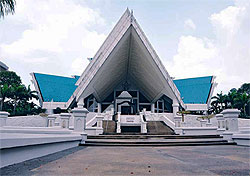
influences. Masjid Negara or the National Mosque dates back to 1965.
Its design is a departure from the strict symmetry of earlier mosques
built in Malaysia and has what architects describe as a ‘free plan’
(form follows function). Its circular, umbrella roof of two-tone blue
tiles is the building’s most radical departure from traditional design.
Just up the hill and opposite the National Mosque is the Islamic
Arts Museum of Malaysia (IAMM) which opened in 1998. Apart
from having the best Islamic arts collection in Southeast Asia, the
exterior design of turquoise domes and Iranian tiles makes it a
‘must visit’ landmark in the city.
Return back to the Padang past the Mughal-styled buildings
that now house the National History Museum and the Textile
Museum on the other side of the road. In the far corner of the
Padang is St. Mary’s Church which would not look out of place
on an English village green.
Little India and Chinatown
A short walk from the Padang down Jalan Tun Perak leads to the
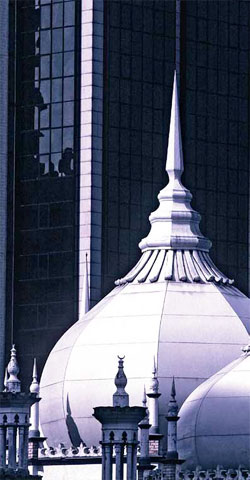
Masjid Jamek Mosque at the confluence of the Gombak and Klang
Rivers. This is where the city started so it is only fitting that one
of the most ornate mosques be located here. Built in 1909 it is the
city’s oldest mosque and unusual in that it was built from red
brick and marble. The setting is shaded by palm trees and serene
in all aspects but it can get very crowded around prayer times
especially at Friday lunchtime.
From here, visitors can branch off to Little India or Chinatown
where the architecture is completely different to the area
around the Padang. Between the two areas is the skyblue
Central Market which dates to the 1930’s when it was
established as KL’s main produce market. It now operates as
a market selling popular Malaysian souvenirs. There are also
many restaurants here to rest before heading off to KL’s modern
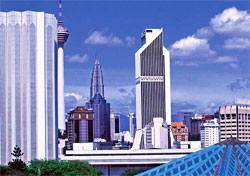
commercial and retail heart where towering skyscrapers
dominate the skyline.
Landmark Structures
There was a flurry of architectural activity
after Malaysia gained independence
in 1957 with some buildings being
an expression of nationhood and the
future aspirations of the young nation.
Vernacular materials and design have
been incorporated in the designs of some
landmark public buildings; others have
gone back to Mughal roots while others
are completely modern in their design.
Academics sought to establish a
Malaysian identity or architectural
heritage especially with the construction
of national symbols such as the
Parliament House and the National
Museum. The result has been labelled
‘traditionalist functionalist’ by
architectural boffins and examples of this
style are reflected in the steep, pitched,
gabled roof of landmark buildings such as
the National Museum. Murals expressing
nationhood were incorporated into the
building design and others in the city like
Dewan Bahasa dan Pustaka (Institute of
Language and Literature).
In other parts of the country, especially
Negeri Sembilan, the horned or upturned
roof of the Minangkabau can be found in
many buildings.
As the economy expanded, so grew the
desire to build landmark headquarters
for successful conglomerates. Some of
these included mega projects such as the
Petronas Twin Towers, the Kuala Lumpur
International Airport and the new garden
city of Putrajaya.
Some of the more interesting recent
buildings to visit in Kuala Lumpur
include the National Library, National
Theatre and National Art Gallery
located near each other on Jalan Tun
Razak not far from Lake Titiwangsa.
All have striking rooflines with the
National Theatre resembling the outline
of a seri junjung or traditional Malay
headgear while that of the National
Library looks like a songket tengkolok or
traditional folded brocade headgear.
The roof of the National Art Gallery
evokes overlapping bumbung panjang (a long ridged roof) of a gajah menyusu
house (supposedly in the shape of
a suckling elephant). The suckling
elephant may be lost on many visitors
but the exterior and the art collection
inside make worth dropping by.
A journey along the Federal Highway
heading west out of the city centre also
reveals two interesting architectural
features including the arched gateway
that delineates the border between the
Federal Territory and Selangor state. Just
before the gate is the imposing Telekom
Tower that makes reference to its South
East Asian location while incorporating
‘smart’ design features to accommodate
the harsh tropical climate.
New buildings reach ever skyward in
the city centre with an explosion of
recent condominium development.
The jury is still out as to whether these
will make a long-term and positive
contribution to the city but most can be
guaranteed to challenge all those who
view them.
  |
 |