By Sarah Rees
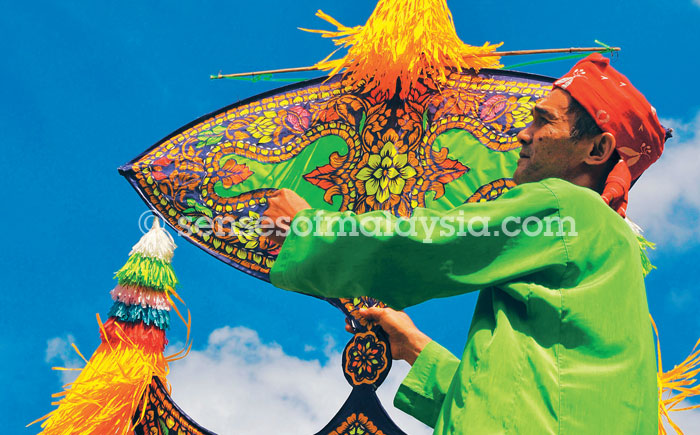
Kite-flying is one of those simple pleasures that can transcend borders, and people from all countries and walks of life have delighted in the simple thrill of throwing a kite skyward and watching it dance on the wind.
Kite-flying is one
of those simple
pleasures that
can transcend
borders, and
people from
all countries
and all walks
of life have
delighted in the simple thrill of throwing
a kite skyward and watching it dance on
the wind.
The first recorded kites were found in
China nearly 3,000 years ago, when
they were used for all manner of things:
signalling, lifting, military operations,
measuring distances or simply testing
the wind. Kites soon sprang up all over
the world, and though their exact date
of arrival in Malaysia is not known, they
quickly became an important part of the
traditions of the local people.
As the kite phenomenon spread
throughout the land, most states
developed their own style of kites
and these beautiful creations were
traditionally flown to celebrate a good
harvest. Kite-making has always been
seen as a real skill, and none attracts
more attention than the kites that are
created in the Eastern states of the
peninsula, particularly in Kuantan and
Terrenganu, where their distinctive
style of kites – known as the wau - have
become something of a cultural symbol as
well as a huge tourist draw.
Now you no longer need to have stepped
foot in the eastern states to be familiar
with the wau. These kites have become
a national icon, appearing on the back of
some 50 sen pieces as well as inspiring
the logo for the national carrier Malaysia
Airlines. Souvenir shops are full with
ornamental waus of all shapes and sizes,
and many a tourist suitcase returns home
full of waus for relatives and friends.
The wau has been flown in Malaysia for
a variety of reasons, and in Kuantan it
was thought to be able to ward away evil
spirits thanks to a small device called a
busul. This device was attached to the
frame of the kite and made a humming
noise when the kite is in flight, scaring
away any nasties lurking in the area.
The word wau is often translated as
“kite”, but it actually got its name from
the Arabic letter that is pronounced “wau”
that bears a resemblance to the distinctive
shape of the kite.
The waus are made using bamboo sticks
that are bent into the distinctive shape
and tied with string, before being covered
in tissue paper or fabric. They are often
elaborately decorated in a traditional style,
sometimes covered with batik, and are
prized for their aesthetic beauty as well
as their ability to fly well. Making a wau
takes a lot of skill and craftsmanship, and
those who possess the skills are highly
valued in the kite-flying community in
Kuantan and Terrenganu.
And while the wau is becoming an icon
and a must-have souvenir, these kites
are still hugely popular for their original
function – flying – and while many
people indulge in the past-time for sheer
pleasure, many more delight in taking
part in the various contests that are held
all over the country. Kites are judged in
every way you can imagine: from how
good they look to whether they can knock
other kites out of the air and, of course,
how high they can fly.
The biggest kiting contest on the
calendar is undoubtedly the Pasir Gudang
International Kite Festival, which has been
an annual event since its inception in
1995 and is steadily growing into a huge
national and international event. Pasir
Gudang is a small town east of Johor, but
for 6 days each February it is swamped
with kite-enthusiasts from all corners of
the globe.Competitors come with their
kites from as far away as Europe, while
thousands of spectators gather just to
watch them in action and admire the
beauty and the sheer variety of the kites
on display.
The event also offers demonstrations,
impressive ground displays and a fiesta
type arrangement of stalls selling
food, drinks and all the kite-related
paraphernalia you can imagine. There is
even a kite museum in the grounds of the
competition site, and people of all nations
and races come together to celebrate the
age-old pleasure of kites.
It is remarkable, in this world of modern
technology, that something as simple as
the humble kite can have prospered for so
long. Kites have been a part of our culture
for thousands of years and yet never
grown old. Indeed, most interestingly, it
seems kites appeared in many countries
simultaneously rather than having been
spread via travellers, thus suggesting
that human beings worldwide were, and
remain to be, magnetically attracted to the
magical process of flight. For a little piece
of the magic this year, Pasir Gudang is the
place to be.
-----------------------------------------------------------------------------------------------------------------------------------
Note: The Pasir Gudang International
Kite Festival,
15-20 February
www.kitefestpasirgudang.com


