 Enter the Dragon
By Hugh Ujhazy
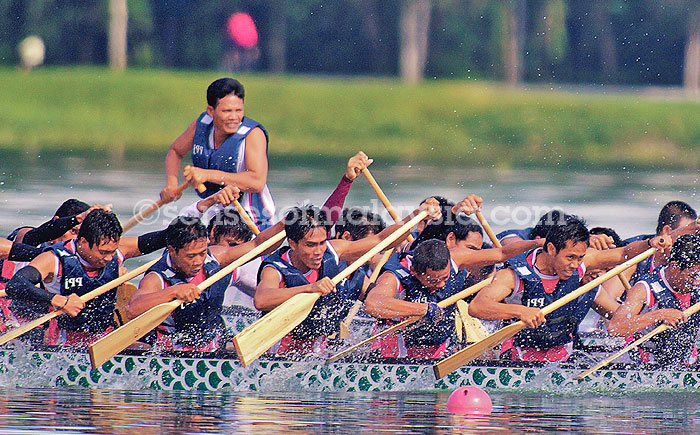
A CRASH OF DRUMS AND THE THRASHING OF PADDLES ON WATER CAN ONLY MEAN ONE THING: DRAGON BOAT RACING. HUGH UJHAZY PLUNGES INTO THE HISTORY OF THIS EXCITING EVENT AHEAD OF TWO RACES SCHEDULED TO TAKE TO THE WATERS AROUND MALAYSIA IN JUNE.
 Throughout parts of the US with significant Latino
populations, 5 May is known as Cinco de Mayo
(literally, "fifth of May"), a day marked as a time
to celebrate the cultural values brought by those
of Mexican ancestry. The date is also observed in
certain parts of Mexico as the day their country
took a strategic step towards ending the occupation by France
in 1862.The Mexicans took on an army of some 8,000 French
infantrymen with a poorly equipped group of only 4,000… and
won. The battle took place on 5 May and ultimately led to the
French being ousted in 1867 with the help of the Americans, newly
unified after the conclusion of their own Civil War in 1865.
On the other side of the globe, the fifth day of the fifth month
(albeit according to the Chinese Lunar Calendar) is the day of the
Dragon Boat Festival. Celebrated in China from 22-24 June, the
day has been an occasion for exploring traditional folk customs
in China for over 2,000 years.
Throughout parts of the US with significant Latino
populations, 5 May is known as Cinco de Mayo
(literally, "fifth of May"), a day marked as a time
to celebrate the cultural values brought by those
of Mexican ancestry. The date is also observed in
certain parts of Mexico as the day their country
took a strategic step towards ending the occupation by France
in 1862.The Mexicans took on an army of some 8,000 French
infantrymen with a poorly equipped group of only 4,000… and
won. The battle took place on 5 May and ultimately led to the
French being ousted in 1867 with the help of the Americans, newly
unified after the conclusion of their own Civil War in 1865.
On the other side of the globe, the fifth day of the fifth month
(albeit according to the Chinese Lunar Calendar) is the day of the
Dragon Boat Festival. Celebrated in China from 22-24 June, the
day has been an occasion for exploring traditional folk customs
in China for over 2,000 years.
The festival commemorates the Chinese folk poet Qu Yuan
(340-278 BC), who was a minister of the state of Chu, one of
seven warring states prior to the unification of China. Slandered
by a rival aristocrat and subsequently exiled by the king,
Qu Yuan wrote many enduring poems
and is regarded as a famous poet in
Chinese history. He wrote his final poem,
"Embracing the Sand," in 278 BC, after
which he threw himself into a river
rather than see his beloved country
occupied by the Kingdom of Qi. Local
people searched the river for the poet's
body, sailing up and down in boats and
throwing food into the river, hoping to
distract fish from eating his body. Thus,
dragon boat racing and eating zongi
(rice dumplings) have become central
elements of the festival.
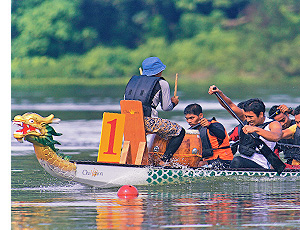
Dragon boats are named for the shape of
the bow and stern of the boat, emulating
the look of mythological Chinese dragons.
Rowers compete to reach the finish line
first, with legend suggesting the winner
will bring good harvests and long life to
the people of his village. Now, centuries
after Qu Yuan threw himself into the
river, the boats have been thoroughly
modernised and replaced with a
lightweight hull, carbon fiber paddles, and
teams who train continuously to maintain
their form.
Races occur regularly in Hong Kong,
Singapore, China, and Japan, and of course
in Malaysia. Two big dragon boat events
happen around the time of the festival.
The Penang Dragon Boat Festival is in its
33rd year and runs from 30 June to
1 July this year. Taking place on the Teluk
Bahang Dam in the northwest of Penang
island, the event will be bracketed by
events in Macau (23 June, also the day of
Dragon Boat Festivals throughout China)
and Hong Kong (4-8 July).
The Penang event hosts competitions
across both 200- and 500-metre courses
for men and women, showcasing the
22-racer boats as well as the smaller
12-racer events.The larger boats offer quite
a spectacle as the 22 rowers beat the water
to a froth as they race for the finish.The
500-metre races are completed in a matter
of only four minutes as the rowers propel
the boats through the water at almost
eight kilometers per hour. Synchronized by
a drummer positioned in the bow, rowers
must perform together to ensure the boat
goes as quickly as possible as they race to
claim the winners' trophy.
Over in East Malaysia, the Sabah Dragon
Boat Race will be held on 16-17 June. This
year marks the event's 27th year and
it regularly attracts teams from across
Malaysia, Singapore, Indonesia, Thailand,
and throughout the region. Last year,
thousands of locals and visitors attended
the event to cheer on local teams and
watch the prowess of the rowers. The
Sabah Dragon Boat Race is held on
Likas Bay off the coast of the capital,
Kota Kinabalu.
Whether your interest is confined to
the Peninsula or you prefer to wander
further afield to Borneo, the Dragon
Boat Festival season is a time to indulge
in some Chinese culture, spend a day
beside the water, and watch some serious
competition in a friendly environment.


