By Ashleigh Seow
ASHLEIGH SEOW TELLS THE
SAD BUT TRUE STORY OF THE
DUGONG - A MAGNIFICENT
SEA CREATURE WHICH FACES
EXTINCTION DUE TO HUMAN
ACTION AND INACTION
An early sun was already
warming the shallow
waters of the bay,
promising a hot day
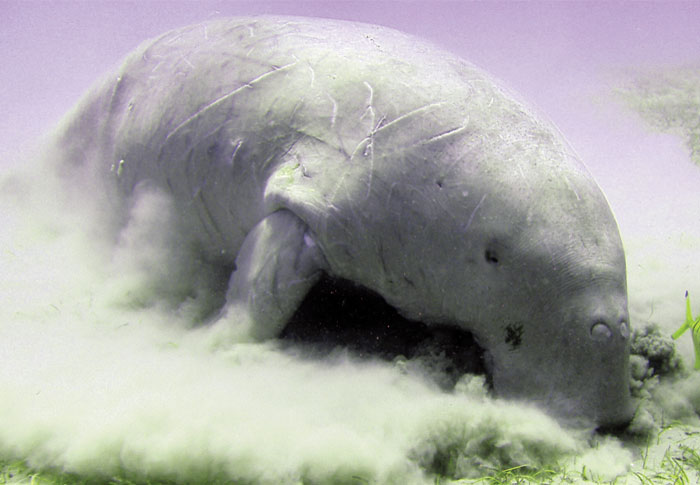
ahead. The dugong
and her calf swam
leisurely across an inlet, like pale-skinned
tourists against the emerald water,
after a breakfast grazing the seagrass
buffet. Every day they moved feeding
grounds, mowing their way though the
sea grass plains like a grass-cutting crew,
favouring the shallow warmer waters in
the mornings then moving to cool deeper
water in the hot afternoons.
They were fortunate to have found this
large untouched bay. Their previous area
was unable to sustain a viable population
anymore as the rivers became increasingly
murky and fouled with the metallic tang
and bitter tastes of industrial chemicals,
oils and household refuse as more of the
coastline came under development. The
once extensive sea grass had begun to
die from poisoning or the lack of light
for photosynthesis. The mother stopped
to rest and touched her calf with her flipper
as it nursed. She was 40 years old and this
was her fourth child. Dugongs become
reproductively mature at about the same
time as humans, in their early teens,
but pregnancies usually occur in the
mid-teens. A dugong carries her baby
for approximately 14 months before it
is born in the warm shallow waters of
a tropical bay before being brought to
the surface for its first breath of air. The
interval between births is about 3 to 7
years reflecting the long 18 months that
the baby is nursed before it is able to
feed solely on seagrass. It also requires
guidance for some time after weaning
before it goes its own way. The birth
intervals can widen due to environmental
stress, for example if there is lack of food
and safety.
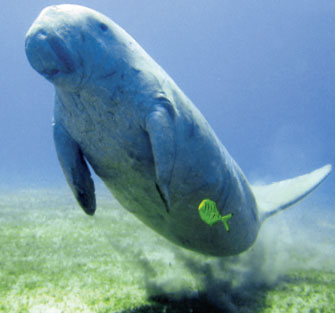
The common name “dugong” comes
from the Malay “duyong” meaning lady of
the sea. Although their scientific name
“Sirenia” comes from the Greek “seiren”
(seductive sea nymphs), they should more
appropriately be considered “mothers
of the sea” than mermaids. Their closest
land relative is the elephant.
 |
Wild dugongs can live to their mid-70s,
but her first two calves had died before
maturity. The first on a day like this when
they had been relaxing on the surface and
the calf playing. It was her inexperience
in not recognising the whine of the
propellers. When she realised and started
to dive it was too late for the calf – the
spinning blades slashed its back; the blood
a crimson bloom staining the blue-green
sea. The craft stopped and the passengers
chattered excitedly while the mother
stayed to support and nuzzle the dying
calf. After an hour she had to leave as the
blood plume had attracted a bull shark,
a powerful coastal predator. Living in
shallow coastal waters, the short-sighted
dugongs are very vulnerable to boat strike,
especially from fast boats or larger craft
which can drag the almost neutrally
buoyant dugong into the propellers even if
it is not on the surface.
Her second child did not survive either.
They were grazing on seagrass when she
heard the propellers. They tried to flee but
are slow swimmers, barely faster than a
good human swimmer. They have nasal
nostrils rather than blow holes, making
breathing while swimming fast more
challenging than for dolphins and whales.
The boat caught up and a harpoon was
hurled into the calf’s back. She was older
and stronger and fought the rope so the
harpooner “played” the line as though
she was a fish. Eventually, when closer to
the boat, a second harpoon was thrown
to ensure the dugong did not slip off and
sink. She soon stopped struggling – a
pink froth bubbled from her nose – a
lung was punctured. The boatmen pulled
her head out of the water and held it by
the side of the boat and started putting
things under her eyes. “Minyak air mata
duyong” (mermaid tears) are believed to
be a powerful love potion. When dugongs
are caught these “tears” are released and
collected while it is still alive. A rope was
attached to the tail fluke and she was
towed away, slowly drowning. In some
places in southern Thailand and northern
Malaysia, the mammary glands are cut off
to make other types of love potions.
Dugong products are a valuable
commodity. Besides the tears, the tusks,
bones, teeth and tail are in demand for
ornaments, “medicines” or Arab dagger
handles; the flesh is considered better
than beef and the fat used in ointments
or, in some places, fuel for lamps. Every
culture on the Indian Ocean rim from
Tanzania to the Arabian Gulf, Iran, India,
Southeast Asia and the Western Pacific
from China and Japan down to Australia
and Oceania are traditionally devourers of
the dugong.
Later the pair moved off to a patch of
seagrass to spend the night. Sleep is
a series of naps of 8-10 minutes after
which they surface, breathe and slowly
sink to the bottom again. On one of these
sleep cycles the mother was awoken by a
strange muted rumbling.
While the calf still slept she began to see
fish all moving in the same direction.
She roused the calf and followed. The
rumbling grew louder; she heard clanking.
By now everything was in flight: sharks,
groupers, sting rays, squid, fish of all
shapes and sizes. The seagrass was
illuminated by several small moons, a
vast dark shape appeared; thousands of
creatures caught inside a gigantic maw
still open and feeding on fish. She swims
desperately, the frightened calf beside her.
They surface to breathe at increasingly
short intervals as the lactic acid builds up
in their tired muscles, each breath slowing
them down. Their heart rate escalates.
Soon the calf cannot keep up: the mother
pauses, maternal instinct strong, but
realises that her responsibility is to
survive and hope that the calf somehow
escapes. The trawler comes remorselessly,
ripping up coral and sea grass like a
bulldozer in a forest. Her tail is already in
the maw when a blaze of pain engulfs her
and then nothing.
The net is hauled on deck. The crew sorts
the catch – commercial fish, rays, grouper,
snapper are put in the hold but the bycatch
of species considered worthless,
often broken bodies barely alive, is tossed
back to the sea.
The calf, an air-breathing mammal, was
fortunately not crushed and was caught
just before the net was hauled up; it is
tossed overboard alive, now on its own
without its mother’s guidance.
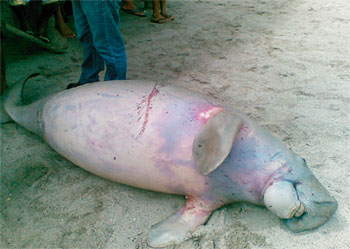
The only “fiction” in this story is in
attributing these events to the life of one
particular female dugong. Dugongs are
regularly wounded or killed by boat strike;
in Thailand, Indonesia, Malaysia and
the Philippines, dugong tears, and other
dugong body parts are collected and sold
by local people to traders.
 |
But the hazards of propeller blades and
traditional dugong hunting is limited
compared to the decimation of dugong
numbers caused by city dwellers when we
pollute and destroy their food resources
and encourage unsustainable commercial
fishing by our insatiable hunger for
seafood. Every year many dugongs
drown in fish nets, die from explosions
caused by blast fishing and those “lucky”
ones that survive all these hazards
face malnutrition in those areas where
industry and development are destroying
the marine environment.Whether it
is Singapore’s land reclamation in the
Johore Strait; pesticide and fertiliser
run-off from agricultural industries; the
demand for “minyak air mata duyong”;
those who simply seek wealth or material
gratification without a care for the
environment, or those who fail to take
action, we are all at fault.
The largest populations of dugong are
now in Australia where most research
takes place, next is the Arabian Gulf and
the third is New Caledonia in the Western
Pacific. These places are at the limits
of the range. In the centre, the Indian
Ocean and Western Pacific coastal belt is
fragmented by habitat loss, dugong are
increasingly rare.
It is especially sad what is happening to
dugongs. Almost alone among mammals,
the dugong does not hunt or injure us,
nor does it eat our crops or our domestic
livestock; compete for food with us
or our animals; damage our homes or
property; transmit deadly diseases to us
and the like.
The dugong is truly inoffensive. But in
Southeast Asia in grim pursuit of gross
materialism, dumping the by-products of
that desire into the seas, dugong have no
choice but to swim into extinction unless
we realize that by saving the dugong and
the seas we save ourselves.


