By Ashleigh Seow
For most visitors, the Malaysian outdoors is seen on short
walks or day trips from a hotel or resort. Few venture to
camp in the forest. Malaysian campgrounds are unknown,
often poorly run and dirty and safety can be a concern. It is
even tougher with children.
This is disappointing to those who were used to camping in their home
countries and miss the outdoor lifestyle.
My family has been going to the Chiling waterfall for several years.
One hour away from Kuala Kubu Bharu on the Frasers Hill road, this
area offers an authentic rainforest experience which is unspoilt yet
reasonably accessible.
Lauded by the authoritative Waterfalls of Malaysia website (http://www.waterfallsofmalaysia.com) as “probably the most beautiful waterfalls
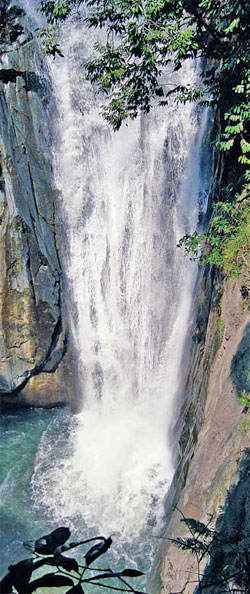
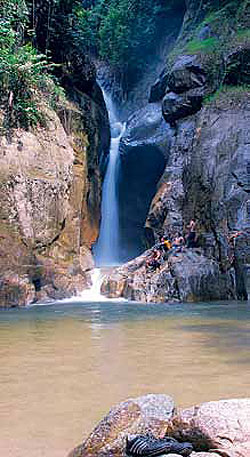
of Selangor,” the lower Chiling is a three-tiered waterfall. Whatever the
season, the mountain waters flow powerfully as shown by the cave
which was hollowed out by the final tier of the waterfall.
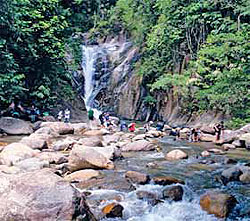
Refreshingly free of the dirty food stalls and crumbling infrastructure
that usually litter such scenic places, Chiling does not even have a car
park which makes all the difference as large tourist buses seldom go
there. There is just a neat ranger’s hut and shower block at the entrance
where one registers with Viji, the head ranger, or his deputy, Noordin.
The fee for a day is only 50 cents, but even if you intend to camp it is
only RM5 per person, though a RM100 refundable deposit is required
to ensure that you clean up after yourself before you leave. You are
allowed to build a campfire and, as for security, there is always a ranger
on duty when campers are around. The electricity for the facilities
comes entirely from solar power.
The pristine condition of the environment it is due to the river being a
fish sanctuary and Viji and Noordin, who are actually fisheries officers,
are responsible for monitoring the quality of the water. Their success
in keeping the environment clean is attested by at least six species of
colorful dragon and damsel flies (which need clean water) and lots of
fungi (which need clean air). Perhaps more parks should be handed
over to Fisheries. While the trail and river crossings are clearly marked,
if you are new to the place it is best to go with a guide. On our first
time we went with Happy Yen, an experienced and licensed nature
guide who is mentioned in the Lonely
Planet (not all guides are licensed or are
wilderness guides so one should always
ask for proof). Yen has been coming here
for nearly 30 years, knows it well and is
confident enough to turn a group around
at the first sign of an unacceptable risk.
For the walk, lightweight trousers or shorts
are recommended as there are several river
crossings ankle to mid-thigh deep. Your
shoes will get wet. The walk is invigorating
and the trail is cooled by the mountain air
coming down the valley. Fish are clearly
visible at some of the river crossings,
mainly kelah (the Malaysian mahseer); an
important game fish. While sitting by the
bank, I saw another fish leap up salmonfashion
to the higher level of the rapids. We
stopped often to enjoy views or the playful
antics of the river’s inhabitants.
The Chiling watershed has orchids,
nepenthes (pitcher plants) and interesting
bamboos as well as well-known primary
forest species. Part of the forest has
been logged and the contrast between
the logged areas and the pristine forest
reveals the myth of “sustainable logging”
by the timber industry.
Most interesting on the walk were the
insects which come in a myriad of
colours. Some, like a metallic multicolored
beetle, which looked like an electronic
component, posed obligingly for our
cameras. Others, like the green and black
damsel fly coyly kept their wings closed.
The first glimpse of the falls is the torrent
shooting out from the upper falls which
leaps several meters away from the rock
face before falling to the first pool. The
force of the fall can be imagined when one
sees the size of some of the trees which
were thrown up on the rocks metres above
the present water level. While the bottom
pool can be swum or waded in perfect
safety, the middle and upper plunge pools
should not be entered as the water is too
aerated to support a swimmer.
Occasionally, climbers are seen abseiling
the two rock formations that look
like gorilla heads. The falls are often
deserted during the week and Happy Yen
told of a German couple who decided
to return to a natural Eden while he
discreetly retired behind a rock to brew
up some coffee for them after their frolic
in the waterfall. On weekends there are
more people but thankfully the louts
and touts are absent. The walk is too
much like work for them.
If you are keen, a trail leads on to the
upper falls and into the mountains. It is
steep, challenging and exposed in places
and no place for young children, the
inexperienced or the ill-equipped. Even
those who do not fall into any of those
categories will need a guide. But if you
just want to chill out at the campground
no guide is necessary. Sometimes we
do not visit the waterfalls at all and our
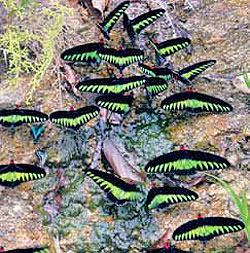
children just play in and around the river
where a salt lick often draws scores of
Raja Brooke butterflies.
Whether you go all the way to the waterfalls
or just play by the stream, Chiling Falls is a
place to return to often as we do.
----------------------------------------------------------------------------
GETTING THERE
Happy Yen can be reached at happyyen@gmail.com or through his website at www.happyyen.webs.com. The falls are 12 km beyond KKB on the Fraser’s hill road. Chiling is 100 metres after the arch bridge after the Selangor dam. The Fisheries officers take bookings for camp sites on +6019 2405491
  |
 |