By Ashleigh Seow
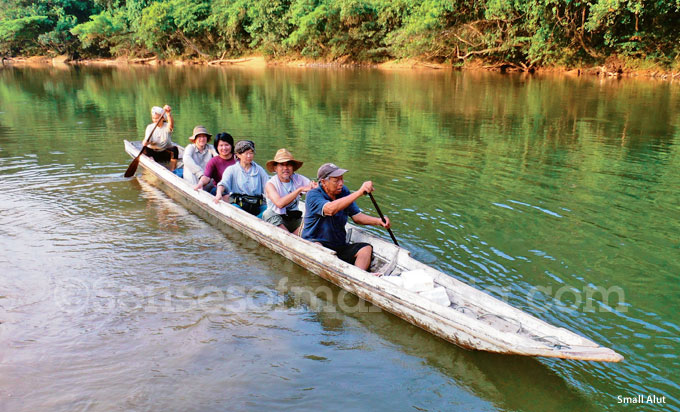
Ashleigh Seow takes a wild and wonderful canoe ride down the Baram River in Sarawak.
River journeys by
canoe are special.
Trips in planes, trains
and automobiles,
even ships, become
monotonous and
travellers soon turn
their thoughts inwards and begin to
listen to IPod music, read books or start
conversations. This boredom does not
arise in a canoe; the river provides its
own music and the conversations of the
animals keep your attention focused
outward. If you doze too long the rapids
will wake you up with a playful spray.
Children seldom ask "how much further,
is it?" as every bend has something new
to see.
Recently, I was reminded of the joys
of river travel when I joined a group of
nature enthusiasts on a trip down the
Baram River in Sarawak. The plan was
to travel in 'aluts', native canoes, from
the upper waters in the WWF's Heart
of Borneo conservation area to the sea;
a journey that has not been done since
colonial times (at least by non-natives).
We flew in Twin Otter aircraft and rode
4x4 trucks to our starting point. We stayed
in longhouses most nights as paying
guests of the Kenyah people. Lunch was
an outdoor barbecue on the river banks
with food we had either bought from
the longhouses, caught from the river
or foraged from the forests – kampong
chicken, various fish, deer, wild boar,
bamboo shoots, ferns and even naturally
pink coconuts! A side trip up a tributary
brought us to an animist spirit house to
listen to the people explain their religion,
Bungan, which is still practiced in this
remote area – a solitary holdout against
the onward march of Christianity which
has converted most of the indigenous
people of Sarawak.
Coincidentally, the triennial Baram
Regatta was on at the same time and
we had planned to arrive at Marudi on
the first day. The Regatta was initiated
by Charles Hose, colonial administrator
and naturalist extraordinaire, as a means
of waging peace on the lawless, warring
Dayak tribes of the upper, middle and
lower Baram. This plan (and the building
of strategically placed forts) worked: the Dayaks had a bloodless,
and headless, mock battle, drank copious amounts of borak (rice
beer) and competed in canoe races and other events. There was
peace on the Baram. It has been held ever since.
We had not realised that the Sultan of Brunei would also be
attending and this knocked our plans awry for almost all able
bodied Dayaks, especially boatmen, travelled to Marudi to
compete in the regatta or see the Sultan whose ancestors had
ruled them till 1882 when the White Rajah Charles Brooke became
their overlord. We could not find any large canoes, and boatmen,
to bring us through the ferocious rapids above the middle Baram.
So rather disappointedly, but probably wisely for our safety, we
took to 4x4 Toyotas to bypass the rapids and re-joined the river
lower down.The scenery was some compensation as we saw
Gunung Murud Kechil, the Usun Apau plateau, the horn shaped
extinct volcano Bukit Kalulong and unknown peaks form the high
road along the ridge although we had three flat tires between four
cars. It would have been shorter and quicker by boat as the road
took a long detour to get to Long Lama a trading settlement once
renowned for its birds’ nests which were traded with China.
We arrived by river in time to see a race between war canoes and
200 furiously paddling Dayaks. We watched several more races
over two days from the cliffs at Fort Hose. In the evening we learnt
the hornbill and ngajat (warrior) dances to the sound of sape and
wooden xylophones and mingled with the people of the Baram.
After two days we left by express boat for Miri and the coast.
Note:A trip which includes the Regatta can only be made
every three years. However a shorter journey of 3-4 days
can be done before the December – March rainy season
on the Upper Baram from Selungo/Long Semiyang to
Long Makaba stopping before the big rapids. Trips can be
arranged through Guide Willie Kajan on +6012 872 9159
and Dominic Langat +6014 599 3686 or visit
www.borneotrekkers.blogspot.com


