By David Bowden
I wasn’t sure whether the pilot of our 19-seater MAS Wings aircraft was serious or not when he informed us to turn off our mobile phones as they would be useless for the duration of out three days in Ba ’Kelalan. We were preparing to take off for this remote community in the Sarawak interior located near the border with Indonesian Kalimantan. He had already cracked a joke in saying: “Feel free to move around the cabin,” after we had packed ourselves like sardines into the cramped Twin Otter aircraft, so I wasn’t too sure.
It turned out that he was serious about both our mobile phones and the inability to move around the aircraft. It seems amazing these days that there are places in Malaysia beyond the range of mobile phones. This was the first of many amazing things that I was to discover in this isolated Christian community one hour’s flying time from Miri.
Had I visited a few decades ago I might not have returned to tell the tale as the people here were once fierce headhunters who would lop your head off rather than talk to you. Christian missionaries soon put a stop to that as well as drinking and smoking so today everyone has their head firmly secured on their shoulders, most don’t smoke and then not in public and, drinking is not important for most of the 1,500 inhabitants.
While it’s definitely a backwater, Ba ‘Kelalan is not as remote as it sounds as the local primary school has just won a national award and is now entered in a Commonwealth wide competition to judge the excellent service it delivers to the students. Mobile phones may not work but I was told there was a satellite phone somewhere and that the Internet was also available in the community centre.
It’s also not as isolated as it once was as MAS Wings flies in three times a week and the small airport has its own three letter international code. An air traffic controller sounds a siren as the small plane approaches to alert all those wandering across the tarmac to get out of the way. When a plane lands it can get downright hectic as most of the villagers come out to welcome visitors.
Walk on the Wild Side
One of my hosts for the annual Apple Festival celebrated here was former resident and ex federal parliamentarian for the district, Mutang Tagal, who told me about how quickly the community had become part of the wider world. “When I was a school kid”, he exclaimed, “we used to walk five days home from boarding school in Lawas. The girls got to fly so we walked and really thought nothing of it.” Hearing people talk about walking is not unusual as everything is measured in how many days it takes to access various destinations. Considering that much of the surrounding countryside is tropical rainforest with undulating buttress roots along the way and rapidly flowing rivers, the difficulty in moving about is even more significant. I also learned that Lawas was a good five hour’s drive away or about 125km along a rugged logging trail.
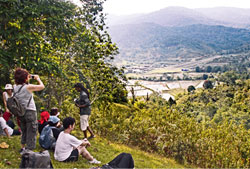
Walking is something most visitors will also do here in the cooler air at 1,000m above sea level. To walk to all nine rice growing communities in the valley would take all day but it’s possible to hitch a ride on one of the four-wheel drive vehicles heading off to Lawas. Another good walk is to head up the hill opposite the tiny airport to a viewpoint to get a comprehensive impression of the landscape. While it’s not a steep climb I took my time to take in the sights of the rice fields we crossed and the secondary forest growing on the slope.
We ended up above the flight path of the airport and watched one of the aircraft landing in the valley below us. It was an unusual perspective to be above the plane as it landed. During the Apple Festival in May the atmosphere at the airport becomes a little frenzied as four charter flights in one day landed and brought in more visitors than probably arrived in the past six months.
Keen walkers may want to consider walking to other destinations such as the Kalimantan border or Bario in the Kelabit Highland. From Bario, it’s possible to then fly back to Miri. Another possibility with the assistance of local guides is to attempt an ascent on Gunung Murud, Sarawak’s highest peak at 2,423m.
Apples and Rice and All Things Nice
While the harvesting of Malaysia’s only apple orchid is newsworthy enough the lifestyle and agricultural practices of the community provide other good reasons to visit this peaceful community.
It’s unusual to see the apple orchard but the story of how cuttings were brought in from Java in 1975 is one of dedication and agricultural prowess. The man responsible for the 1,000 tree orchard is Tagal Paran and despite his youthful 75 years, he still proudly shows visitors the seven varieties that are grown. He enjoys telling his tale and informing visitors that the apples are organically grown.
Sadly, their distribution is limited to the local community and the markets in Lawas but one day, with some slick marketing they could be gracing the gourmet kitchens of Singapore and Kuala Lumpur.
While the apples harvest is unique, rice production is essential for sustaining the community. The highlands rice is known as adan or commonly called Bario rice and is highly prized for its fragrance.
Living Culture
I’m told there are 1,500 people living around Ba ‘Kelalan and I can vouch for this as I think I shook the hands of every villager. There is an incredible welcoming process here where it is important for everyone to greet you. It’s not a formality but an essential part of the social fabric and you know it’s sincere when people look you in the eye with a warm smile across their face.
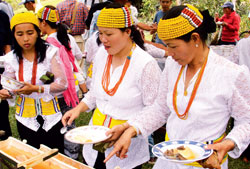
While every plane that landed on the day I arrived was given a community welcome, no two were the same. Our plane was greeted by the women’s bamboo pipe orchestra while others had dancers and community elders. Despite it being a Sunday when most people attended church, there were still large crowds on hand to ensure we were made welcome.
Maybe the welcome was somewhat predictable during the festival but this continued throughout my stay no matter where I went or what I did. People were genuinely happy to see us and to make sure we were well looked after.
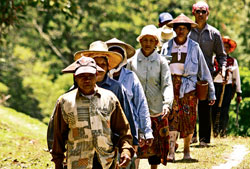
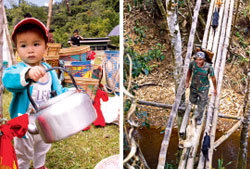
The villagers are Lun Bawang people who happily showed us their daily routine of growing rice and vegetables, hunting, raising livestock, cooking, producing salt and making handicrafts. Being so isolated, the residents are resourceful in finding materials in the natural forest and crafting utilitarian items especially from bamboo. Handicrafts are another part of village life and the delicate and colourful bamboo products such as baskets make excellent value-for-money souvenirs.
If all this isn’t enough reason for you to visit Ba ‘Kelalan, you could pack your golf clubs and hack around Malaysia’s remotest and least developed golf course. With a grand title of Meligan Highland Golf & Country Club the nine-hole, cow grass ‘fairways’ and ‘greens’ may not be ready for Tiger Woods, but they prove a distraction for the budding young golfers in the community.
Who knows, one day, Ba ‘Kelalan could develop its own cool highland golf course resort but in the meantime the warm hospitality of the community and its unhurried life are reason enough to visit here. With just three small planes a week in to the village you know you will be enjoying the cool air pretty well all to yourself.
Ba ‘Kelalan is located in the Sarawak interior and along with neighbouring territories and states it’s known as the heart of Borneo. Visit here and you will become part of the heart and soul of this welcoming and friendly community.
Getting There
MAS Wings, the propeller-propelled division of Malaysia Airlines (www.maswings.com.my) has three flights per week from Miri and Lawas on Monday and Saturday and direct from Miri on Wednesday.
Where to Stay
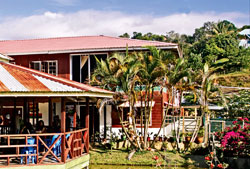
Apple Lodge is the best accommodation in the village although those used to luxuries had best stay at home. This homestay offers comfortable beds, around the clock electricity (generated by a micro hydro plant), solar-heated hot water and some great local food. Satellite television is provided in a common lounge. There are two other homestays in the community and all accommodation is best organised as a package by Borneo Jungle Safari.
Contact
Borneo Jungle Safari (Tel: +603 2260 4981, www.borneojunglesafari.com) can arrange a visit to the village.

  |
 |