 A City Romance
By Sarah Rees
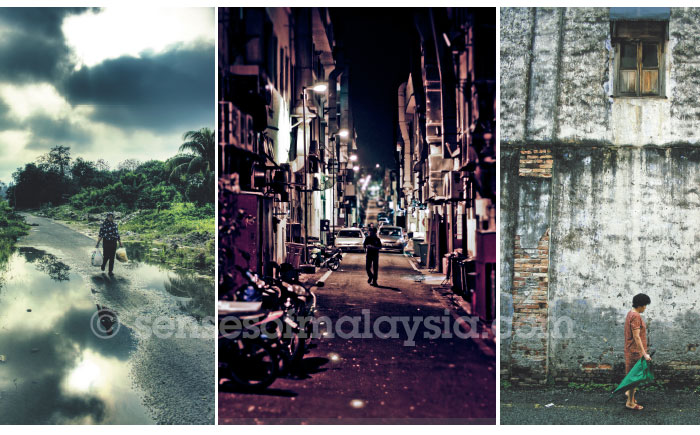
MANY EYES HAVE BEEN CAUGHT BY THE GRITTY STREET PHOTOGRAPHY OF
WORDSMANIFEST, AND SARAH REES CAUGHT UP WITH THE MAN BEHIND
THE PEN NAME TO DISCOVER JUST WHY HE LOVES TO CAPTURE THE CITY OF
KL AT STREET LEVEL.
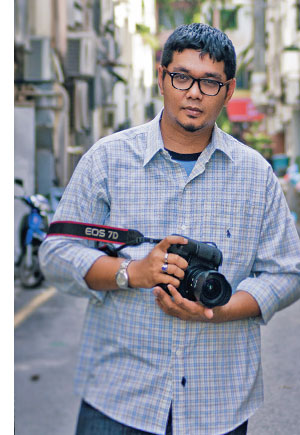 Azwan Mahzan is a
city boy through
and through.
Having been born
and bred in KL,
he is old enough
to have seen it
change, and to
begin to develop
those first pangs of nostalgia for a city that is
disappearing under the waves of modernity.
Perhaps it is this that sends him to the streets,
with his camera in tow, looking to capture raw
and gritty moments of city life.
Azwan Mahzan is a
city boy through
and through.
Having been born
and bred in KL,
he is old enough
to have seen it
change, and to
begin to develop
those first pangs of nostalgia for a city that is
disappearing under the waves of modernity.
Perhaps it is this that sends him to the streets,
with his camera in tow, looking to capture raw
and gritty moments of city life.
"It's not to say that the Twin Towers have never
been interesting to me, of course they are,"
says Azwan, or WordsManifest, as he fashions
himself, "but there are other things in KL
that are not only overlooked, but in danger of
disappearing. I'm not talking about heritage buildings, per se, but even just certain
ways in which people interact with KL are
disappearing. Things like that need to be
captured, need to be preserved. Not just
things and places, but things people do."
Azwan describes himself as a street
photographer, and his photos are
everything that title suggests: gritty,
honest, and offering a less clinical, more
artistic view of the capital. His pictures
capture something of the spirit of the
city, as well as serving to satisfy his
endless curiosity about his home. "KL is a
transitory place, so I always wonder why
people are in KL. Of course I can see what
they're doing, but how did they get there?"
His own history with KL is fairly
straightforward. His parents moved down
from the northern states to the capital
before he was born, and he grew up in
a house on the grounds of the Royal
Selangor Golf Club where his father
worked, trailing after his Dad as his
completed his rounds. "One of his duties
was to document the grounds," explains
Azwan. "He had this old camera and he
handed it to me just to keep me quiet. So
I suppose that's where my photography
interest comes from."
Photography wasn't something that
seized him or enveloped his life – "I just
figured it was something everyone did,"
he says with a laugh. After he put down
the camera of his childhood, the interest
lay dormant until his twenties and he
began studying at design school, where
his struggles with drawing storyboards
led him to pick up a camera as a way of
capturing what he wanted to say.
Only this time he didn't put it down. Now,
after years of experience with a whole
host of magazines, he works as a photo
editor in a local media house – "that's
my bread and butter" he says – while he
spends his weekend prowling the streets
with his camera in hand.
His eye for shots and his talent at
capturing an ordinary sight in an
extraordinary way is evident from a mere
glance at his creations, but for Azwan it is
not just about the finished product. He has
found solace behind the lens of a camera,
and it is a way for him to express himself
when his inhibitions rein him in.
"I'm pretty shy," he admits, "and when
I was younger, I didn't speak clearly; it
was a struggle to get my point across, so I
found other ways of expressing myself."
Photography was just one of his means of
expression – although he turned out to be
rather good at it – while his other outlets
are music and writing, which satisfied his
natural creativity as well as providing an
opportunity to hide behind a pseudonym
and a persona. As WordsManifest, Azwan
writes music and performs with a local
hip hop band called "The Rebel Scum," as
well as penning columns for a popular
local magazine.
"I am a bit more comfortable with it all as
WordsManifest," he says, "Azwan Mahzan
is not a very outgoing person, so I set up a
brand. Other people do it too; I appreciate
Iggy Pop wasn't born with that name."
His quick wit reveals a sharp mind
behind the shy frontage, and his creative
achievements stand testament to the
talent that has been allowed to blossom
and that enables him to capture the
capital is interesting ways.
While the city changes at a lightning
pace, Azwan is determined to keep
going to his usual haunts to preserve
what he views as the more "sincere"
locations of the fast-modernising city.
"I go to places like Chow Kit," he says,
"because there is less pretence. No one
is making any bones about why they're
there. They are not there to be seen; they
are there because this is where they live,
where they get paid, where they do their
shopping."
And weekend wanderings around certain,
less-salubrious parts of town can prove
to be just as fraught with dangers as
expeditions into the jungles if he doesn't
take care. "I was taking a photo of a toy
shop – it was just a picture of a store
front – but the man thought I was taking
his picture and working for the police, so
he chased me down the road!"
However, Azwan generally finds people
to be gracious and polite, and he explores
the warren of downtown KL with ease.
"KL is very untidy but it's not dangerous,"
he says, "If you don't impose too much,
people just leave you alone."
Does he have worries that the KL he loves
will no longer be here in twenty years?
Like the creative man he is, he answers
my question with a metaphor. "It's like
you commit yourself to a relationship
and you have no idea how your partner
is going to be in five or ten years," he says
carefully, "but you're in it for the long
haul, so you just stay."
DAY ONE
We started our journey by sailing from
Singapore to Kukup, and I was skipper for
this short leg. After getting our passports
and visas sorted we motored slowly out of
Raffles marina and into the narrow straits
separating Singapore from Malaysia (near
the new causeway to Johor).
The Singapore maritime patrol boats kept
a close eye on us until we had cleared this
channel and changed our course to 230
degrees, which was to be our heading for
the next ten miles. After crossing the 30-m
contour line we kept a lookout for a green
light flashing every three seconds on our
starboard side, which, according to the
chart, was about five miles away.
This light signalled the entrance to the
Kukup port, a port that proved to be much
shallower than the chart datum indicated.
At one stage we touched the soft muddy
bottom but, by turning to starboard, we
found enough depth to make our way
slowly into port. Once we reached the
extensive fish farms between Kukup town
and the large mangrove island, the depth
increased.We followed this channel down
until we could edge our way through the
farms, and we anchored on the islandside
of the fish farms.
Kukup is renowned as the place for fresh
seafood on the south western tip of
peninsular Malaysia. Seafood is plentiful,
and there are many waterside restaurants
on stilts to satisfy locals' and visitors'
culinary wishes. We launched Doris,
Kay Sira's dinghy, and went into town for
one of Kukup's famous seafood dinners
and a few beers.
DAY TWO
The next morning we visited Pulau Kukup,
one of the largest mangrove islands in
the world, where we found an attractive
boardwalk leading to a lookout over the
extensive mangroves. We spotted a lot
of bird life, including beautiful whitebreasted
sea eagles and Brahminy kites,
and we also glimpsed a wild boar rooting
around for a feed, some monkeys, and
many bug-eyed mudskippers.
On our departure, Lee and Frazer had
the job of retrieving and cleaning the
anchor chain which was covered in thick
mud. This took some time as it all had to
be done manually, but when we finally
set off, we were travelling north from
Kukup to Melaka, about 90 nautical
miles away. Very calm weather would
allow us to motor-sail all day and
overnight, and so our ETA was set for early
the following morning.
Barry offered to cook bangers and mash
for dinner, so we duly enjoyed a great
meal of fried sausages with Barry's special
onion sauce (I think a bit of everything
went into this tasty concoction), mashed
potatoes, and stir-fried vegetables. After
a nice cup of tea, we began keeping
watches; three hours on and three hours
off, from 2030 hours onwards.
DAY THREE
It was an uneventful journey and we
arrived at the Melaka marina at 0730.
The water depth here was shallow, so we
had to take care, staying to the left of the
port marker just outside the marina. As
this was our first official port of call in
Malaysia we had to undergo customs and
visa formalities with the local authorities.
We decided to have a day off from
sailing in Melaka as we realised that it
was St Patrick's Day. We passed the day
re-provisioning for the next leg of our
journey, enjoying some good deals on
draught beer, and eating some excellent
food before returning to the marina
relatively early in anticipation of another
early start the next day.
DAY FOUR
We departed Melaka at 0700 at the top
of the high tide, raising all of our sails
as soon as we were clear of the marina
and motoring on in very light winds for
1.5 miles at 190 degrees. We started our
three-hour watches at 0730 hours, with
Barry and me taking the first watch.
We managed to sail beautifully in a
freshening NNE breeze for the better part
of three hours.
The trip up the coast was just magical.
There was a lot of storm activity over
the land, but no bad weather at sea. We
passed numerous fishing vessels, some of
which put out very long nets which they
guarded zealously lest we catch them on
our keel or propeller.
At dusk, we put two reefs in the mainsail
for safety's sake and motor-sailed north
until, at 2130 hours, we reached the
southern entry channel to Pelabuhan
(Port) Klang.This was the sailing school
classroom come to life! For the next three
and a half hours we saw every ship's light
and navigation mark light imaginable,
and a lot of traffic. I was surprised at just
how fast the big ships travel when entering
and leaving port – three or four times faster
than us! We also marvelled at the constant
hustle and bustle of tugs-in-tow, containers
and cargo vessels, pilot boats, and many
other vessels going about their business.
This was a very exciting and somewhat
stressful time for me. I was skippering a
lovely yacht in the midst of an incredible
cacophony of shipping in a strange port.
I had to rely only on my pilotage notes,
various charts of the area in different
scales and detail, our instruments,
navigation markers, and the entire crew
on deck as lookouts.
A pilot boat went past us and had a good
look at us with his searchlight, which
added to the excitement! With almost
continuous course changes and the need
to keep a sharp lookout for the next
pertinent navigation mark, we were all
kept busy until, finally, the Royal Selangor
Yacht Club hove into view, albeit in total
darkness due to a local blackout.
I took the helm after a big pat on the back
for Lee and adopted the ferry-gliding
technique, using the strong current to
assist us to berth safely. Once we were
safe, sound, and securely berthed outside
the RSYC, we all had a nice, hot cup of
tea before slipping into our beds. Mission
accomplished.


