 A Labour of Love...
By Pat Fama
AMONG THE COUNTRY'S FINEST ASSETS ARE THE MULTITUDE OF HERITAGE BUILDINGS THAT OFFER VISITORS AND LOCALS A GLIMPSE OF THE PAST. SADLY, TOO MANY OF THESE OLD STRUCTURES
DISAPPEAR IN THE NAME OF DEVELOPMENT AND MODERNITY. PAT FAMA FINDS OUT WHAT
CHALLENGES FACE THOSE LOOKING TO RESTORE HERITAGE BUILDINGS AND WHICH PARTS OF THE
COUNTRY ARE SUCCEEDING IN THE EFFORT TO SAVE MALAYSIA'S PAST.
 One of the treats of
travelling to exotic
foreign lands is
imagining what it would
be like to live there full
time, particularly if it's
cold and grey back home.
A familiar trigger for
this fantasy is seeing
a dilapidated building
which, with the right owner (i.e., you), and heaps of
tender loving care, could make a fabulous home.
One of the treats of
travelling to exotic
foreign lands is
imagining what it would
be like to live there full
time, particularly if it's
cold and grey back home.
A familiar trigger for
this fantasy is seeing
a dilapidated building
which, with the right owner (i.e., you), and heaps of
tender loving care, could make a fabulous home.
The good news for anyone prone to such daydreams is
that Malaysia is full of beautiful old structures, many in
a sorry state of disrepair.These buildings fall into three
main categories: colonial mansions, Chinese shophouses,
and traditional Malay bungalows. With sympathetic
restoration, all three would suit a range of uses, from
comfortable private dwellings to boutique guesthouses.
The bad news is that turning the fantasy into a reality in
Malaysia is a long, hard slog. Elizabeth Cardosa, Executive
Director of Badan Warisan (the Malaysian Heritage Trust),explains that there are several major
challenges facing restoration projects in
Malaysia, not least the prevailing popular
attitudes:
"There is still a bias against traditional/
heritage buildings. Heritage is often
represented in the media and in overall
general commentary as ‘old fashioned'
and impeding development and progress.
There is also very limited research into
traditional building technology and this
is compounded by limited professional
knowledge among architects.
"Other issues include greatly diminished
craftsmanship skills among contractors,
carpenters, and builders, which often
results in inappropriate use of modern
materials for repair work, as well as
the high cost of maintenance and
diminishing availability of traditional
materials for repair."
Public attitudes towards heritage
preservation are slowly changing in
Malaysia, but a depressing number
of historic structures are still levelled
every year to make way for modern
commercial and residential developments.
Recognising the tourist potential of
heritage is key to saving as much as
possible of what is left.
There is no clearer sign of the merit of
restoration than in the transformation
that has taken place in George Town since
it gained UNESCO World Heritage Status
(together with Melaka) in 2008. Decades
of decay and neglect in the city's historic
core have been replaced with a heartening
picture of renewal. Across George Town,
historic buildings – both large and small –
are being brought back to life, and not just
in the official UNESCO Heritage area.
What has no doubt been a big boost to the
restoration boom in George Town is The
George Town Grants Programme (GTGP),
an innovative scheme that has been
running since 2009, awarding public funds
to deserving urban regeneration projects.
The GTGP has assigned RM12.9 million
so far, the majority of it for physical
conservation work, with RM7.1 million
still to be awarded before next September.
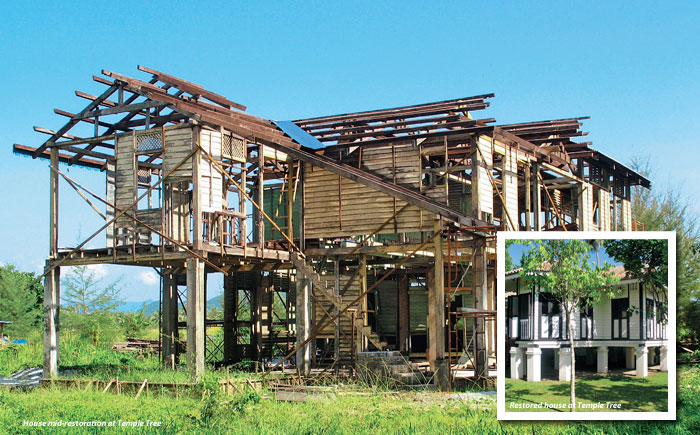
Restored house at Temple Tree Supported projects include everything
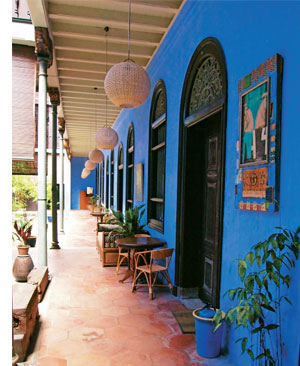
Cheong Fatt Tze Mansion guest wing
from restoring a row of shophouses to
repairing a temple roof.
UNESCO Heritage status aside, plenty of
restoration was carried out before 2008,
as gems like Cheong Fatt Tze Mansion
and Suffolk House amply attest. Though
it cannot be assumed that George Town is
now immune to losing historic buildings
to the wrecking ball, the last four years
have seen a sea change in attitudes to
Penang's built heritage. For Cardosa,
the challenge is to extend that progress
beyond the recognised UNESCO sites:
"While these positive changes appear
to be growing among more urban
communities, especially in areas which
have achieved some kind of international
recognition for their heritage assets such
as Melaka and George Town, we hope
that we will see this spread to other
communities, especially those in smaller
towns and rural environments. We also
hope that they will recognise and protect
their local heritage assets."
Restoring a heritage property is often a
labour of love, and so the trend is that
dedicated individuals and NGOs take
this challenge on rather more often than
corporations and public bodies. Passion
is certainly important, but as expected,
along with inspiration there has to be
plenty of perspiration, as well.
Another increasing necessity, given
spiralling land and property prices, is for
restoration projects to make financial
sense. This is particularly true of central
KL, where only those with particularly
deep pockets could afford to buy and
restore a derelict building for use as a
private home. This is why so many of the
city's restored pre-war bungalows and
shophouses are now used as restaurants,
bars, or guesthouses.
There is certainly money to be made from
old-world charm, as shown by the number
of new heritage hotels which have opened
over recent years, but not everyone wants
to run a business out of their dream
house. Small scale non-commercial
restorations could be aided by a roll-out of
the GTGP nationwide, while introducing
effective legal protection for heritage
buildings would help moderate land and
property prices.
Cardosa welcomes the growth of privately
funded restoration projects, and sees this
as a sign of the deepening understanding
of the value of heritage, as well the
willingness on the part of owners to
enhance their properties. She adds that
Badan Warisan is on hand to help make
sure restoration projects go as smoothly
as possible:
"We have a Resource Centre which has
a wealth of technical documentation
and is open to the public. We also have
a consultancy service with a multidisciplinary
team of conservationists
drawn from our membership. We are
always happy to provide basic advice on
heritage ‘best practices' to individuals
or companies who are embarking on
restoration projects and who are
seeking information or direction for
their projects."
So should you fall madly in love with
a neglected historic building, help is at
hand to turn your dream into a reality.
Or, like all the best holiday romances, you
could always decide that what happens in
Malaysia stays in Malaysia.


